
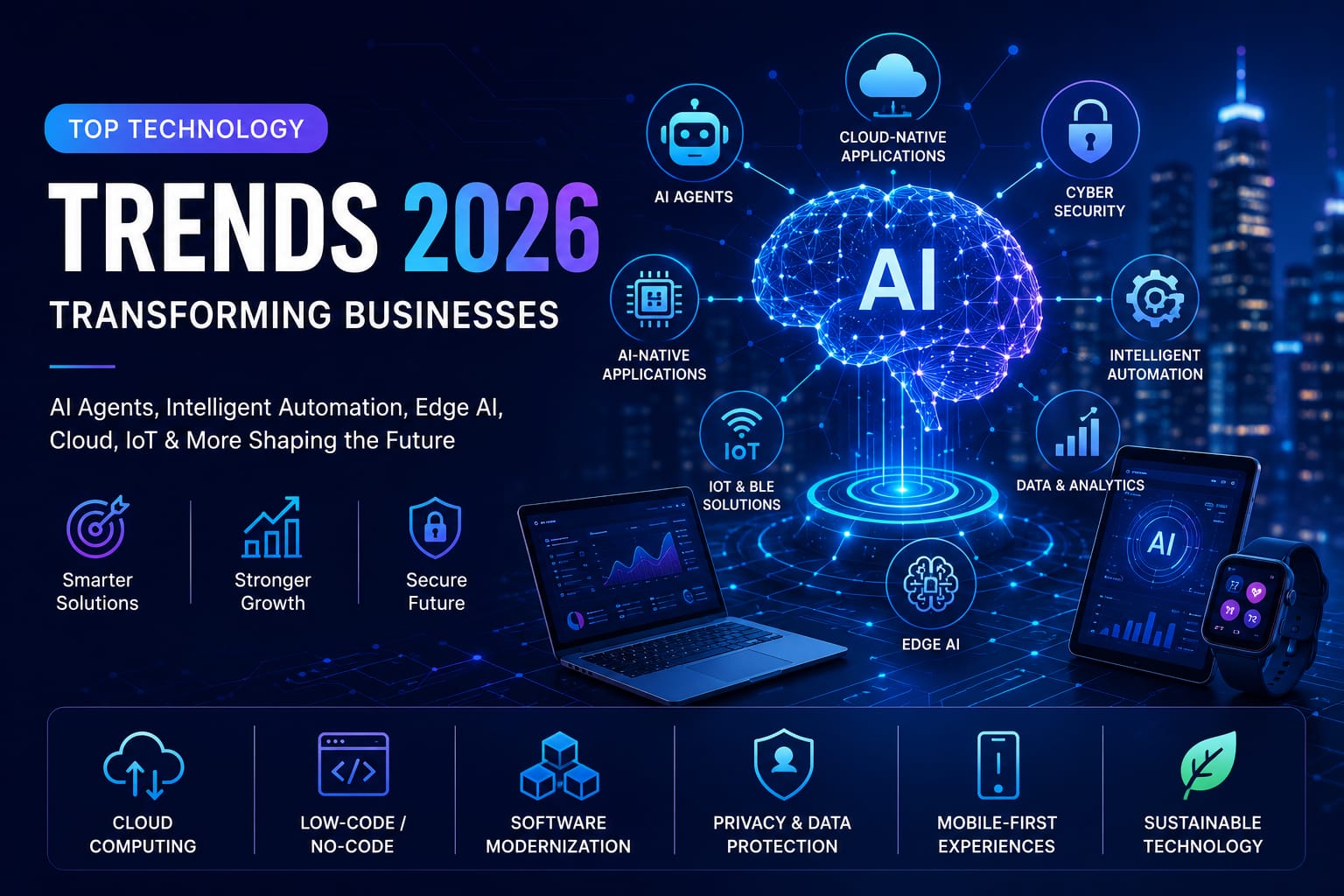
Technology in 2026 is moving beyond simple automation and standalone digital tools. Businesses are now investing in intelligent software, AI-powered workflows, connected devices, secure cloud platforms, and applications that can adapt to changing customer needs.
The biggest shift is clear: companies are no longer asking, “How can we use AI?” They are asking, “How can AI, automation, and modern software create measurable business value?”
AI is increasingly becoming part of enterprise architecture and software development rather than remaining an experimental feature. At the same time, businesses are modernizing legacy applications, improving data systems, and building stronger technology foundations to support advanced AI capabilities.
Here are the technology trends shaping business innovation in 2026.
1. AI Agents Are Moving Beyond Traditional Chatbots
Traditional chatbots mainly answer questions. AI agents can be designed to understand goals, use connected tools, analyze information, and complete approved multi-step workflows.
For example, an AI customer support agent could:
- Understand a customer request
- Check order information
- Review account details
- Identify a potential issue
- Create a support ticket
- Send a personalized update
This makes AI agents more useful for business operations than basic question-and-answer chatbots.
However, AI agents still require strong governance, security controls, monitoring, and human oversight. As AI systems become more autonomous, businesses need reliable systems that support accountability and safe operation.
2. AI-Native Applications Are Becoming a Business Priority
AI is no longer being added only as an extra feature. Many businesses are designing products with AI as a core part of the application.
AI-native applications may include:
- Intelligent recommendations
- Predictive analytics
- AI-powered search
- Automated workflows
- Smart customer support
- Personalized user experiences
- AI assistants
- Real-time business insights
The goal is not simply to add a chatbot. The goal is to create applications that understand information, assist users, and improve business outcomes.
3. Custom AI Solutions Are Replacing One-Size-Fits-All Tools
Generic AI tools can be useful, but businesses often need solutions designed around their own data, workflows, customers, and industry requirements.
Custom AI applications can support:
- Healthcare workflows
- Retail operations
- Financial services
- Manufacturing systems
- Logistics platforms
- Education technology
- Customer service
Industry-focused AI can provide more relevant results because it is designed around specific business processes and domain requirements.
4. AI Is Transforming Software Development
AI is changing how software is planned, designed, developed, tested, and maintained.
Development teams are using AI to support:
- Code generation
- Software testing
- Bug detection
- Documentation
- Code reviews
- Application modernization
- Development workflow automation
AI can reduce time spent on repetitive development tasks. However, human developers remain important for architecture, business logic, security, quality assurance, and technical decision-making.
Recent research shows that AI is having a strong impact on implementation, testing, and documentation, while also increasing the importance of human review and governance.
5. Legacy Software Modernization Is Becoming Essential
Many businesses still depend on outdated applications, disconnected systems, and fragmented data.
These older systems can make it difficult to:
- Integrate AI
- Connect modern APIs
- Improve application performance
- Scale operations
- Protect business data
- Deliver better customer experiences
In 2026, companies are investing in software modernization to prepare their technology infrastructure for AI and future growth.
Modernization may include:
- Migrating applications to the cloud
- Rebuilding outdated software
- Modernizing databases
- Improving APIs
- Updating user interfaces
- Integrating AI capabilities
6. Edge AI Is Making Applications Faster and Smarter
Edge AI processes information closer to where it is generated instead of sending every request to a distant cloud server.
This can provide:
- Faster response times
- Lower latency
- Improved privacy
- Reduced cloud usage
- Better real-time performance
Edge AI is especially useful for:
- IoT devices
- Smart manufacturing
- Healthcare monitoring
- Connected vehicles
- Retail technology
- Industrial automation
For businesses using IoT and BLE technology, edge intelligence can help devices make faster decisions while reducing dependence on constant cloud connectivity.
7. Cybersecurity Is Becoming Part of Every Development Stage
As applications become more connected and AI-powered, cybersecurity must be included from the beginning.
Modern software development increasingly focuses on:
- Secure authentication
- Role-based access
- Data encryption
- API security
- Continuous security testing
- Zero-trust principles
- AI security monitoring
Security should not be treated as a feature added after development. It should be part of the application architecture, development process, testing, and long-term maintenance.
8. Cloud-Native Applications Continue to Support Business Growth
Cloud-native development helps businesses build applications that are flexible, scalable, and easier to update.
Cloud-based applications can support:
- Rapid deployment
- Global accessibility
- Automatic scaling
- Reliable data management
- Faster feature releases
- Better system availability
Cloud platforms also make it easier to connect AI services, business tools, APIs, and distributed applications.
9. Intelligent Automation Is Expanding Across Business Operations
Automation is evolving from simple rule-based workflows to intelligent systems that can understand data and support more complex processes.
Businesses are using intelligent automation for:
- Customer support
- Sales follow-ups
- Document processing
- Data analysis
- Employee workflows
- Inventory management
- Report generation
- Business notifications
The strongest automation solutions combine AI with human approval and clear business rules.
10. Connected IoT and BLE Solutions Are Creating Smarter Experiences
IoT and Bluetooth Low Energy technology are helping businesses connect physical devices with mobile and web applications.
Common use cases include:
- Smart healthcare devices
- Fitness wearables
- Asset tracking
- Smart home applications
- Industrial monitoring
- Connected retail systems
- Location-based experiences
BLE technology supports low-power communication between devices and applications, making it useful for many connected products.
How Businesses Can Prepare for These Trends
Technology adoption should begin with a clear business goal.
Before investing in AI, automation, or custom software, businesses should consider:
- What problem are we solving?
- Which processes require improvement?
- What data is available?
- Can the solution scale?
- How will customer information be protected?
- Where is human oversight required?
- How will success be measured?
The best technology strategy is not about adopting every trend. It is about selecting the right technology for a real business need.
Build Future-Ready Digital Solutions with QuartusTech
At QuartusTech, we help startups and businesses transform ideas into intelligent, scalable, and secure digital products.
Our technology services include:
- AI application development
- AI agent development
- Custom software development
- Mobile app development
- Web application development
- SaaS development
- IoT and BLE solutions
- NFC application development
- POS software development
- Cloud integration
- Software modernization
- UI and UX design
Whether you want to build an AI-powered application, modernize legacy software, automate business workflows, or develop a connected IoT solution, our team can help create technology designed around your business goals.
Conclusion
The biggest technology trends of 2026 are connected by one idea: software is becoming more intelligent, automated, secure, and adaptable.
AI agents, AI-native applications, edge intelligence, cloud platforms, cybersecurity, and connected IoT solutions are changing how businesses operate and serve customers.
Companies that build strong digital foundations today will be better prepared to innovate, scale, and compete in the future.
Ready to build your next digital solution? Connect with QuartusTech and turn your technology idea into a scalable business product.