
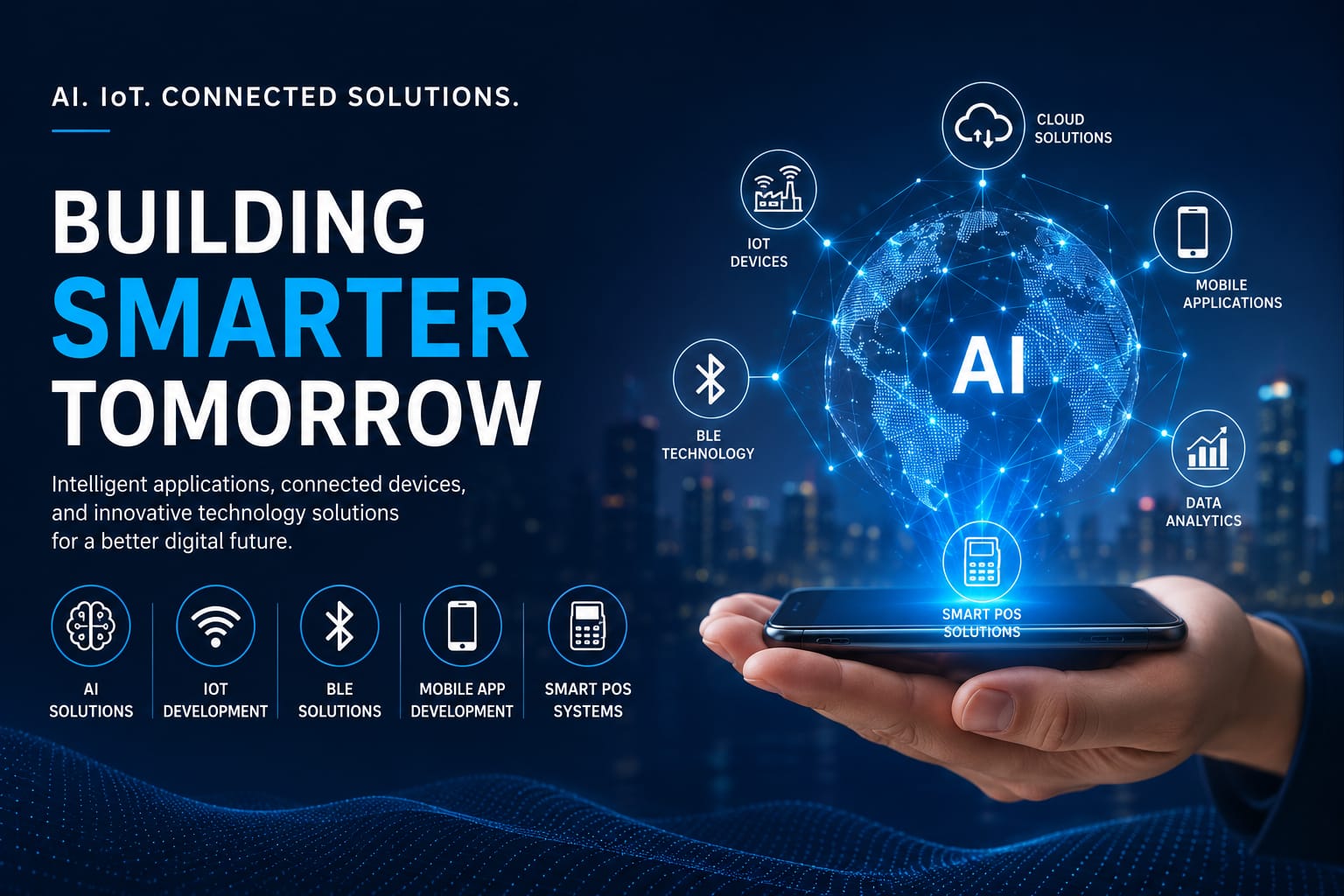
Technology is no longer just supporting business operations—it is becoming the foundation of how modern businesses compete, serve customers, and grow.
From AI-powered applications and IoT devices to mobile platforms, BLE solutions, POS systems, and cloud-based software, businesses are increasingly investing in connected and intelligent technology.
The real question is no longer “Should we adopt new technology?”
“How can we build technology that creates measurable business value?”
The Rise of Intelligent Business Applications
Traditional software typically follows predefined rules. Modern applications can analyze information, learn from patterns, automate decisions, and deliver personalized experiences.
Artificial intelligence is helping businesses introduce capabilities such as:
- Intelligent automation
- AI-powered customer support
- Predictive analytics
- Recommendation systems
- Computer vision
- Natural language processing
- Personalized user experiences
- AI-assisted business decision-making
For businesses, the goal should not simply be to add an “AI feature.”
The goal should be to identify where intelligence can reduce costs, improve productivity, increase revenue, or create a better customer experience.
IoT Is Connecting the Physical and Digital Worlds
The Internet of Things is transforming ordinary physical devices into connected business assets.
Sensors and connected devices can collect real-time information and send it to applications and cloud platforms for analysis.
IoT solutions can be used for:
- Asset tracking
- Smart manufacturing
- Industrial monitoring
- Healthcare devices
- Retail systems
- Smart buildings
- Logistics
- Energy monitoring
- Predictive maintenance
For example, a connected industrial machine can continuously monitor temperature, vibration, and operating conditions. Instead of waiting for equipment to fail, businesses can identify potential problems earlier.
That can translate into less downtime and better operational efficiency.
BLE Makes Connected Devices More Practical
Bluetooth Low Energy (BLE) has become an important technology for applications where devices need reliable wireless communication while maintaining low power consumption.
BLE can support solutions such as:
- Smart wearables
- Healthcare monitoring devices
- Asset tracking
- Indoor positioning
- Smart locks
- Retail proximity solutions
- Industrial sensors
- Fitness applications
A well-designed BLE solution requires more than simply connecting a device to a smartphone.
Developers need to consider communication protocols, power consumption, device compatibility, security, data handling, and user experience.
Mobile Applications Remain a Critical Digital Channel
Smartphones continue to be one of the primary ways customers interact with businesses.
Modern mobile applications can combine multiple technologies into a single experience.
For example:
Mobile App + AI + BLE + Cloud + IoT
can create an ecosystem where users can control devices, receive real-time information, analyze data, and interact with intelligent services from a single application.
Businesses can also use cross-platform technologies such as React Native to accelerate application development while maintaining a consistent user experience across platforms.
Modern POS Systems Are Becoming Intelligent
Point-of-sale technology is also evolving.
Today’s POS platforms can go far beyond processing payments.
A modern POS ecosystem can include:
- Inventory management
- Customer management
- Sales analytics
- Employee management
- Online ordering
- Loyalty programs
- Multi-location management
- Cloud synchronization
- Business reporting
With AI and analytics, POS data can potentially help businesses identify purchasing patterns, understand customer behavior, and improve operational decisions.
For restaurant chains and retail businesses, this can become an important competitive advantage.
Why Businesses Need a Technology Strategy
One of the biggest mistakes businesses make is adopting technology without a clear strategy.
Buying separate tools for AI, IoT, mobile applications, analytics, and cloud infrastructure can eventually create disconnected systems.
A better approach is to design the technology ecosystem around business objectives.
Step 1: Identify the Business Problem
Start with the problem—not the technology.
Ask:
What are we trying to improve?
It could be customer engagement, operational efficiency, automation, security, sales, or cost reduction.
Step 2: Select the Right Technology
Once the problem is understood, determine whether the solution requires:
- AI
- Mobile development
- Web applications
- IoT
- BLE
- Cloud infrastructure
- POS technology
- APIs
- Data analytics
Technology should serve the business objective.
Step 3: Build for Scalability
A successful application may start with a small number of users and eventually serve thousands or millions.
Architecture should therefore consider:
- Performance
- Security
- Cloud scalability
- API architecture
- Database design
- Device compatibility
- Future integrations
Step 4: Focus on Security
Connected applications and IoT ecosystems can process valuable business and customer information.
Security should be considered from the beginning rather than added after development.
Authentication, authorization, encryption, secure APIs, data protection, and secure device communication should all be part of the development strategy.
The Future Will Be More Connected
The next generation of digital products will increasingly combine multiple technologies.
Imagine a healthcare device that uses BLE to communicate with a mobile application, AI to analyze the collected information, and cloud infrastructure to provide insights to authorized users.
Or imagine a retail environment where IoT sensors, mobile applications, analytics, and AI work together to improve inventory and customer experiences.
These are not isolated technologies.
They are pieces of a larger connected digital ecosystem.
Build Technology That Creates Business Value
Businesses don’t need to adopt every emerging technology.
They need to adopt the right technology for the right problem.
AI can provide intelligence.
IoT can provide connectivity.
BLE can provide efficient device communication.
Mobile applications can provide accessibility.
Cloud platforms can provide scalability.
Together, these technologies can help businesses create powerful digital products designed for the next generation of customers.
Partner With QuartusTech
Building a successful technology product requires more than writing code. It requires business understanding, product strategy, architecture, development, testing, security, and long-term scalability.
QuartusTech helps businesses develop technology solutions across AI, mobile and web applications, IoT, BLE, POS applications, NFC, SaaS, and custom software development.
Whether you are building a new digital product or modernizing an existing platform, the right technology strategy can turn an idea into a scalable business solution.
Ready to build your next-generation application?
Explore how QuartusTech can help transform your technology idea into a real-world digital product.