
Businesses in 2026 are operating in a technology-first environment.
Customers expect faster digital experiences. Employees need smarter tools. Managers want real-time data. And business leaders need technology that can adapt as their companies grow.
For many organizations, simply buying another off-the-shelf software solution is no longer enough.
The real competitive advantage is increasingly coming from custom software development—technology designed around the way a business actually operates.
What Is Custom Software Development?
Custom software development means creating applications, platforms, or digital systems specifically for a company’s requirements.
Instead of changing business processes to fit generic software, custom technology allows the software to fit the business.
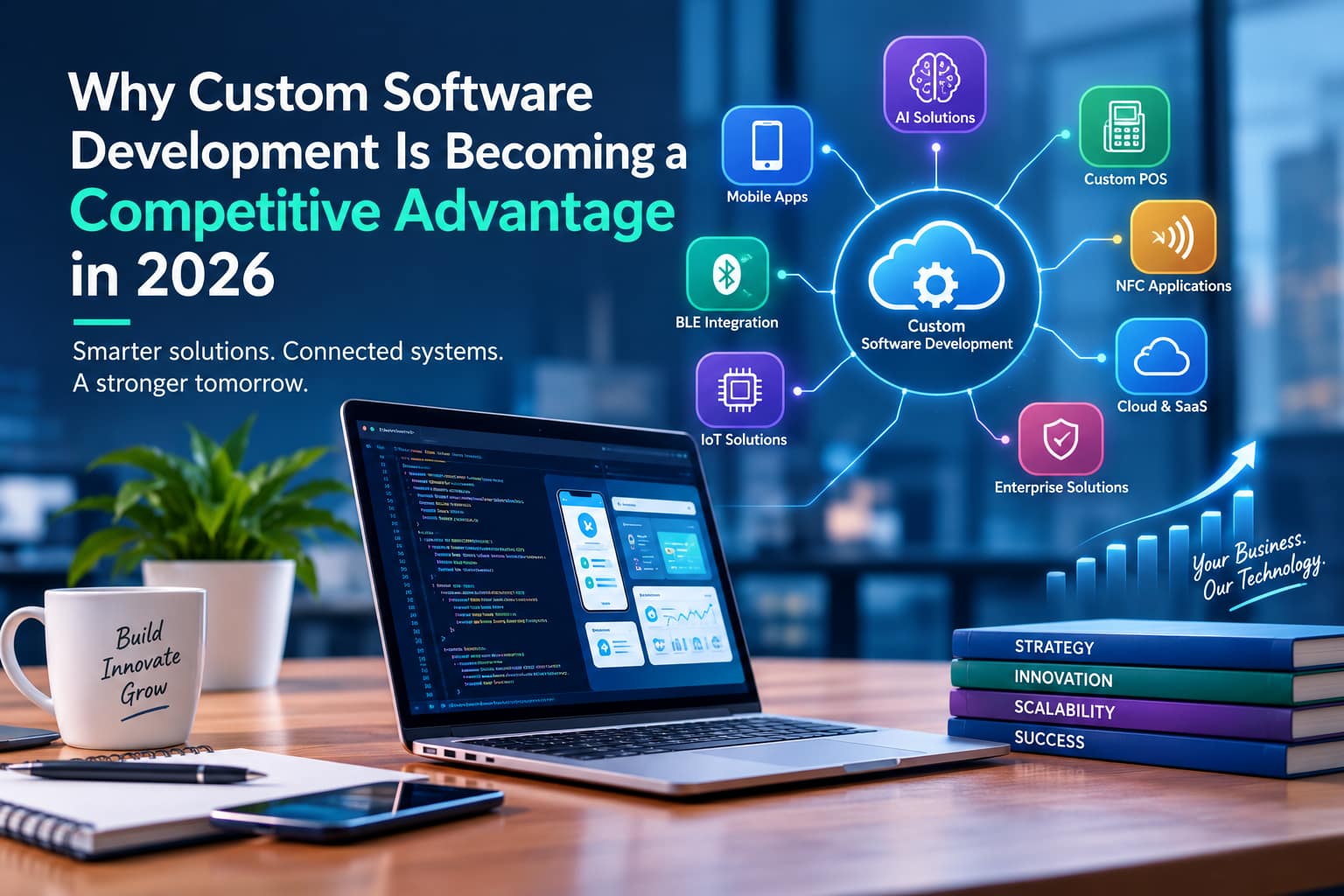
A custom solution can include:
- Web applications
- Mobile applications
- Enterprise software
- AI-powered platforms
- POS systems
- IoT solutions
- BLE-enabled applications
- NFC applications
- SaaS platforms
- Cloud-based dashboards
- API integrations
- Business automation systems
This approach gives businesses greater control over functionality, integrations, scalability, and user experience.
Why Off-the-Shelf Software Isn’t Always Enough
Off-the-shelf applications are useful for many common business requirements.
However, growing companies often discover limitations.
A business may need a specific workflow that the software doesn’t support. Another company may need integration with proprietary hardware. A retailer may require a customized POS workflow, while a healthcare company may need an application that communicates with connected devices.
When businesses start adding multiple applications to overcome these limitations, technology can become fragmented.
Instead of one connected system, employees may end up working with:
CRM + ERP + Spreadsheet + POS + Mobile App + Analytics Tool + Third-Party Integrations
This can create duplicated data, manual processes, security concerns, and inefficient workflows.
Custom software provides an opportunity to bring these processes together.
Custom Software Can Create a Connected Business
Modern software is no longer limited to a single application.
Businesses are increasingly creating connected digital ecosystems where applications, devices, cloud platforms, APIs, and intelligent systems communicate with one another.
For example:
BLE Device → Mobile App → Cloud Platform → AI Analysis → Business Dashboard → Automated Action
This type of architecture can support businesses across healthcare, retail, logistics, manufacturing, hospitality, finance, and other industries.
The goal isn’t simply to build more software.
The goal is to make existing technology work together more intelligently.
AI Is Making Custom Software Even More Powerful
Artificial Intelligence is changing what businesses expect from software.
Traditional software generally waits for users to perform actions.
AI-powered software can analyze information, identify patterns, generate recommendations, automate repetitive processes, and assist employees with decision-making.
For example, a custom business platform could use AI to:
- Analyze customer behavior
- Forecast demand
- Automate repetitive tasks
- Detect unusual activity
- Generate business reports
- Provide intelligent recommendations
- Improve customer support
- Predict operational issues
When AI is built directly into a company’s technology infrastructure, businesses can create workflows that are specifically designed around their data and objectives.
Mobile Applications Are Becoming Business Tools
Mobile applications are no longer limited to consumer entertainment or basic customer services.
Businesses are using mobile applications for operations, communication, field services, payments, inventory, device management, customer engagement, and more.
A modern mobile application can connect with:
- Cloud databases
- AI services
- BLE devices
- IoT platforms
- Payment systems
- POS systems
- CRM platforms
- Enterprise APIs
This makes mobile applications an important interface between people and connected business systems.
BLE and IoT Open New Possibilities
Bluetooth Low Energy and IoT technologies allow software to communicate with the physical world.
Businesses can use connected devices and sensors to collect real-time information about equipment, products, assets, locations, temperature, movement, and other operational conditions.
That information can then be sent to cloud platforms where it can be analyzed and turned into actionable insights.
For example:
Sensor → BLE → Mobile Application → Cloud → Analytics → Business Decision
This creates opportunities for smarter monitoring, automation, predictive maintenance, asset tracking, and connected customer experiences.
Custom POS Systems Can Transform Operations
Retail and restaurant businesses have unique workflows.
A standard POS system may provide basic billing, but growing businesses often require much more.
A modern custom POS platform can combine:
- Billing
- Inventory management
- Payment processing
- Customer management
- Employee management
- Multi-location operations
- Real-time analytics
- Cloud reporting
- Loyalty programs
- Hardware integrations
QuartusTech also develops POS solutions, including its MUSE POS platform for retail and restaurant environments.
The advantage of a customized POS strategy is that the technology can be designed around the company’s actual operational requirements.
Security and Scalability Matter From Day One
Building software isn’t only about adding features.
Businesses also need to think about:
Security. Performance. Scalability. Reliability. Integration.
A system that works for 1,000 users may need a different architecture when it reaches 100,000 users.
Similarly, a system that works as a standalone application may need significant architectural changes when it starts integrating with payment platforms, IoT devices, AI services, CRM systems, and enterprise databases.
This is why technology architecture should be considered from the beginning of the development process.
The Business Benefits of Custom Software
A well-designed custom software solution can help businesses achieve several important objectives.
1. Better Efficiency
Automating repetitive workflows can reduce manual effort and allow employees to focus on higher-value activities.
2. Better Customer Experiences
Businesses can create digital experiences around their customers instead of forcing customers through generic workflows.
3. Better Integration
Custom applications can connect existing systems, APIs, devices, and platforms.
4. Greater Scalability
Software can be designed to evolve as the business grows.
5. Better Data Visibility
Integrated dashboards can provide decision-makers with real-time information.
6. Competitive Differentiation
Technology built around a company’s unique processes can become a competitive advantage that competitors cannot easily copy.
How to Decide If Your Business Needs Custom Software
Custom development isn’t automatically the right answer for every company.
It becomes particularly valuable when:
- Existing software doesn’t match your workflows
- Multiple systems need to communicate
- You require specialized functionality
- Your business has unique operational processes
- You need AI-powered automation
- You need BLE or IoT integration
- You need a customized POS solution
- You expect significant future growth
- Your current software creates operational bottlenecks
The right question isn’t:
“Do we need custom software?”
A better question is:
“Is our current technology helping our business grow—or forcing our business to work around technology limitations?”
Why Choose QuartusTech for Custom Software Development?
QuartusTech focuses on building technology around real business requirements.
Its capabilities span AI application development, mobile and web development, BLE and IoT solutions, NFC applications, POS systems, SaaS platforms, and custom enterprise software.
This broader technology expertise can be valuable when a project requires multiple technologies to work together.
Instead of treating AI, mobile applications, IoT, BLE, cloud systems, and enterprise software as completely separate projects, businesses can develop a connected technology strategy.
The Future Belongs to Adaptable Software
Technology will continue to change.
New AI capabilities will emerge. Connected devices will become more common. Customer expectations will continue to evolve. Businesses will need faster and more intelligent ways to respond.
The companies that succeed won’t necessarily be the ones with the most software.
They will be the ones with the right software architecture.
Custom software gives businesses the ability to build technology around their unique requirements today while creating a foundation for tomorrow.
Final Thoughts
In 2026, software is no longer simply an operational tool.
It can become part of a company’s competitive strategy.
AI can provide intelligence.
IoT can provide real-world data.
BLE can connect devices.
Mobile applications can connect users.
Cloud platforms can provide scalability.
APIs can connect systems.
And custom software can bring everything together.
For businesses ready to move beyond generic technology and build solutions around their actual goals, custom software development can be the foundation for long-term digital growth.
The future isn’t about having more technology. It’s about having technology that works for your business.