
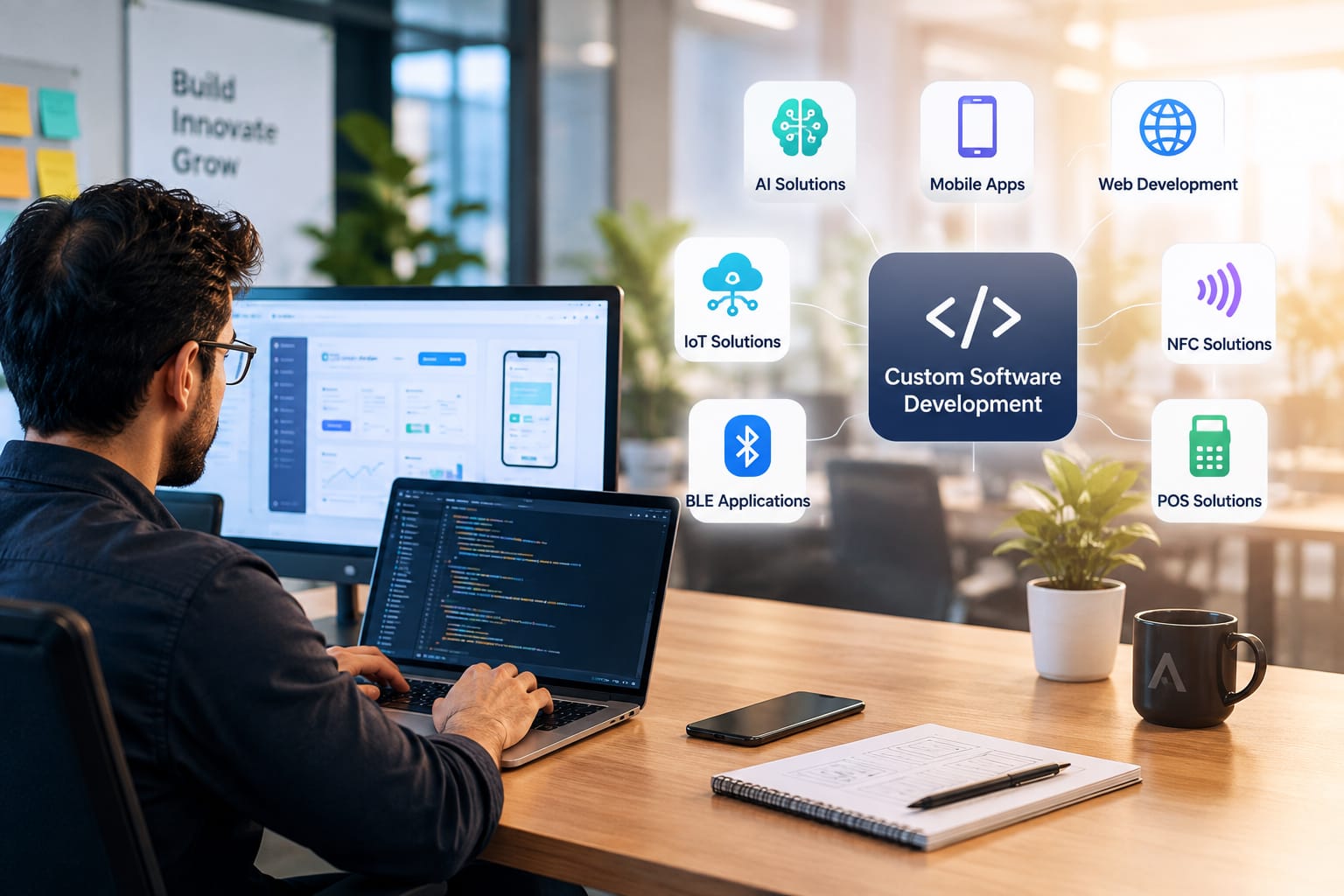
Businesses in 2026 are under increasing pressure to operate faster, automate repetitive processes, deliver better customer experiences, and make smarter decisions from their data.
Off-the-shelf software can solve common business requirements, but growing companies often need technology that matches their specific workflows, customers, integrations, and long-term goals.
That is where custom software development becomes important.
Custom software allows businesses to create applications and digital platforms around their actual operational requirements instead of forcing their processes to fit a generic product.
For organizations looking for a custom software development company, the objective is not simply to build another application. The goal is to create a scalable technology solution that can evolve as the business grows.
What Is Custom Software Development?
Custom software development is the process of designing, developing, testing, deploying, and maintaining software specifically for a business or organization.
Unlike ready-made software, custom applications can be designed around specific:
- Business workflows
- Customer requirements
- Operational processes
- Data structures
- Third-party integrations
- Security requirements
- Reporting needs
- Automation opportunities
A custom solution can range from an internal business platform to a customer-facing mobile application, enterprise system, AI-powered application, POS platform, or connected IoT ecosystem.
Why Businesses Are Investing in Custom Software in 2026
The technology requirements of modern businesses are changing rapidly.
Companies increasingly need applications that can communicate with other systems, process large amounts of information, automate workflows, and provide real-time insights.
1. Better Alignment With Business Processes
Every organization operates differently.
A standard software package may include dozens of features that a business never uses while missing functionality that is critical to its operations.
Custom software development allows businesses to prioritize the workflows and features that actually matter.
For example, a company may need:
- Automated approval workflows
- Custom dashboards
- CRM integration
- Payment processing
- Inventory management
- AI-powered recommendations
- Customer portals
- Mobile applications
- Real-time notifications
Instead of changing the business process to match existing software, the software can be designed around the business.
2. Improved Business Automation
Automation is becoming an important part of digital transformation.
Custom software can connect different systems and automate repetitive tasks that traditionally require manual work.
For example, a business platform could automatically:
- Receive customer information.
- Validate the data.
- Update the CRM.
- Generate a task for the appropriate employee.
- Send a notification.
- Create a report.
- Use AI to analyze the information.
This type of connected workflow can reduce unnecessary manual work while giving employees more time to focus on higher-value activities.
3. AI-Powered Software Development
Artificial intelligence is changing how businesses use software.
Modern applications can incorporate AI for tasks such as:
- Intelligent search
- Customer support
- Predictive analytics
- Document processing
- Recommendation engines
- Data analysis
- Workflow automation
- Natural-language interfaces
- Business intelligence
AI does not have to be a separate product. It can be integrated directly into existing business applications.
For example, an enterprise platform could allow managers to ask questions about business data using natural language rather than manually searching through multiple reports.
4. Integration With Existing Business Systems
Businesses rarely operate with a single software platform.
A typical organization may use:
- CRM software
- Accounting platforms
- ERP systems
- Payment gateways
- Marketing platforms
- Cloud services
- Inventory systems
- Communication tools
- Mobile applications
A custom software development company can build integrations that allow these systems to exchange information.
This creates a more connected technology environment and can reduce duplicate data entry.
5. Scalable Architecture
A software application that works for 100 customers may not be suitable for 100,000 customers.
Scalability should therefore be considered from the beginning of the development process.
A scalable software architecture can support future growth through technologies and approaches such as:
- Cloud infrastructure
- API-driven architecture
- Modular development
- Database optimization
- Automated testing
- Containerized applications
- Load balancing
- Monitoring and analytics
The exact architecture depends on the application’s requirements, expected traffic, data volume, security needs, and business model.
6. Better Security and Control
Security is another important consideration for businesses developing custom software.
Organizations may have specific requirements for:
- User authentication
- Role-based access
- Data encryption
- Audit logs
- API security
- Payment security
- Data privacy
- Backup and recovery
With a custom platform, security requirements can be incorporated into the application’s architecture rather than relying entirely on the security model of a third-party product.
Custom Software Development vs. Off-the-Shelf Software
Both approaches can be appropriate depending on the business requirements.
| Requirement | Off-the-Shelf Software | Custom Software |
|---|---|---|
| Initial implementation | Often faster | Requires planning and development |
| Custom workflows | Limited by available features | Designed around business requirements |
| Integrations | Depends on available APIs | Can be developed specifically |
| User experience | Standardized | Fully customizable |
| Scalability | Product-dependent | Architecture can be designed for growth |
| Feature control | Vendor-controlled | Business-controlled |
| Long-term flexibility | Depends on vendor roadmap | Greater control over development |
The decision should therefore be based on business requirements rather than simply comparing development costs.
Types of Custom Software Businesses Can Build
Custom software development can support many different business models and industries.
Enterprise Software
Enterprise applications can connect departments, automate processes, manage data, and provide centralized business intelligence.
Mobile Applications
Businesses can develop custom Android and iOS applications for customers, employees, partners, or internal operations.
AI Applications
AI-powered software can support automation, analytics, customer interactions, document processing, and decision-support workflows.
POS Software
Restaurants, retailers, hospitality businesses, and other organizations can develop custom POS systems that integrate billing, inventory, payments, reporting, and customer management.
IoT and BLE Applications
Connected products can combine mobile applications, Bluetooth Low Energy, IoT devices, cloud platforms, and analytics.
NFC Applications
NFC technology can be integrated into applications for identification, authentication, contactless interactions, product experiences, and other connected use cases.
How the Custom Software Development Process Works
A structured development process can help reduce technical and business risks.
Step 1: Business and Requirement Analysis
The development team first understands the business problem, users, workflows, and desired outcomes.
Step 2: Product Strategy
The team defines the core functionality, technology requirements, integrations, and development roadmap.
Step 3: UX/UI Design
User journeys, wireframes, interfaces, and prototypes are developed before full implementation.
Step 4: Software Development
Developers build the application using an architecture appropriate for the project’s requirements.
Step 5: Integration
APIs, payment systems, cloud services, databases, IoT devices, AI services, or other required platforms can be integrated.
Step 6: Testing
Applications should be tested for functionality, usability, performance, compatibility, and security.
Step 7: Deployment
After testing and validation, the application can be deployed to the appropriate cloud, web, mobile, or enterprise environment.
Step 8: Maintenance and Optimization
Software development does not end at launch.
Applications require monitoring, updates, security improvements, performance optimization, and new functionality as business requirements evolve.
How AI, IoT, BLE and Mobile Apps Work Together
Modern digital products increasingly combine multiple technologies instead of operating as isolated applications.
For example:
IoT Device → BLE Connectivity → Mobile App → Cloud Platform → AI Analytics → Business Dashboard
A connected product might collect information through sensors, transfer data using BLE, send it through a mobile application to a cloud platform, and use AI to analyze the resulting information.
This creates opportunities for businesses to build complete digital ecosystems rather than individual software products.
Why Choose QuartusTech for Custom Software Development?
QuartusTech works across several technology areas, including AI application development, custom software, mobile applications, web development, BLE, IoT, NFC, and POS solutions. Its website describes its focus as building custom digital products for startups, SMEs, and enterprises.
A technology partner can support businesses across multiple stages of development, including:
- Product planning
- UI/UX design
- Software architecture
- Mobile development
- Web development
- AI integration
- BLE and IoT integration
- NFC development
- POS development
- API integration
- Testing
- Deployment
- Ongoing support
This broader approach can be useful when a project requires several technologies to work together.
What Should Businesses Consider Before Starting a Custom Software Project?
Before development begins, organizations should clearly define:
Business Objective
What specific business problem should the software solve?
Target Users
Who will use the application?
Core Features
Which features are essential for the first version?
Integrations
Which existing platforms or services need to connect with the application?
Security
What security, privacy, authentication, and compliance requirements apply?
Scalability
How many users, transactions, devices, or data records may the system eventually need to support?
Budget and Timeline
What resources are available for development, testing, deployment, and long-term maintenance?
Answering these questions early can create a clearer development roadmap.
The Future of Custom Software Development
The next generation of business software will increasingly combine traditional application development with AI, automation, connected devices, cloud platforms, and real-time analytics.
Instead of building isolated applications, businesses can create connected technology ecosystems where:
Applications + AI + Data + Cloud + IoT + Automation
work together.
This approach can help organizations create software that is not only functional today but also adaptable to future business requirements.
Conclusion
Custom software development gives businesses an opportunity to create technology around their actual requirements instead of adapting their operations to generic software.
From enterprise platforms and mobile applications to AI systems, POS solutions, BLE applications, IoT platforms, and NFC integrations, custom software can support a wide range of digital transformation initiatives.
For businesses planning a new digital product in 2026, the key is to start with the business problem, define the required technology architecture, and build a scalable solution that can evolve over time.
QuartusTech helps businesses turn software ideas into practical digital products across AI, mobile, web, BLE, IoT, NFC, POS, and custom software development.
Frequently Asked Questions
What is custom software development?
Custom software development is the process of creating software specifically around the requirements, workflows, users, and goals of a particular business.
How much does custom software development cost?
The cost depends on factors such as application complexity, features, integrations, platforms, technology stack, security requirements, and development timeline.
Why choose custom software instead of off-the-shelf software?
Custom software can provide greater control over workflows, integrations, user experience, features, and future development.
Can AI be integrated into custom software?
Yes. AI can be integrated into applications for automation, analytics, search, recommendations, document processing, customer support, and other use cases.
Can custom software integrate with existing systems?
Yes. APIs and other integration technologies can connect custom applications with existing business platforms, databases, payment systems, cloud services, and third-party applications.
How long does it take to develop custom software?
Development time varies according to project scope, number of features, integrations, platforms, testing requirements, and team size.