
Introduction
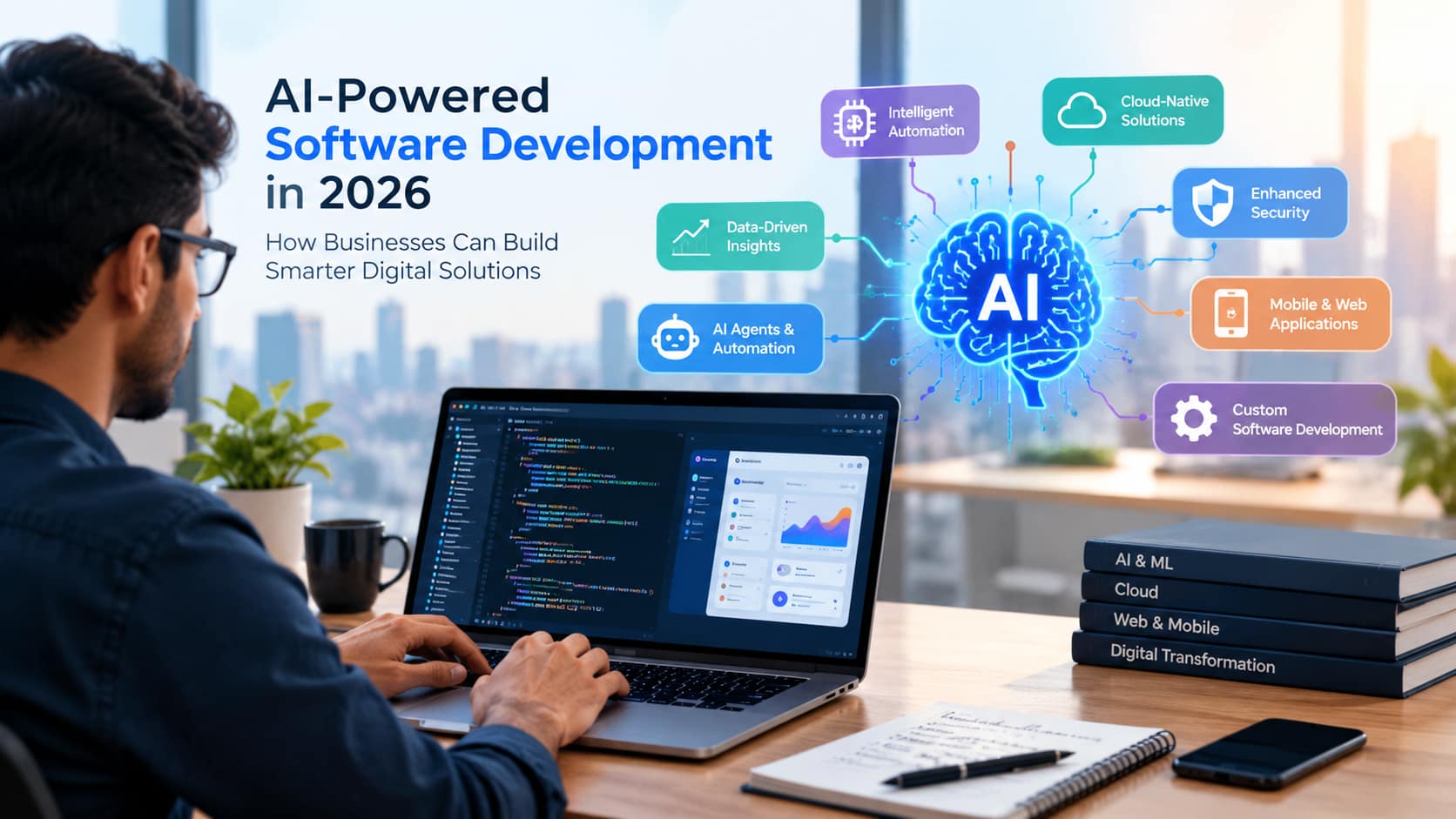
Artificial intelligence is changing how businesses design, develop, and manage software. In 2026, companies are looking beyond basic automation and exploring intelligent applications that can analyze data, improve workflows, personalize customer experiences, and support faster decision-making.
For startups and established enterprises, investing in the right technology is no longer just about building an application. It is about creating a scalable digital solution that solves real business problems.
According to Deloitte’s 2026 software industry outlook, AI-first product design and agentic AI are becoming important forces shaping the software industry. However, businesses must connect technology investments to measurable outcomes rather than adopting AI simply because it is trending.
For organizations looking to modernize their digital infrastructure, QuartusTech can help turn software development ideas into practical, business-focused technology solutions.
What Is AI-Powered Software Development?
AI-powered software development combines artificial intelligence technologies with traditional software engineering to create applications that can automate tasks, recognize patterns, generate insights, and assist users.
Depending on the business requirements, these solutions may incorporate machine learning, generative AI, natural language processing, computer vision, or AI agents.
Examples include:
- Intelligent customer support applications
- Predictive analytics dashboards
- AI-powered business process automation
- Smart mobile and web applications
- Automated document processing systems
- Personalized recommendation engines
- AI-enabled enterprise management platforms
The objective is not simply to add an AI feature. It is to make software more useful, efficient, adaptable, and aligned with business goals.
Top Software Development Trends Businesses Should Watch in 2026
1. Agentic AI and Intelligent Automation
AI agents are attracting attention because they can help coordinate multiple steps in a workflow instead of responding to individual commands alone.
For example, a business application could use an AI agent to organize incoming customer requests, retrieve relevant information, prepare a response, and route complex cases to a human employee.
Businesses should begin with well-defined workflows, clear permissions, and human approval for important decisions. AI agents should be tested carefully before being allowed to perform sensitive or irreversible actions.
2. Custom AI Application Development
Generic software does not always meet the requirements of specialized businesses. Custom AI application development allows organizations to build solutions around their own workflows, users, data, and operational challenges.
A custom application might help a manufacturer identify equipment maintenance needs, assist a retailer with demand forecasting, or enable a service company to automate routine administrative tasks.
The best approach starts with a specific business problem and a measurable objective, such as reducing processing time, improving response rates, or minimizing manual data entry.
3. AI Integration With Existing Business Systems
Businesses do not necessarily need to replace their entire technology infrastructure to benefit from AI.
Integrating AI with existing CRM platforms, ERP systems, databases, payment systems, and customer portals can help teams access relevant information and automate repetitive processes.
Successful integration requires secure APIs, reliable data synchronization, access controls, and a clear understanding of how information moves between systems.
4. Cloud-Native and Scalable Application Architecture
As applications grow, their infrastructure must support increasing traffic, additional features, and changing business requirements.
Cloud-native architecture, containerization, API-based services, and automated deployment pipelines can help development teams build and maintain scalable applications.
Choosing the right architecture depends on the expected workload, security requirements, budget, and the complexity of the application. Not every project requires a large microservices architecture; a simpler design may be more cost-effective.
5. Security-First Software Engineering
AI introduces additional considerations around sensitive data, model outputs, third-party services, and application permissions.
Businesses should integrate security into every stage of the development lifecycle, including planning, design, coding, testing, deployment, and maintenance.
Important practices include secure authentication, encryption, dependency scanning, access controls, vulnerability testing, logging, and regular updates.
For AI-enabled systems, teams should also evaluate prompt injection, unintended data disclosure, inaccurate outputs, and unauthorized tool access.
6. AI-Assisted Development and Quality Assurance
AI-assisted development tools can help engineers generate code suggestions, create test cases, explain unfamiliar code, and identify potential defects.
However, faster code generation does not automatically guarantee better software. Human review, automated testing, architecture decisions, and security validation remain essential.
Companies should measure whether AI tools actually improve delivery speed, software quality, and maintainability rather than relying on code-generation volume alone.
Benefits of Custom Software Development for Growing Businesses
A well-planned custom software solution can provide several long-term advantages.
Improved operational efficiency: Automate repetitive work and reduce unnecessary manual processes.
Better customer experiences: Create intuitive interfaces, personalized services, and more responsive digital channels.
Greater flexibility: Adapt features and workflows as business needs evolve.
Stronger system integration: Connect disconnected applications and reduce duplicate data entry.
Actionable business insights: Turn operational data into reports, forecasts, and decision-support tools.
Scalable growth: Build an application that can accommodate additional users, locations, integrations, and features.
The actual benefits depend on implementation quality, user adoption, data readiness, and how well the software addresses the original business problem.
How to Choose the Right Software Development Partner
Selecting a software development partner is an important decision for any organization investing in digital transformation.
Before starting a project, businesses should evaluate the following factors:
- Technical expertise: Look for experience relevant to your project, whether it involves AI, mobile applications, web platforms, embedded systems, or third-party integrations.
- Business understanding: The development team should understand your users, objectives, operational constraints, and success criteria.
- Security practices: Discuss secure coding, testing, data handling, and ongoing maintenance.
- Scalability: Confirm that the proposed architecture supports your expected growth without unnecessary complexity.
- Communication: Establish clear milestones, reporting processes, responsibilities, and delivery expectations.
- Post-launch support: Plan for monitoring, bug fixes, performance optimization, and future enhancements.
A strong development partnership should focus on long-term product value, not just delivering code.
Why Consider QuartusTech for Your Software Development Needs?
QuartusTech works in the technology and software development space, helping businesses explore digital solutions suited to their technical and operational requirements.
Organizations planning a new application or modernizing an existing platform can evaluate services such as:
- Custom software development
- Mobile and web application development
- AI application development and integration
- Bluetooth Low Energy (BLE) and IoT solutions
- NFC application development
- Circuit board design and hardware-software integration
The appropriate solution depends on the project’s scope, technical requirements, and business objectives.
Whether you are planning a new digital product, integrating connected devices, or improving an existing software platform, the first step is to identify the problem the technology should solve.
A Practical Roadmap for Starting Your Next Software Project
Businesses can reduce project risk by following a structured development process.
Step 1: Define the business objective. Identify the problem, target users, and desired outcomes.
Step 2: Prioritize essential features. Separate must-have functionality from features that can be introduced later.
Step 3: Assess technical feasibility. Review existing systems, integrations, data availability, security, and infrastructure.
Step 4: Build a minimum viable product (MVP). Launch a focused initial version to validate assumptions with real users.
Step 5: Test and measure performance. Evaluate usability, reliability, security, adoption, and business impact.
Step 6: Improve and scale. Use feedback and performance data to guide the next development phase.
This approach helps organizations avoid unnecessary complexity while building a foundation for future growth.
Frequently Asked Questions
What is AI-powered software development?
AI-powered software development uses artificial intelligence to support software engineering or introduce intelligent capabilities into applications, including automation, predictive analytics, conversational interfaces, and decision support.
How much does custom software development cost?
The cost depends on project complexity, features, integrations, platform requirements, security needs, and ongoing support. A discovery phase can help establish a realistic scope and budget.
How long does it take to develop a custom application?
A simple MVP may take several weeks to a few months, while complex enterprise platforms can require considerably longer. Timelines depend on requirements, team size, testing, and integration challenges.
Can AI be integrated into an existing application?
Yes. AI can often be integrated through APIs, model services, retrieval systems, or custom-built components. Feasibility depends on the existing architecture, data quality, security requirements, and intended use case.
Why should businesses invest in custom software development?
Custom software can support specialized workflows, integrate existing systems, improve operational efficiency, and provide flexibility that may not be available in off-the-shelf products.
How can businesses measure the ROI of AI software?
Organizations can measure indicators such as time saved, cost per transaction, customer response time, error rates, conversion rates, and employee productivity. Establish a baseline before implementation and evaluate results after deployment.
Conclusion
AI-powered software development is creating new opportunities for businesses to improve workflows, develop differentiated digital products, and make better use of operational data.
The most successful projects will not necessarily be the ones using the newest technology. They will be the ones that combine strong software engineering, thoughtful AI integration, reliable security, and clearly defined business outcomes.
Ready to plan your next software development project? Connect with QuartusTech to discuss your requirements and explore a practical technology roadmap for your business.
Suggested CTA: Contact QuartusTech to discuss your custom software, AI application, mobile development, or connected-device project.