
Artificial intelligence is moving beyond chatbots and content generation. In 2026, businesses are increasingly looking at AI systems that can understand goals, make decisions, use business data, and complete tasks with limited human intervention.
This shift is creating a major change in software development: traditional applications are evolving into intelligent, AI-powered applications.
For enterprises planning their next digital product, the question is no longer simply whether to add AI. The bigger question is:
Should you build traditional software, add AI capabilities, or develop an AI-agent-powered application?
The answer depends on the business problem, data, workflow complexity, security requirements, and long-term scalability.
What Are AI Agents?
AI agents are software systems designed to perform tasks based on objectives rather than simply responding to individual commands.
A traditional chatbot might answer:
“What is the status of my order?”
An AI agent could potentially go further by checking the order system, identifying a delay, contacting the relevant workflow, updating the customer, and escalating the issue when necessary.
This makes AI agents particularly interesting for enterprise automation.
Recent research also points toward increasing human-AI collaboration and the adoption of agentic AI systems in enterprise software environments.
Traditional Software vs. AI-Powered Software
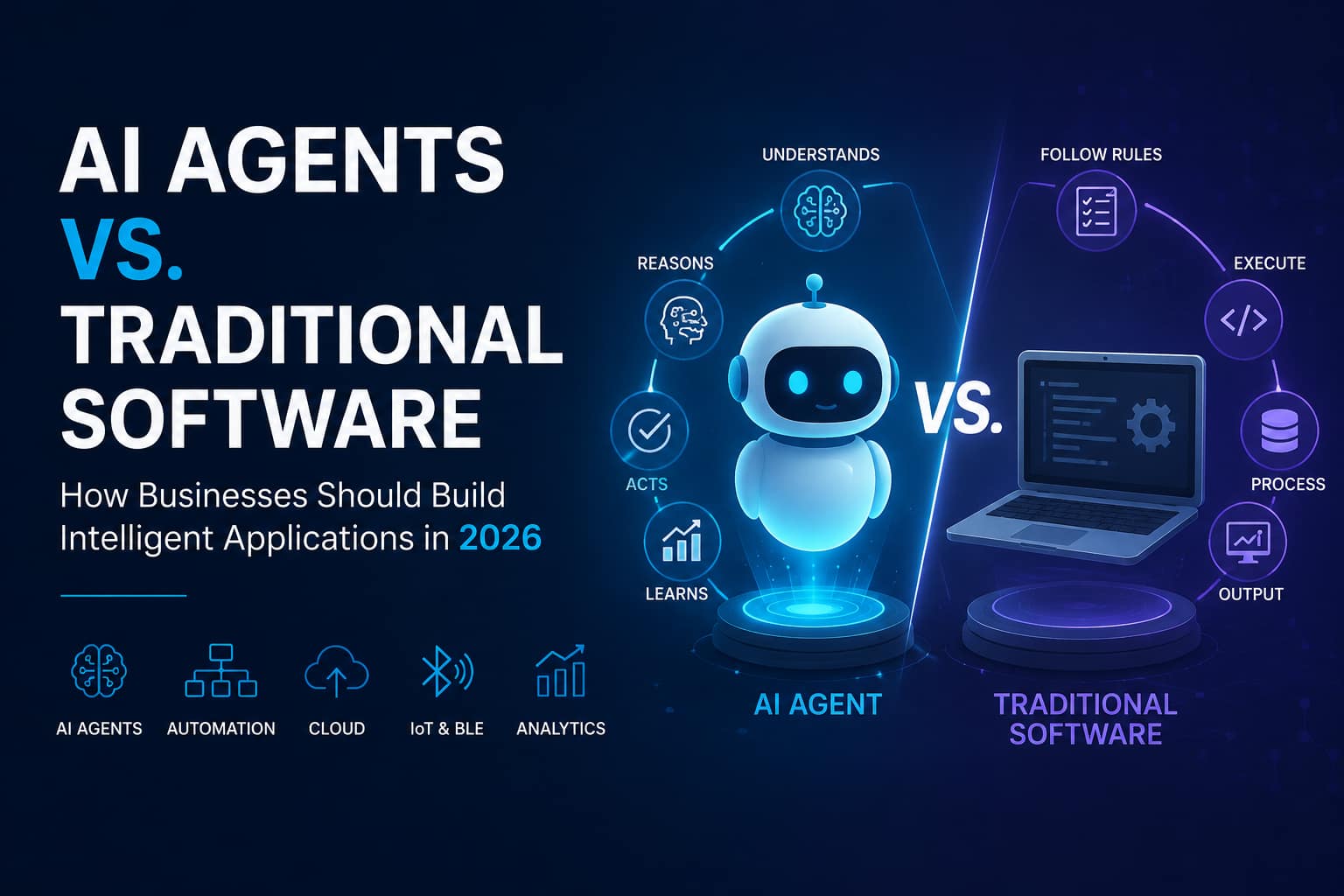
Traditional software generally follows predefined rules.
For example:
User input → Business rules → Database → Output
This architecture remains extremely valuable for predictable processes such as:
- Payment processing
- Inventory management
- Employee management
- Billing
- Order processing
- Authentication
- Reporting
AI-powered software introduces an additional intelligence layer:
User input → AI reasoning → Business data/tools → Action → Result
This can make applications more flexible when users have complex or unpredictable requirements.
However, AI should not replace deterministic software everywhere. Critical business processes often still require predictable rules, validation, security controls, and human oversight.
Why AI Agents Are Becoming Important in 2026
Businesses are under pressure to improve productivity while controlling operational costs.
AI agents can potentially assist with repetitive knowledge-work processes such as:
- Customer support
- Lead qualification
- Sales assistance
- Document processing
- Data analysis
- Internal knowledge search
- Workflow automation
- Scheduling
- Reporting
- IT operations
The important change is that AI is increasingly being positioned as a workflow participant, rather than simply a conversational interface.
For enterprises, this opens the possibility of building software where AI can interact with existing systems and help execute multi-step processes.
5 Ways AI Agents Can Transform Enterprise Applications
1. Intelligent Customer Support
Instead of relying entirely on static FAQs or basic chatbots, businesses can build AI-powered support systems capable of understanding customer context.
An intelligent support application could:
- Understand customer questions
- Retrieve relevant account information
- Search knowledge bases
- Recommend solutions
- Create support tickets
- Escalate complex cases
This can help organizations provide faster customer experiences while allowing human support teams to focus on complicated cases.
2. Automated Business Workflows
Many enterprise processes involve multiple applications.
For example:
Customer request → CRM → Approval → Documentation → Notification → Reporting
AI agents can serve as an intelligent orchestration layer between these systems.
Rather than forcing employees to manually move information between applications, businesses can design workflows where AI assists with the coordination of these tasks.
3. AI-Powered Analytics
Traditional dashboards tell businesses what happened.
AI-powered analytics can help businesses explore:
- Why something happened
- What might happen next
- Which factors are influencing performance
- What actions could be considered
For example, an intelligent retail system could analyze sales patterns and help identify products that may require additional inventory.
In manufacturing, AI can combine operational data with sensor information to support predictive maintenance and process optimization.
4. Personalized Mobile Applications
Mobile applications are also becoming more intelligent.
Instead of providing every user with exactly the same experience, AI can help personalize:
- Recommendations
- Notifications
- Search results
- Content
- User journeys
- Customer support
- Product suggestions
This creates opportunities for businesses to move from static mobile applications toward AI-native digital experiences.
5. Connected AI + IoT Systems
One of the most powerful opportunities is combining AI with IoT and BLE technologies.
A connected ecosystem can look like:
BLE/IoT Device → Sensor Data → Cloud Platform → AI Processing → Decision → Automated Action
For example, sensors could collect real-time information from equipment while an AI system analyzes the data and identifies unusual behavior.
QuartusTech’s technology portfolio already spans BLE integration, IoT, mobile applications, cloud solutions, and custom software development, making this type of connected architecture particularly relevant to its service positioning.
When Should a Business Choose Traditional Software?
AI isn’t automatically the right answer.
Traditional software may be better when:
- Business rules are highly predictable
- Exact calculations are required
- Regulatory compliance requires deterministic behavior
- The workflow is simple
- AI provides little additional business value
- The cost of AI infrastructure isn’t justified
For example, a simple invoicing calculation does not necessarily need an AI agent.
The best enterprise architecture often combines traditional software with AI, rather than replacing everything with AI.
When Should a Business Consider AI Agents?
AI agents become more attractive when applications involve:
- Complex decision-making
- Natural-language interaction
- Multiple business systems
- Repetitive knowledge work
- Dynamic workflows
- Large amounts of unstructured data
- Personalized user experiences
- Intelligent automation
The objective should always be business value—not simply adding AI because it is a current technology trend.
Security Must Come First
Enterprise AI applications introduce additional security considerations.
Businesses should carefully evaluate:
- Data privacy
- Authentication
- Authorization
- API security
- Model access
- Prompt injection risks
- Data leakage
- Auditability
- Human approval workflows
- Third-party AI dependencies
AI agents should operate within clearly defined permissions.
An agent that can read business data should not automatically have permission to modify or delete it.
AI + Cloud + IoT: The Next Software Architecture
The next generation of enterprise applications is likely to become increasingly interconnected.
A modern architecture could combine:
Mobile Apps + Web Applications + AI Agents + Cloud + BLE + IoT + APIs + Analytics
This creates an intelligent digital ecosystem rather than an isolated application.
For example:
Smart Device
↓
BLE Connectivity
↓
Mobile Application
↓
Cloud Platform
↓
AI/ML Engine
↓
Business Decision
↓
Automated Workflow
This approach can be useful in industries such as healthcare, logistics, manufacturing, retail, smart buildings, fitness, automotive, and enterprise operations.
Why Custom AI Development Matters
Off-the-shelf AI tools can be useful for experimentation, but enterprises often need solutions designed around their specific workflows.
A custom AI application can be built around:
- Existing databases
- Internal APIs
- Business rules
- Enterprise security
- Customer workflows
- Mobile applications
- IoT devices
- Cloud infrastructure
- Analytics systems
This gives organizations greater control over how AI interacts with their technology ecosystem.
How QuartusTech Can Help
QuartusTech helps businesses build technology solutions across AI, mobile and web development, BLE integration, IoT, cloud services, and custom software development.
Its approach can support businesses across the complete product lifecycle:
Idea → Architecture → UI/UX → Development → AI Integration → IoT/BLE Integration → Cloud → Testing → Deployment
For businesses exploring intelligent applications, the combination of AI with connected technologies can create new opportunities for automation, personalization, and real-time decision-making.
The Future Is Not AI vs. Software
The future of enterprise technology isn’t necessarily about replacing traditional software with AI.
It is about combining the strengths of both.
Traditional software provides:
- Reliability
- Predictability
- Security
- Structured workflows
- Deterministic business rules
AI provides:
- Reasoning
- Natural-language interaction
- Pattern recognition
- Personalization
- Adaptive workflows
Together, they can create applications that are both reliable and intelligent.
Final Thoughts
AI agents are changing how businesses think about software development in 2026.
The biggest opportunity isn’t simply building another chatbot. It is creating intelligent applications that can connect business data, software systems, devices, and users into a unified digital ecosystem.
Businesses that carefully combine AI with traditional software, cloud platforms, mobile applications, BLE, and IoT can build technology that is more intelligent, connected, and scalable.
Ready to build an AI-powered application for your business?
Partner with QuartusTech to design and develop intelligent software solutions tailored to your business requirements.