
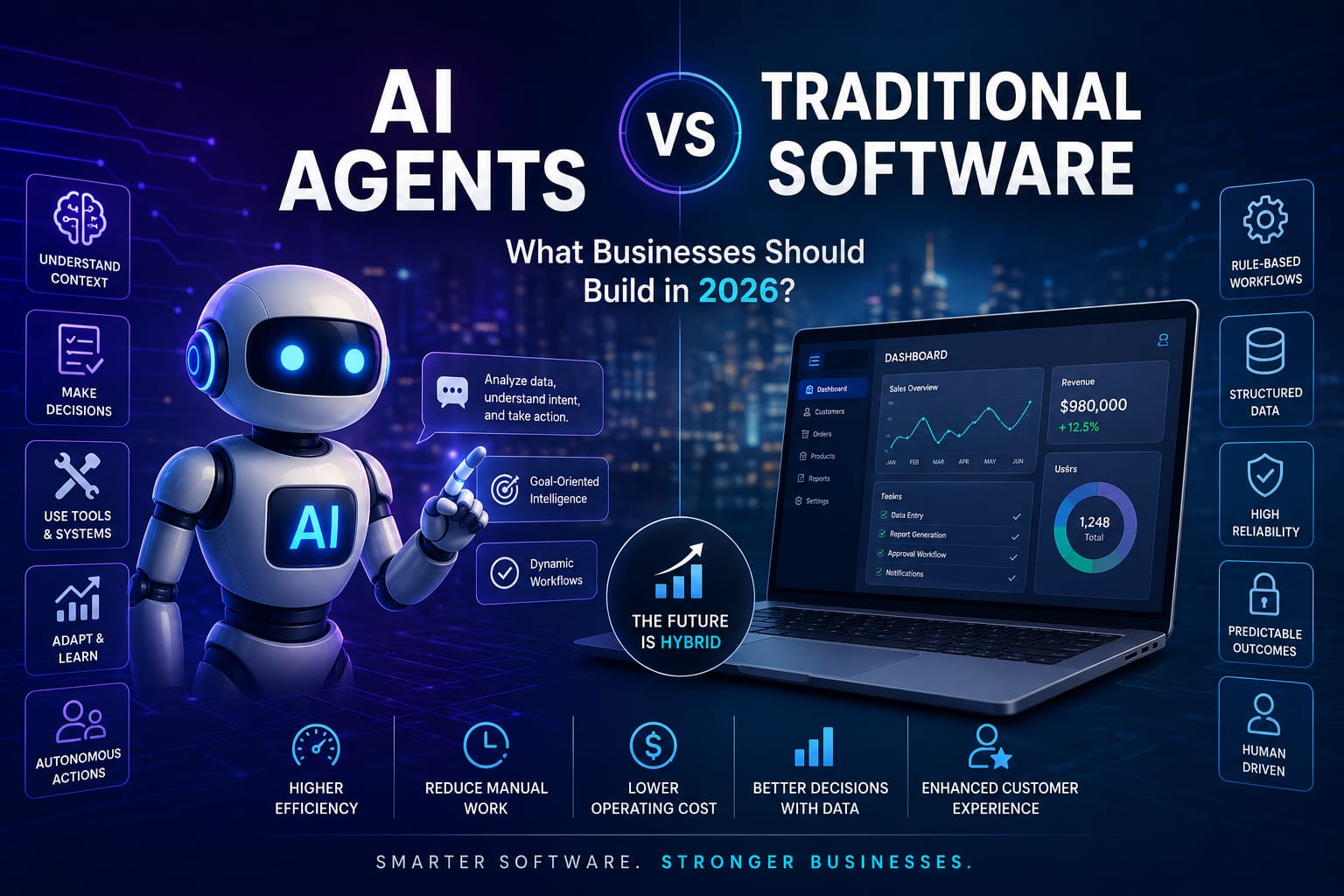
Artificial intelligence is changing the way businesses build and use software. Traditional applications still power everything from accounting and inventory management to customer portals and enterprise workflows. But a new generation of software is emerging: AI agent-powered applications.
Unlike conventional software that follows predefined instructions, AI agents can understand context, make decisions, interact with tools, and complete multi-step tasks with limited human intervention.
In 2026, businesses are increasingly asking an important question:
Should we build traditional software, an AI-powered application, or a combination of both?
The answer depends on the business process, data, users, and desired outcome.
What Is Traditional Business Software?
Traditional software is generally built around predefined rules and workflows.
For example, an inventory management application might follow a workflow such as:
Order Received → Inventory Checked → Stock Updated → Invoice Generated → Notification Sent
Every step is programmed according to specific business rules.
This approach is highly reliable when processes are predictable and clearly defined.
Traditional software remains valuable for:
- Financial transactions
- POS systems
- Inventory management
- CRM platforms
- Booking systems
- HR applications
- Enterprise dashboards
- E-commerce platforms
- Compliance workflows
However, traditional applications can become difficult to maintain when businesses have highly variable or unstructured processes.
What Is an AI Agent?
An AI agent is software designed to understand a goal, reason about available information, use tools, and take actions to complete a task.
Instead of simply following one fixed workflow, an AI agent can potentially determine the next step based on the situation.
For example, a traditional customer-support application might route a ticket based on predefined categories.
An AI agent could:
- Read the customer’s message.
- Understand the problem.
- Review the customer’s account.
- Search the company’s knowledge base.
- Determine the appropriate solution.
- Update the support system.
- Respond to the customer.
- Escalate the issue if human assistance is required.
This makes AI agents particularly useful for complex, knowledge-intensive workflows.
AI Agents vs Traditional Software
The biggest difference is how the application handles decisions.
| Feature | Traditional Software | AI Agent Software |
|---|---|---|
| Decision making | Rule-based | AI-assisted |
| Workflow | Predetermined | Dynamic |
| Data | Structured | Structured + unstructured |
| Adaptability | Limited | High |
| Human intervention | Often required | Can be reduced |
| Natural language | Limited | Strong |
| Automation | Rule-based | Goal-oriented |
| Predictability | Very high | Requires guardrails |
| Best use | Fixed processes | Complex workflows |
Neither approach is universally better.
The best architecture often combines both.
Why Businesses Are Moving Toward AI-Powered Applications
Businesses generate enormous amounts of information every day.
Emails, documents, customer conversations, invoices, reports, support tickets, product information, and internal knowledge can contain valuable information that traditional software may struggle to process.
AI can help turn this information into actionable workflows.
For example:
Customer Email → AI Understanding → Business Data → Decision → Action
Instead of simply displaying information to employees, an AI-powered application can help employees act on it.
AI Agents Can Automate Multi-Step Workflows
One of the most important advantages of AI agents is their ability to participate in multi-step workflows.
Consider a sales process.
A traditional CRM may store:
- Customer information
- Sales activity
- Deals
- Emails
- Notes
- Follow-up dates
An AI sales agent could use this information to assist with the workflow.
It could identify leads that require attention, summarize previous interactions, prepare follow-up messages, update CRM records, and notify sales representatives.
The human remains in control while the repetitive work is automated.
AI Agents Need Traditional Software
AI agents are not replacing traditional software completely.
In fact, AI agents often depend on conventional software systems.
An AI agent may need to interact with:
- Databases
- APIs
- CRM systems
- Payment systems
- POS platforms
- ERP software
- Cloud services
- Mobile applications
- Authentication systems
This creates a powerful architecture:
User → AI Agent → Business Logic → APIs → Enterprise Systems → Data
The AI becomes an intelligent layer on top of existing technology.
Where AI Agents Make the Most Sense
Not every business process needs an AI agent.
AI agents are particularly useful when a process involves:
Unstructured Information
Emails, documents, conversations, images, and natural-language requests are difficult to manage using simple rules.
Multiple Decisions
If employees constantly evaluate different situations before deciding what to do, AI can assist with those decisions.
Repetitive Knowledge Work
Tasks such as summarizing reports, classifying information, researching records, and preparing responses can often be automated.
Multiple Systems
When employees move between several applications to complete one task, an AI agent can potentially coordinate those systems through APIs and tools.
Examples of AI Agent Applications
AI Customer Support Agent
An AI support agent can understand customer questions, search documentation, retrieve account information, and provide responses.
Complex issues can be transferred to human representatives.
AI Sales Assistant
An AI sales assistant can analyze customer interactions, identify opportunities, prepare follow-ups, and assist sales teams with lead management.
AI Employee Assistant
Internal AI assistants can help employees find company information, summarize documents, create reports, and complete routine administrative tasks.
AI Finance Assistant
AI can assist with invoice processing, document classification, financial reporting, and identifying unusual transactions.
Financial decisions and sensitive workflows should still include appropriate human review and controls.
AI Healthcare Applications
AI-powered applications can assist with administrative workflows, documentation, scheduling, and information retrieval.
Healthcare applications require particularly strong privacy, security, validation, and human oversight.
Building an AI Application Requires More Than an AI Model
One common misconception is that developing an AI application simply means connecting an application to an AI API.
A production-ready AI application requires much more.
A complete architecture may include:
Frontend
Web or mobile application through which users interact with the system.
Backend
Business logic, APIs, authentication, permissions, and application services.
AI Layer
Large language models, AI agents, prompt orchestration, and model management.
Data Layer
Databases, vector databases, documents, business records, and knowledge bases.
Integration Layer
APIs connecting the AI system with CRM, ERP, POS, payment, cloud, or other enterprise systems.
Security Layer
Authentication, authorization, encryption, monitoring, and access controls.
Evaluation Layer
Testing AI responses, monitoring performance, detecting failures, and improving system reliability.
The Importance of Human-in-the-Loop AI
Businesses should not blindly automate every decision.
A better approach is to determine which decisions can be automated and which require human approval.
For example:
AI recommends → Employee reviews → System executes
This model can be particularly useful for sensitive business operations.
Over time, businesses can measure accuracy and determine whether specific workflows can safely become more automated.
How to Decide What Your Business Should Build
Before starting an AI development project, ask five questions:
1. Is the process predictable?
If the workflow is completely predictable, traditional software may be sufficient.
2. Does the process involve natural language?
If employees spend significant time reading emails, documents, or messages, AI may provide substantial value.
3. Are multiple systems involved?
If employees constantly switch between applications, AI-powered orchestration could reduce manual work.
4. What is the cost of human intervention?
The greater the amount of repetitive knowledge work, the stronger the potential business case for AI automation.
5. What happens if the AI makes a mistake?
High-risk workflows need validation, permissions, monitoring, and human oversight.
The Future Is Hybrid
The future of enterprise software is unlikely to be purely traditional or purely AI-driven.
Instead, businesses will increasingly combine both.
Traditional software provides:
- Reliability
- Structured workflows
- Data management
- Security
- Business rules
- Transaction processing
AI provides:
- Natural-language interaction
- Reasoning assistance
- Unstructured data processing
- Intelligent automation
- Personalized experiences
- Dynamic workflow assistance
Together, they can create a more intelligent software ecosystem.
How QuartusTech Can Help Businesses Build AI-Powered Software
Building an AI application requires expertise across multiple technology layers.
QuartusTech can help businesses design and develop custom technology solutions that combine AI with modern software systems.
Depending on the project requirements, an AI solution can include:
- Custom AI application development
- AI assistant development
- AI agent development
- Mobile application development
- Web application development
- API development and integrations
- Cloud-based applications
- SaaS platforms
- BLE and IoT integrations
- POS application development
- Enterprise automation
The objective should not simply be to “add AI” to an existing application.
The goal is to identify where intelligent automation can create measurable business value.
Conclusion
Traditional software isn’t disappearing. Instead, it is evolving.
Businesses will continue to rely on conventional applications for structured, predictable, and transaction-heavy processes. At the same time, AI agents will increasingly handle tasks involving language, reasoning, research, decision support, and workflow automation.
The most successful applications in 2026 may therefore combine the reliability of traditional software with the intelligence of AI.
For businesses planning their next digital product, the real question isn’t:
“Should we use AI?”
It is:
“Where can AI create the greatest measurable improvement in our business?”
That is where thoughtful AI application development can turn emerging technology into a practical business advantage.