
Businesses have spent decades relying on traditional software to manage operations, automate repetitive tasks, and improve productivity. While these systems remain essential, they often require human intervention whenever conditions change or unexpected situations arise.
In 2026, organizations are moving toward AI-powered agents that can understand goals, make decisions, collaborate with other systems, and continuously improve performance. This shift is helping enterprises reduce operational costs, accelerate business processes, and create smarter customer experiences.
At QuartusTech, we help organizations design and develop intelligent AI solutions that integrate seamlessly with existing business ecosystems while delivering measurable business value.
What Is Traditional Software?
Traditional software follows predefined instructions. Developers write logic for every possible scenario, and the application performs exactly as programmed.
Examples include:
- ERP systems
- CRM platforms
- Inventory management software
- Payroll applications
- Accounting software
- HR management systems
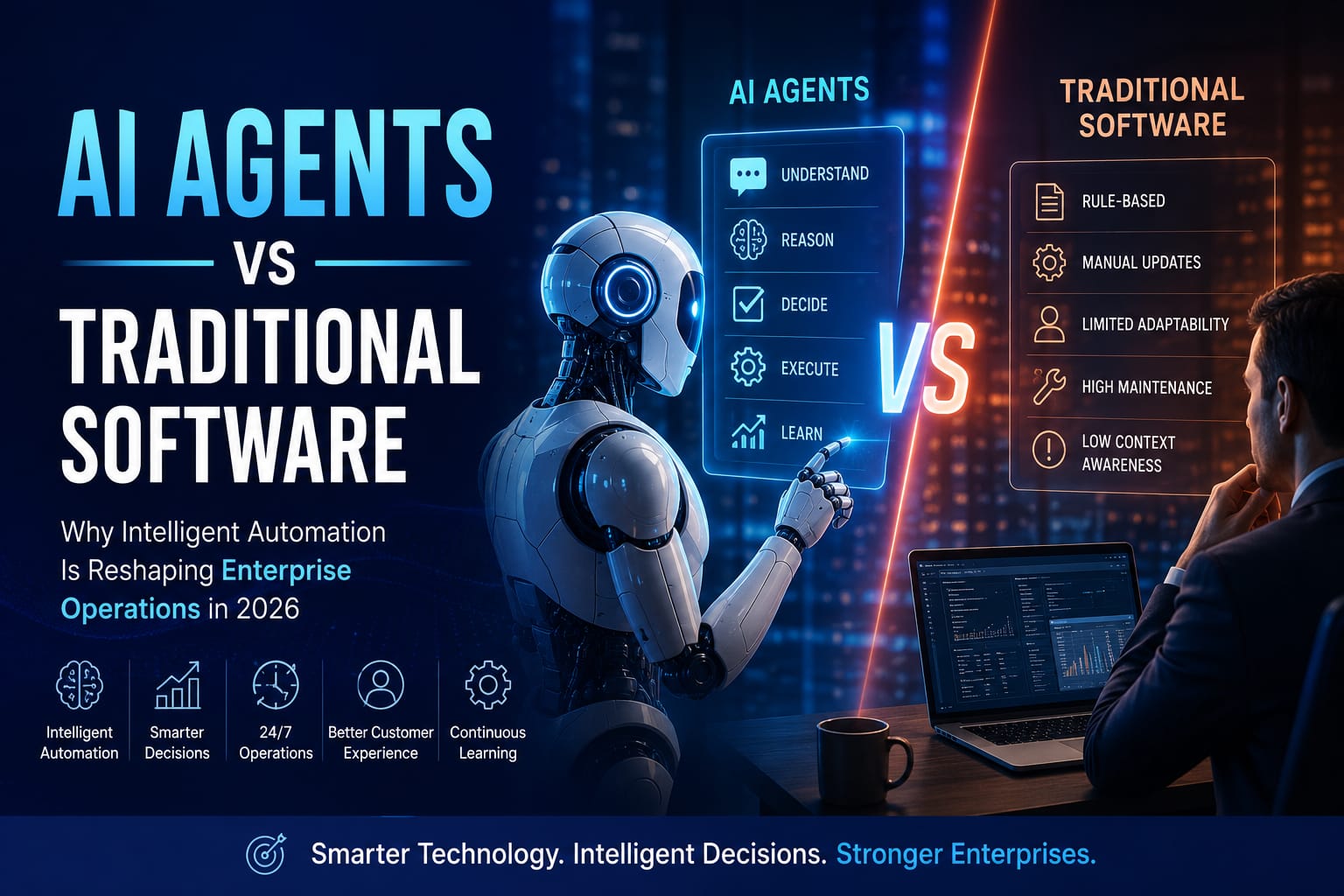
Although these applications are highly reliable, they have limitations:
- Rule-based execution
- Manual updates
- Limited adaptability
- Heavy maintenance
- Minimal contextual understanding
Whenever business requirements change, developers usually need to modify the application manually.
What Are AI Agents?
AI agents are intelligent software systems capable of:
- Understanding natural language
- Making contextual decisions
- Planning multi-step tasks
- Learning from interactions
- Collaborating with other AI systems
- Executing workflows autonomously
Unlike conventional automation, AI agents don’t simply execute commands—they analyze situations and determine the best course of action.
For example, instead of simply forwarding customer emails, an AI customer support agent can:
- Read customer intent
- Retrieve account information
- Generate personalized responses
- Schedule follow-ups
- Escalate complex issues when needed
This significantly reduces response time while improving customer satisfaction.
AI Agents vs Traditional Software
| Feature | Traditional Software | AI Agents |
|---|---|---|
| Rules | Fixed | Adaptive |
| Learning | No | Continuous |
| Decision Making | Manual | Autonomous |
| Natural Language | Limited | Advanced |
| Process Automation | Basic | Intelligent |
| Context Awareness | Low | High |
| Flexibility | Low | High |
| Scalability | Moderate | Excellent |
Why Enterprises Are Moving Toward AI Agents
1. Reduced Operational Costs
AI agents automate repetitive tasks that traditionally require human employees, reducing labor costs while improving consistency.
Examples include:
- Data entry
- Invoice processing
- Customer service
- Report generation
- Document classification
2. Faster Decision Making
Modern AI agents analyze large datasets within seconds, helping executives make informed decisions much faster than manual reporting processes.
Business leaders receive:
- Predictive insights
- Risk analysis
- Sales forecasts
- Inventory recommendations
- Market intelligence
3. 24/7 Business Operations
Unlike human teams, AI agents operate continuously.
They can:
- Monitor systems
- Process customer requests
- Detect anomalies
- Send alerts
- Execute workflows
without downtime.
4. Personalized Customer Experiences
AI agents understand customer behavior and preferences to deliver personalized interactions.
Applications include:
- Smart product recommendations
- AI chatbots
- Dynamic pricing
- Personalized marketing campaigns
- Automated customer onboarding
5. Continuous Learning
One major advantage over traditional software is continuous improvement.
AI agents become more effective as they process additional data, helping organizations improve efficiency over time.
Enterprise Use Cases
Customer Support
AI agents can:
- Answer FAQs
- Resolve support tickets
- Route complex cases
- Analyze customer sentiment
Sales Automation
AI sales assistants help organizations:
- Qualify leads
- Schedule meetings
- Generate proposals
- Forecast revenue
Healthcare
Hospitals use AI agents for:
- Appointment scheduling
- Medical documentation
- Patient communication
- Clinical decision support
Finance
Financial institutions deploy AI agents for:
- Fraud detection
- Compliance monitoring
- Loan processing
- Investment analysis
Manufacturing
Manufacturers leverage AI agents for:
- Predictive maintenance
- Quality inspection
- Production optimization
- Supply chain monitoring
Human Resources
HR departments automate:
- Resume screening
- Employee onboarding
- Internal support
- Performance insights
The Technology Behind AI Agents
Modern AI agents combine multiple technologies:
- Large Language Models (LLMs)
- Machine Learning
- Natural Language Processing (NLP)
- Retrieval-Augmented Generation (RAG)
- Vector Databases
- Knowledge Graphs
- API Integrations
- Workflow Automation Platforms
Together, these technologies enable intelligent decision-making across complex enterprise environments.
Why AI Agents Are Better Than Traditional Automation
Traditional automation follows:
If X happens → Do Y
AI agents follow:
Understand → Reason → Decide → Execute → Learn
This difference enables AI agents to solve problems dynamically rather than relying solely on predefined rules.
Challenges Businesses Should Consider
Before implementing AI agents, organizations should evaluate:
- Data quality
- Security and compliance
- Model governance
- Integration with legacy systems
- Human oversight
- Ethical AI practices
A successful AI deployment requires careful planning and ongoing optimization.
Why Choose QuartusTech for AI Agent Development?
QuartusTech develops intelligent AI solutions tailored to modern enterprise needs. Our expertise includes:
- Custom AI Agent Development
- Enterprise AI Integration
- AI Workflow Automation
- Generative AI Applications
- Conversational AI
- Intelligent Process Automation
- AI-Powered Mobile & Web Applications
- Cloud-Based AI Solutions
Our team focuses on building scalable, secure, and business-driven AI systems that integrate seamlessly with your existing technology stack.
The Future of Enterprise Software
The future of enterprise software lies in systems that don’t just process information—they understand it, reason about it, and act on it intelligently.
Organizations adopting AI agents today are positioning themselves to improve efficiency, reduce costs, enhance customer experiences, and gain a competitive advantage in an increasingly AI-driven marketplace.
As AI technologies continue to evolve, businesses that embrace intelligent automation will be better equipped to innovate, scale, and thrive in the digital economy.
Conclusion
Traditional software remains an important foundation for enterprise operations, but AI agents represent the next evolution in business technology. By combining automation with intelligence, organizations can streamline workflows, improve decision-making, and unlock new growth opportunities.
Whether you’re modernizing existing systems or building AI-first applications, investing in AI agent development today can help your business stay ahead of the competition.
Ready to build intelligent AI solutions for your business? Partner with QuartusTech to develop secure, scalable, and future-ready AI applications that drive real business outcomes.