
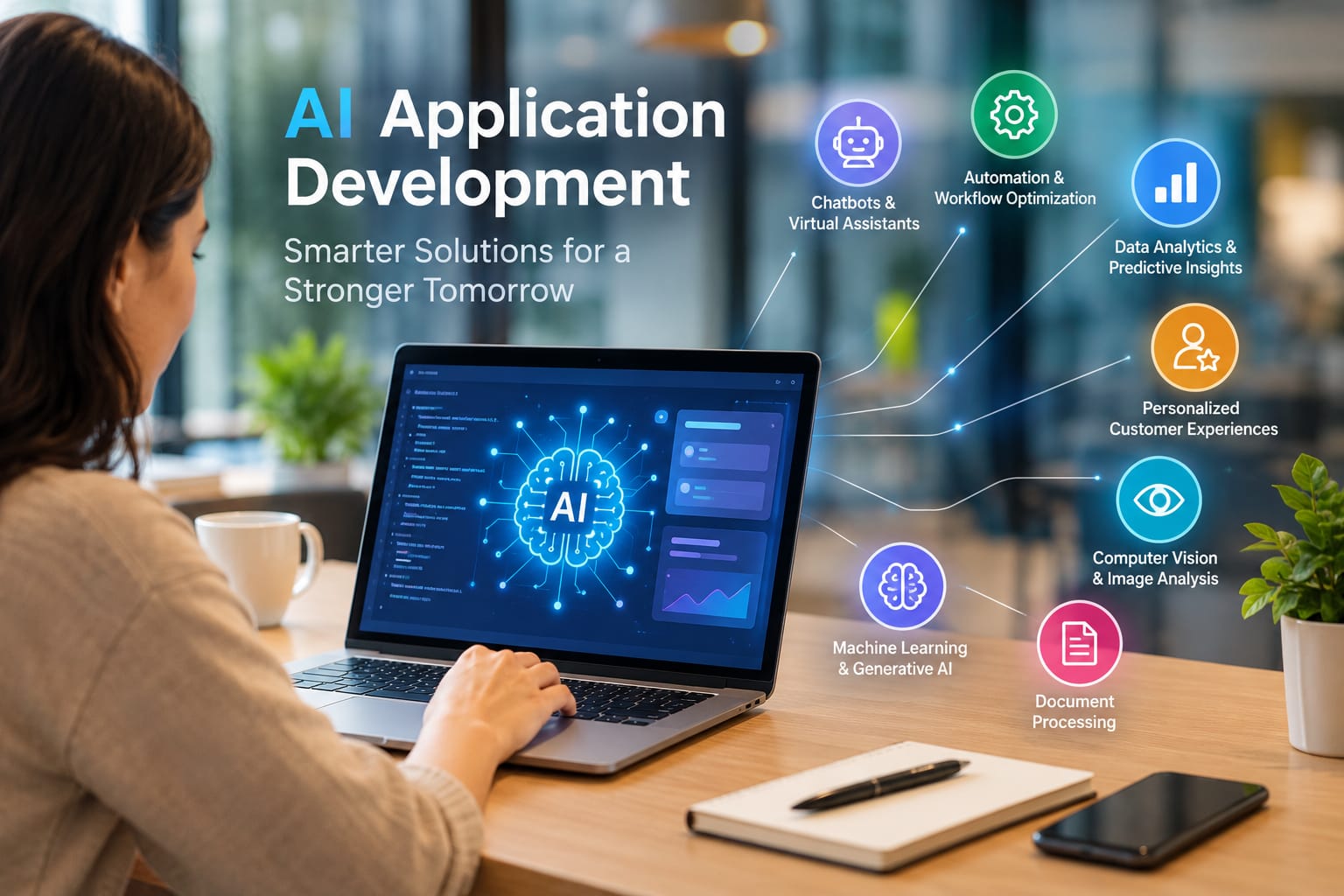
Artificial intelligence has moved beyond experimental projects and chatbots. In 2026, businesses are increasingly using AI application development to automate workflows, analyze data, improve customer experiences, and create smarter digital products.
From healthcare and retail to finance, hospitality, logistics, and enterprise operations, AI-powered applications are becoming an important part of modern business strategy.
However, successful AI adoption is not simply about adding an AI feature to an existing application. Businesses need solutions that understand their workflows, integrate with existing systems, protect sensitive data, and deliver measurable business value.
This is where custom AI application development becomes important.
What Is AI Application Development?
AI application development involves designing and building software applications that use artificial intelligence technologies to perform tasks that traditionally require human intelligence.
These applications can understand information, identify patterns, generate content, make predictions, automate workflows, and assist users with complex decisions.
Depending on the business requirement, an AI application may use technologies such as:
- Machine learning
- Generative AI
- Natural language processing
- Computer vision
- Predictive analytics
- Recommendation engines
- AI agents
- Intelligent automation
- Speech and conversational AI
The objective is not simply to use AI technology. The objective is to use AI to solve a specific business problem.
Why Businesses Are Investing in AI Applications in 2026
Businesses are under increasing pressure to improve productivity while delivering better customer experiences.
Traditional software can automate predefined processes, but AI-powered applications can take automation further by analyzing information, adapting to changing conditions, and supporting more intelligent decision-making.
1. Automating Repetitive Work
Employees often spend significant time on repetitive tasks such as data entry, document processing, reporting, customer communication, and information retrieval.
AI applications can automate many of these workflows and allow teams to focus on higher-value activities.
2. Faster Business Decisions
Modern businesses generate enormous amounts of data.
AI can analyze large datasets and identify patterns that may be difficult to discover manually. Businesses can use these insights for forecasting, customer analysis, operational planning, and performance optimization.
3. Better Customer Experiences
AI-powered applications can personalize customer interactions based on behavior, preferences, and previous activity.
Examples include:
- Intelligent recommendation systems
- AI-powered customer support
- Personalized shopping experiences
- Smart search
- Virtual assistants
- Automated communication
4. Smarter Internal Operations
AI can also improve internal business processes.
Organizations can build intelligent systems that help employees find information, summarize documents, generate reports, monitor workflows, and automate repetitive operational tasks.
AI Applications Businesses Can Build
Every organization has different requirements, which is why custom AI application development can provide more flexibility than generic AI tools.
AI-Powered Customer Support
Businesses can develop intelligent support applications that understand customer questions, retrieve relevant information, and provide automated responses.
AI support systems can also escalate complex issues to human representatives when necessary.
AI-Powered Business Analytics
AI analytics applications can process business data and identify trends, anomalies, and opportunities.
Instead of simply displaying information through traditional dashboards, AI can help explain what the data means and what actions a business could consider.
Intelligent Document Processing
Businesses working with large numbers of documents can use AI to extract, classify, summarize, and organize information.
This can be useful for industries such as finance, healthcare, insurance, logistics, and enterprise operations.
AI Recommendation Engines
Recommendation systems can analyze user behavior and provide personalized products, services, content, or actions.
These solutions can improve engagement while creating more relevant digital experiences.
AI-Powered Mobile Applications
AI can be integrated directly into mobile applications to provide features such as voice interaction, personalized recommendations, image analysis, intelligent search, and automated assistance.
AI Agents and the Next Generation of Business Applications
One of the biggest developments in AI application development is the rise of AI agents.
Traditional software generally waits for users to perform actions.
AI-powered agents can work toward a defined objective by understanding information, deciding what steps are required, using connected systems, and completing tasks within controlled workflows.
For example, an AI business agent could potentially:
- Receive a customer request.
- Understand the customer’s requirement.
- Retrieve relevant information.
- Check available business data.
- Prepare a response.
- Update an internal system.
- Escalate the request when human approval is required.
This creates a shift from passive software toward more intelligent digital systems.
What Makes a Successful AI Application?
Building an AI application requires more than selecting an AI model.
A successful solution should consider several important factors.
Business Requirements
The development process should begin with the problem the application needs to solve.
Data Strategy
AI applications depend heavily on data quality. Businesses need appropriate processes for collecting, organizing, securing, and using data.
User Experience
Even powerful AI becomes difficult to adopt if users cannot understand or control it.
AI features should be integrated into a simple and intuitive user experience.
Security and Privacy
AI applications may process sensitive business or customer information. Security, authentication, access control, encryption, and responsible data handling should therefore be considered from the beginning.
Scalability
An AI solution should be designed to handle increasing users, data volumes, integrations, and business requirements.
Integrating AI With Existing Business Systems
Many businesses already use CRM platforms, ERP systems, payment systems, mobile applications, websites, cloud platforms, and internal databases.
A successful AI solution should work with this existing technology ecosystem rather than creating another disconnected system.
AI applications can be integrated with:
- CRM platforms
- ERP systems
- Mobile applications
- Web applications
- Cloud infrastructure
- Databases
- APIs
- IoT devices
- BLE-connected devices
- POS systems
- Enterprise software
This connected approach allows businesses to build a more intelligent digital ecosystem.
Why Custom AI Development Can Be Better Than Generic AI Tools
Generic AI tools can be useful for everyday productivity, but businesses with specialized workflows often need more control.
Custom AI application development allows organizations to build solutions around their:
- Business processes
- Industry requirements
- Data
- User roles
- Existing technology
- Security requirements
- Integration needs
- Long-term growth plans
Instead of forcing business processes to fit a generic tool, custom development allows technology to be designed around the business.
How QuartusTech Helps Businesses Build AI Applications
QuartusTech helps businesses transform ideas into practical, scalable digital products using modern technologies.
Its technology expertise spans AI applications, custom software, mobile and web development, BLE, IoT, NFC, and POS solutions.
The development approach can include:
Business Discovery → Solution Strategy → UX/UI Design → AI & Software Development → System Integration → Testing → Deployment → Continuous Improvement
This approach helps businesses move from an initial concept to a production-ready digital solution.
The Future of AI Application Development
AI application development is moving toward systems that are more connected, context-aware, and capable of supporting complete business workflows.
The next generation of applications will increasingly combine:
- AI
- Cloud computing
- IoT
- Mobile technology
- BLE connectivity
- Automation
- Data analytics
- Enterprise software
The competitive advantage will not come simply from saying that a product uses AI.
It will come from using AI effectively to solve real business problems.
Final Thoughts
AI application development is becoming a major part of digital transformation in 2026.
Businesses can use AI to automate repetitive processes, improve decision-making, personalize customer experiences, and create intelligent digital products.
But successful AI implementation requires more than technology. It requires a clear business objective, reliable data, thoughtful UX, strong security, scalable architecture, and the right development strategy.
For businesses looking to turn an AI idea into a practical digital product, working with an experienced technology partner can help reduce complexity and accelerate the path from concept to deployment.
Ready to build your next AI-powered application?
Partner with QuartusTech to transform your business idea into an intelligent, scalable, and future-ready digital solution.