
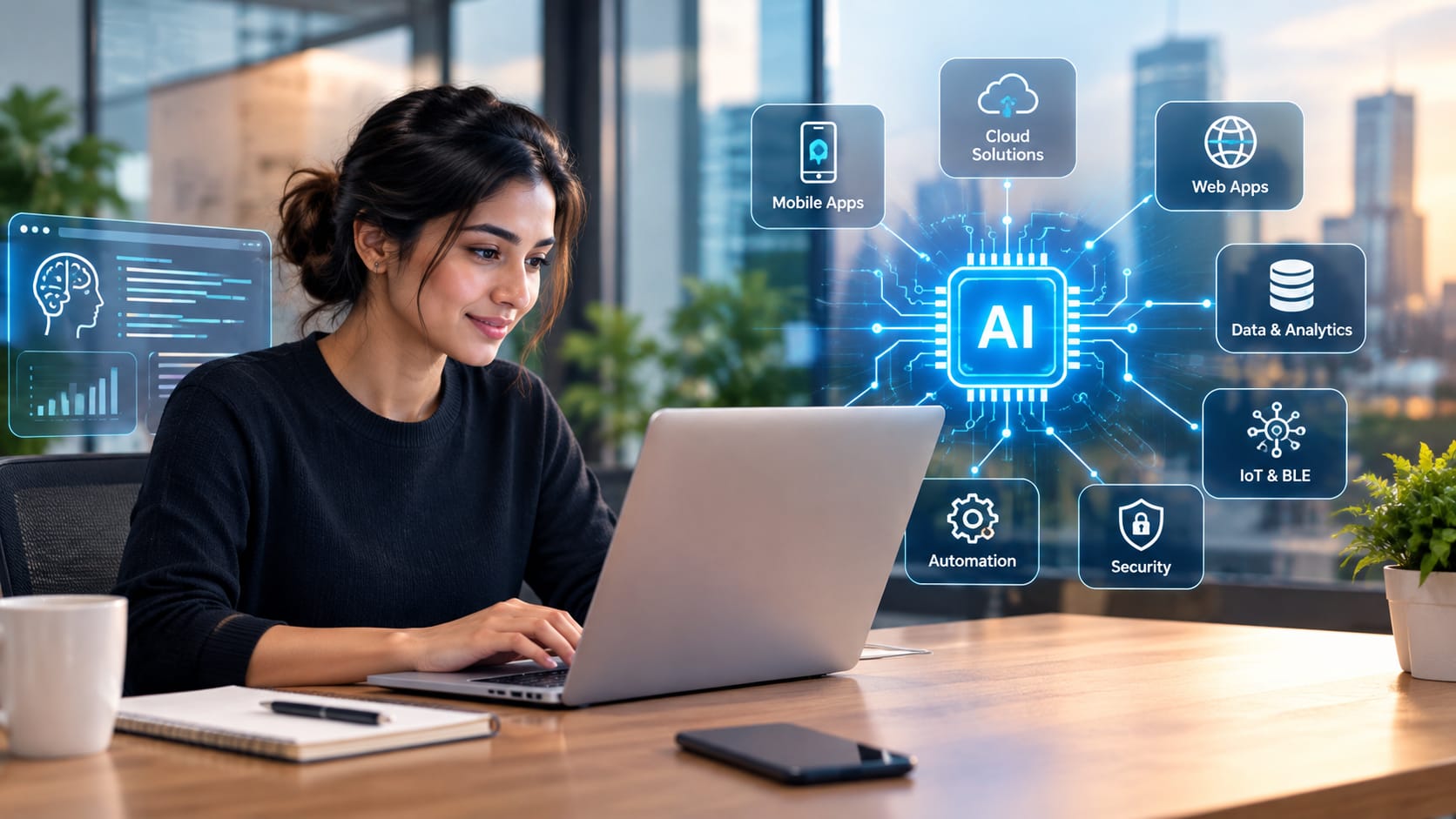
Businesses in 2026 are no longer looking at software simply as a tool for completing tasks. Modern organizations want software that can understand data, automate workflows, improve customer experiences, and support faster business decisions.
This shift is driving the rapid growth of AI-powered software development.
From intelligent mobile applications and enterprise platforms to automated workflows, predictive analytics, and connected devices, companies are combining artificial intelligence with traditional software development to create smarter digital products.
For businesses planning their next technology investment, the question is no longer just “What software should we build?” but “How intelligent should our software become?”
What Is AI-Powered Software Development?
AI-powered software development combines traditional software engineering with technologies such as:
- Artificial Intelligence
- Machine Learning
- Generative AI
- Natural Language Processing
- Predictive Analytics
- Computer Vision
- Intelligent Automation
- Data Analytics
- Cloud Computing
Instead of relying entirely on predefined rules, AI-enabled applications can analyze information, identify patterns, generate insights, and automate selected processes.
For example, a traditional business application may display sales data.
An AI-powered application can analyze that data and help identify:
- Which products are performing best
- Which customers are likely to return
- Where operational problems are occurring
- Which processes can be automated
- What trends may affect future business performance
This creates a fundamental difference between software that stores information and software that helps businesses use information intelligently.
Why Businesses Are Investing in AI Software
Several factors are accelerating AI adoption across industries.
1. Automation of Repetitive Work
Businesses often spend significant time on repetitive activities such as data entry, document processing, customer support, reporting, and internal communication.
AI-powered workflows can automate parts of these processes while allowing employees to focus on higher-value responsibilities.
2. Faster Business Insights
Modern businesses generate enormous amounts of data.
AI can help transform that data into actionable insights through:
- Predictive analytics
- Automated reporting
- Pattern recognition
- Customer segmentation
- Forecasting
- Recommendation systems
This allows decision-makers to work with information more efficiently.
3. Better Customer Experiences
Customers increasingly expect personalized and responsive digital experiences.
AI can support:
- Intelligent chatbots
- Personalized recommendations
- Voice-enabled applications
- AI-powered search
- Automated customer support
- Personalized content
When integrated properly, these capabilities can make digital products more responsive to customer needs.
AI + Custom Software: A Powerful Combination
Off-the-shelf AI tools can be useful, but they may not fully understand a company’s unique workflows, data, or operational requirements.
This is where custom software development becomes important.
A custom AI application can be designed around a company’s:
- Business processes
- Customer journey
- Existing software
- Databases
- APIs
- Security requirements
- Industry regulations
- Growth plans
For example, a company may already have a CRM, ERP, mobile application, payment system, and internal database.
Instead of replacing everything, developers can build an intelligent layer that connects these systems and introduces AI-powered capabilities.
AI Is Becoming Part of Mobile and Web Applications
AI is no longer limited to standalone tools.
Businesses are integrating AI directly into their web and mobile applications.
Examples include:
AI-Powered Mobile Apps
Mobile applications can use AI for:
- Personalized recommendations
- Virtual assistants
- Image recognition
- Voice interactions
- Predictive notifications
- Smart search
Intelligent Web Applications
Web platforms can use AI to provide:
- Automated customer support
- Intelligent search
- Content recommendations
- Data analysis
- Business forecasting
- Personalized user experiences
This combination of AI and application development is helping businesses build more adaptive digital products.
AI, BLE and IoT Are Creating Connected Intelligence
AI becomes even more powerful when combined with connected devices.
BLE and IoT solutions can collect real-time information from sensors and connected devices, while AI can analyze that information to identify patterns and support automated decisions.
For example:
Connected Device → BLE/IoT → Cloud Platform → AI Analysis → Business Action
This architecture can support applications in areas such as:
- Healthcare
- Manufacturing
- Logistics
- Retail
- Hospitality
- Smart buildings
- Asset tracking
- Industrial monitoring
Instead of simply collecting device data, businesses can turn that data into intelligent operational insights.
AI in Enterprise Software
Enterprise organizations often have complex workflows involving multiple departments and systems.
AI can be integrated into enterprise software to support:
- Workflow automation
- Document processing
- Forecasting
- Customer analytics
- Risk detection
- Employee productivity
- Knowledge management
- Business intelligence
The goal isn’t necessarily to replace existing enterprise systems.
In many cases, the opportunity is to make existing systems more intelligent.
What Makes an AI Software Project Successful?
Building an AI-powered application requires more than adding an AI API.
A successful project generally needs several components working together.
Business Strategy
The technology should solve a clearly defined business problem.
Data
AI systems depend heavily on relevant, reliable, and appropriately managed data.
Software Architecture
The application needs an architecture that can support AI services, APIs, databases, integrations, and future scaling.
User Experience
AI features should make the product easier to use rather than making it more complicated.
Security
Sensitive business and customer information needs appropriate protection throughout the application.
Continuous Improvement
AI-powered applications often require monitoring, testing, optimization, and updates after launch.
AI Software Development Challenges
AI provides significant opportunities, but businesses should also understand the challenges.
Data Quality
Poor-quality or incomplete data can affect AI-generated results.
Integration Complexity
Connecting AI with legacy applications, databases, APIs, and enterprise systems can require significant engineering work.
Security and Privacy
AI applications may process sensitive business or customer information, making security an essential part of development.
Cost Management
AI workloads can involve infrastructure, model, API, and data-processing costs. Architecture should therefore be designed with scalability and cost efficiency in mind.
Human Oversight
Not every business decision should be fully automated. Critical workflows may require human review and approval.
How QuartusTech Helps Businesses Build Intelligent Digital Products
At QuartusTech, technology development focuses on solving real business problems through scalable digital solutions.
The company works across areas including:
- AI application development
- Custom software development
- Mobile app development
- Web application development
- BLE and IoT solutions
- NFC application development
- POS software development
- Enterprise software
- Cloud-based applications
- Intelligent automation
QuartusTech’s website describes its approach as combining AI with a human-centric focus, while its development capabilities cover AI, mobile applications, web development, and user-centered digital products.
The objective is not simply to add technology for the sake of technology. The focus is on building digital products that can support business operations, customer experiences, automation, and long-term growth.
The Future of AI-Powered Software
The next generation of software will increasingly combine AI, automation, connected devices, cloud platforms, and intelligent user experiences.
Businesses that previously used software mainly for record keeping are now exploring systems that can analyze information, automate processes, and assist employees.
This doesn’t mean every application needs dozens of AI features.
Instead, businesses should identify where intelligence can create meaningful value.
The strongest AI software strategies will likely focus on three questions:
- What business problem are we solving?
- Where can AI create measurable value?
- How can the solution scale securely as the business grows?
Conclusion
AI-powered software development is changing how businesses think about digital products.
The future is moving from applications that simply store and process information toward intelligent systems that can understand data, automate workflows, generate insights, and assist users.
Whether the goal is an AI-powered mobile application, intelligent enterprise platform, connected IoT solution, smart POS system, or custom business software, the right combination of AI and software engineering can create new opportunities for efficiency and innovation.
For businesses planning their next digital product, AI should not simply be another feature on the roadmap—it should be considered as part of the overall software strategy.