
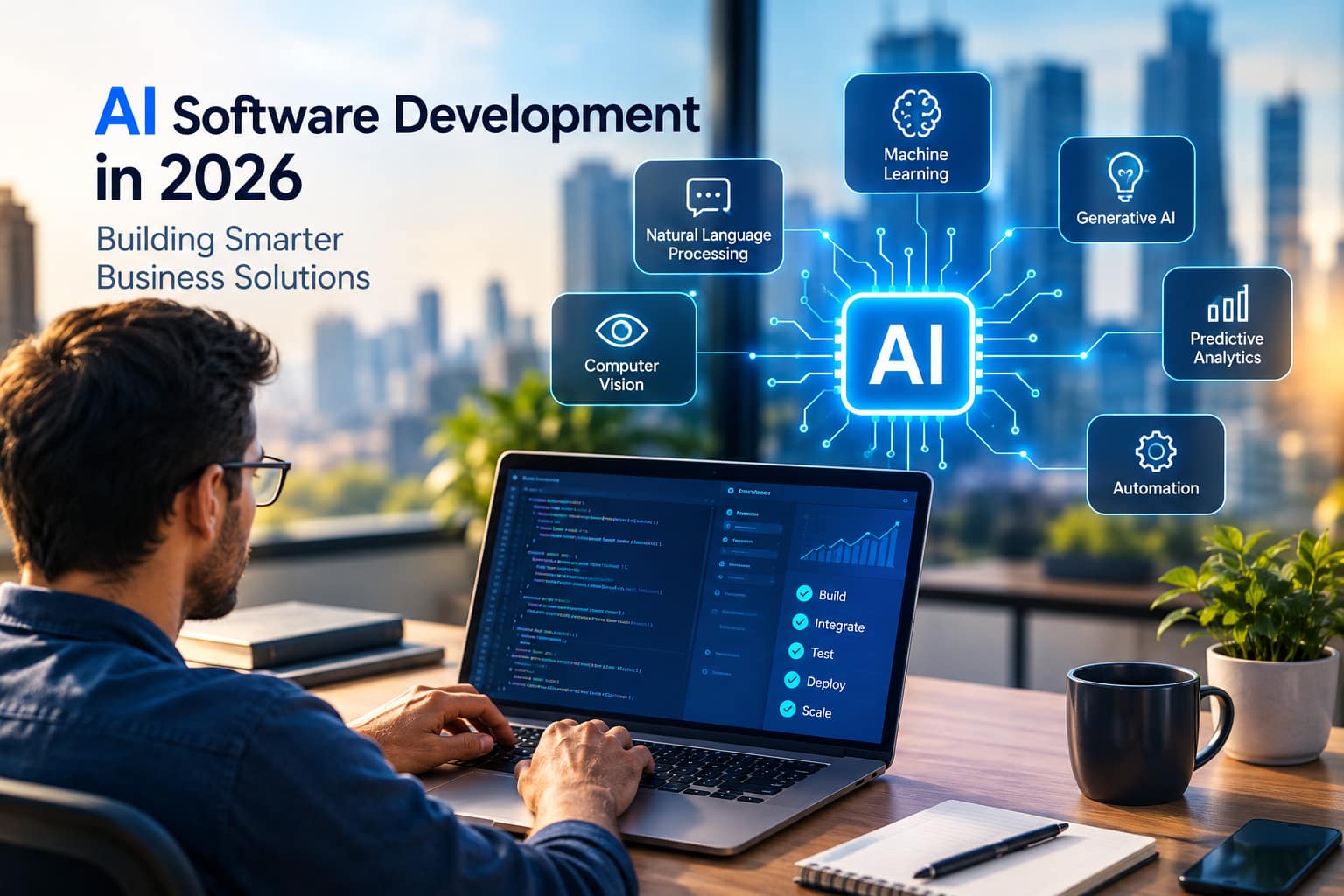
Artificial intelligence is rapidly changing how businesses build software, automate operations, analyze data, and interact with customers. In 2026, companies are moving beyond basic AI experiments and integrating intelligent capabilities directly into mobile apps, web platforms, enterprise software, and connected products.
For businesses planning a new digital product, AI software development can help automate repetitive processes, improve customer experiences, and create data-driven workflows.
What Is AI Software Development?
AI software development is the process of building applications that use artificial intelligence technologies such as machine learning, natural language processing, computer vision, predictive analytics, and generative AI.
Modern AI-powered software can help businesses:
- Automate repetitive business processes
- Analyze large volumes of data
- Generate content and reports
- Improve customer support
- Detect patterns and anomalies
- Personalize digital experiences
- Support business decision-making
- Connect AI with existing enterprise systems
The right architecture depends on the business objective, available data, security requirements, and the type of AI functionality required.
Why Businesses Are Investing in AI Applications
Businesses across industries are adopting AI because intelligent software can be integrated into existing workflows rather than operating as a standalone technology.
For example, an enterprise application can use AI to automatically classify incoming requests, summarize documents, identify potential issues, or provide employees with relevant information.
AI can also be combined with mobile and web development to create customer-facing products with intelligent features.
Common AI Software Use Cases
Some practical applications include:
AI Customer Support
AI assistants can answer common questions, summarize conversations, and help support teams manage customer requests.
Predictive Analytics
Businesses can analyze historical and real-time data to identify trends and support forecasting.
Document Processing
AI can extract information from invoices, forms, contracts, and other business documents.
Recommendation Systems
AI can analyze user behavior and provide personalized product, content, or service recommendations.
Intelligent Automation
AI can automate multi-step workflows that previously required manual intervention.
Computer Vision
Organizations can use image and video analysis for inspection, monitoring, recognition, and other industry-specific applications.
AI Software Development Process
Building an AI-powered application requires more than simply adding an AI API to an existing application.
1. Define the Business Objective
The first step is identifying the specific problem the software needs to solve.
Instead of starting with a technology such as generative AI, businesses should define measurable objectives such as reducing manual processing, improving response times, or creating a more personalized customer experience.
2. Identify Data Requirements
AI applications often depend on high-quality data.
Development teams evaluate:
- Data sources
- Data quality
- Data volume
- Data security
- Data ownership
- Data processing requirements
The results help determine which AI approach is appropriate.
3. Design the AI Architecture
The architecture may include an AI model, application backend, databases, APIs, cloud infrastructure, authentication, and monitoring systems.
For generative AI applications, the architecture may also include retrieval-augmented generation (RAG), vector databases, prompt management, and model monitoring.
4. Develop and Integrate the Application
AI functionality is integrated into the application while developers build the required frontend, backend, APIs, databases, and business logic.
This creates a complete software product rather than an isolated AI prototype.
5. Test AI Performance
AI systems require functional and performance testing.
Teams can evaluate:
- Accuracy
- Response quality
- Latency
- Security
- Scalability
- Reliability
- Failure handling
Continuous monitoring is important because AI outputs can change as models, prompts, data, or integrations change.
Generative AI and Enterprise Software
Generative AI has become an important component of modern enterprise applications.
Businesses can integrate generative AI into internal platforms to help employees search company information, summarize documents, generate reports, answer questions, and automate repetitive communication.
For organizations handling proprietary information, security and access controls are particularly important.
A properly designed enterprise AI system should ensure that users only receive information they are authorized to access.
AI + Mobile App Development
AI can also transform mobile applications.
An AI-powered mobile application may include:
- Voice-based interaction
- Personalized recommendations
- Intelligent search
- Image recognition
- AI assistants
- Predictive features
- Automated content generation
Combining AI with mobile application development allows businesses to deliver intelligent functionality directly through iOS and Android applications.
AI + IoT and Connected Devices
AI becomes even more powerful when combined with connected devices and IoT systems.
IoT devices can generate large amounts of operational data. AI can analyze that data to identify patterns, detect anomalies, and support predictive decision-making.
For example, an industrial system could monitor equipment data and identify unusual behavior before it develops into a larger operational issue.
This combination of AI software development and IoT development can support applications across manufacturing, healthcare, logistics, retail, energy, and other industries.
Security Considerations for AI Applications
Security should be considered throughout the AI software development lifecycle.
Important areas include:
- User authentication
- Authorization
- Encryption
- API security
- Data privacy
- Secure model integration
- Access controls
- Logging and monitoring
- Protection against prompt injection
- Secure handling of sensitive information
Businesses should also determine what information can be sent to external AI services and what information needs to remain within their controlled infrastructure.
How Much Does AI Software Development Cost?
The cost of developing an AI application depends on the project’s complexity.
Factors that influence development costs include:
- Application size
- Number of platforms
- AI model requirements
- Data preparation
- Third-party API integrations
- Custom model development
- Security requirements
- Cloud infrastructure
- Number of users
- Ongoing maintenance
A simple AI feature integrated into an existing application can require significantly less development effort than a complete enterprise AI platform.
For this reason, businesses should define the minimum viable AI functionality before expanding the product.
Choosing an AI Software Development Partner
Businesses evaluating an AI development company should consider its experience across software architecture, AI integration, cloud technologies, APIs, mobile development, and enterprise systems.
A development partner should also understand the business problem rather than focusing only on the underlying AI model.
At QuartusTech, AI can be incorporated into broader software development projects, including web applications, mobile applications, enterprise platforms, connected products, and custom business solutions.
Why Choose QuartusTech for AI Software Development?
QuartusTech works with businesses looking to develop custom software and integrate emerging technologies into digital products.
Our development approach can include:
- AI application development
- Custom software development
- Mobile app development
- Web application development
- AI automation
- IoT and connected solutions
- API development and integration
- Enterprise software solutions
The objective is to develop technology around the business requirement rather than using a one-size-fits-all approach.
The Future of AI Software Development
AI development is moving toward more integrated and specialized business applications.
Instead of using AI only for chatbots or content generation, organizations are exploring AI for automation, analytics, customer experiences, software workflows, IoT systems, and enterprise decision support.
Businesses that approach AI development strategically can identify specific processes where intelligent automation provides measurable value.
Frequently Asked Questions
What is AI software development?
AI software development involves creating software applications that use technologies such as machine learning, generative AI, natural language processing, computer vision, and predictive analytics.
How long does it take to build an AI application?
Development time depends on the application’s features, integrations, data requirements, AI architecture, and testing requirements. A focused MVP can generally be developed faster than a complex enterprise AI platform.
Can AI be added to an existing application?
Yes. AI functionality can often be integrated into existing web, mobile, and enterprise applications through APIs, AI models, automation workflows, or custom AI infrastructure.
Is AI software development suitable for small businesses?
Yes. Small businesses can start with focused AI solutions such as customer support automation, document processing, intelligent search, or workflow automation instead of developing a large AI platform.
Can AI be integrated with IoT applications?
Yes. AI can analyze data generated by connected devices and support anomaly detection, predictive analytics, automation, and intelligent decision-making.
Conclusion
AI software development is becoming an important part of modern digital transformation. From intelligent enterprise applications and mobile apps to automation and connected IoT systems, AI can be integrated into many types of software products.
The key is to begin with a clearly defined business problem, select an appropriate AI architecture, protect business data, and build a scalable application around measurable objectives.
Businesses looking to develop an AI-powered product can work with QuartusTech to plan, develop, integrate, and scale custom software solutions.