
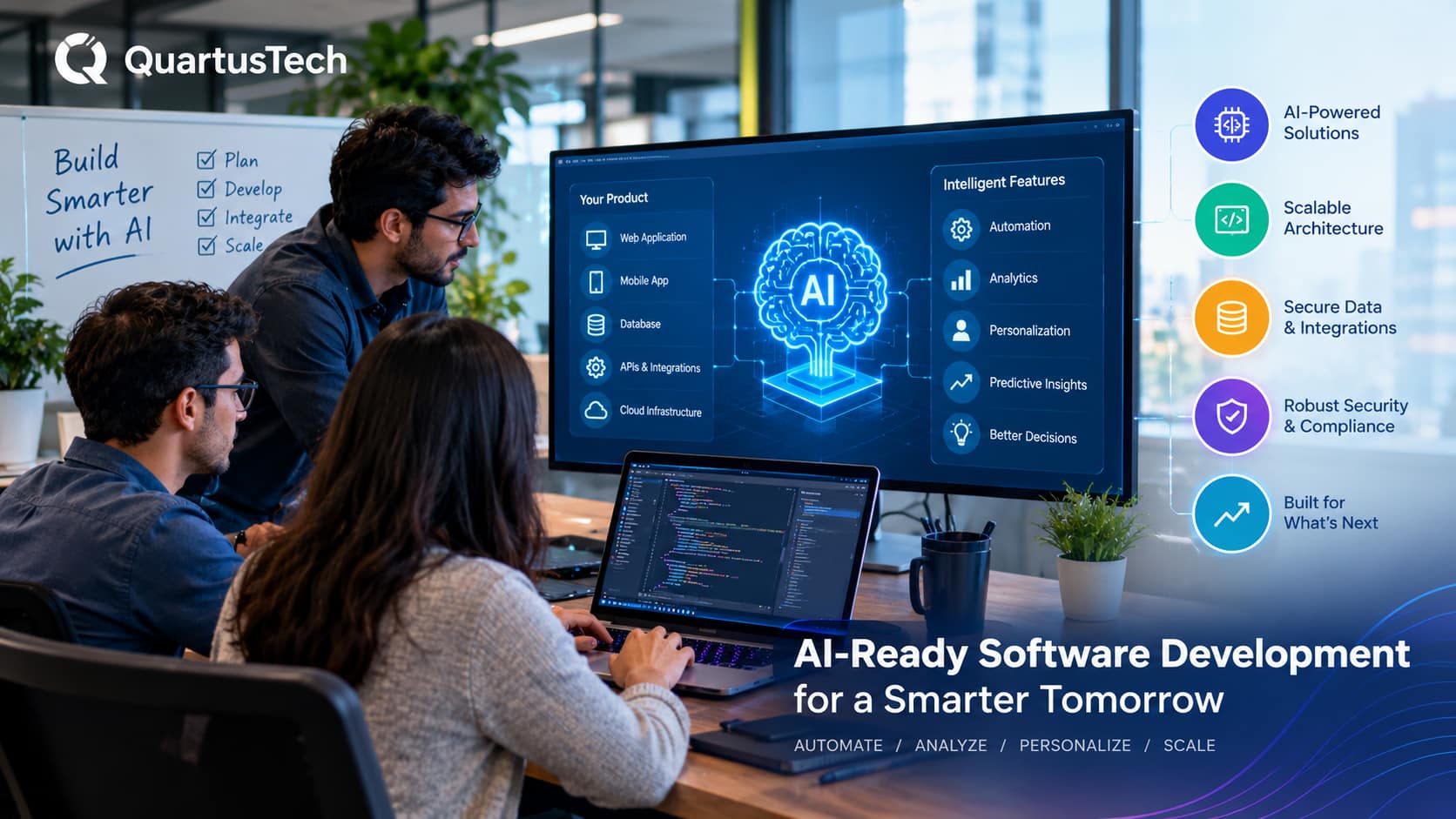
Businesses in 2026 are moving beyond experimenting with artificial intelligence. They want software that solves real problems, improves operational efficiency, supports better decisions, and delivers measurable business value.
However, adopting AI is not simply about adding a chatbot or connecting an API. Successful implementation requires the right software architecture, reliable data, secure integrations, and a clear understanding of business goals.
For companies planning their next digital product, AI-ready software development offers a practical way to build flexible applications that can evolve as technology and customer expectations change.
What Is AI-Ready Software Development?
AI-ready software development means designing applications and digital platforms that can integrate artificial intelligence capabilities effectively, whether immediately or in future releases.
Instead of treating AI as an isolated feature, developers consider how intelligent functionality fits into the entire product ecosystem.
An AI-ready application may include:
- Automated business workflows
- Intelligent search and personalized recommendations
- Predictive analytics and forecasting
- AI-powered customer support
- Data processing and reporting automation
- Integrations with existing enterprise systems
For example, a logistics company could use AI to forecast delivery delays, while a retail business could analyze sales patterns to improve inventory planning.
The objective is straightforward: build software that addresses a genuine business need rather than adopting AI simply because it is trending.
Why Businesses Need AI-Ready Applications in 2026
1. Increasing Demand for Intelligent Automation
Manual processes can consume valuable time and introduce avoidable errors. AI-enabled applications can help automate repetitive tasks, classify information, summarize documents, and route requests to the appropriate teams.
With proper workflow design and human oversight, organizations can reduce administrative work while allowing employees to focus on higher-value activities.
2. Better Use of Business Data
Many companies already collect information through CRM platforms, mobile applications, websites, payment systems, and internal databases. The challenge is turning that information into useful decisions.
AI-ready software can connect relevant data sources and support analytics, forecasting, and contextual search, subject to data quality and access controls.
3. More Personalized Digital Experiences
Customers increasingly expect relevant recommendations and quick, helpful responses. AI-powered software can support personalized experiences based on appropriate customer preferences, previous interactions, and business rules.
Companies should also provide privacy safeguards and clear ways for customers to reach a human when needed.
4. Greater Flexibility for Future Growth
Business requirements change. Modular architecture and well-designed APIs can make it easier to add new capabilities without rebuilding an entire application.
This flexibility helps organizations introduce AI features gradually, evaluate their performance, and scale the capabilities that deliver measurable value.
Essential Components of an AI-Ready Software Product
Building an intelligent application requires more than selecting an AI model. Several technical foundations work together.
Scalable Software Architecture
A well-structured application separates core business logic, data services, user interfaces, and AI integrations where appropriate. This makes components easier to maintain and replace as requirements evolve.
Reliable Data Infrastructure
AI functionality depends on relevant, accurate, and appropriately governed data. Data validation, access permissions, retention policies, and integration quality should be addressed early in development.
Secure API Integrations
APIs connect applications with AI services, CRMs, ERP platforms, payment systems, and other business tools. Secure authentication, rate limits, monitoring, and error handling help protect these integrations.
Security and Responsible AI Controls
AI-enabled products should consider sensitive data exposure, access control, inaccurate outputs, model limitations, and auditability. Depending on the use case, safeguards may include output validation, human approval, logging, and ongoing evaluations.
Performance Monitoring
Teams should measure more than whether a feature works during a demonstration. Production monitoring should cover reliability, latency, operating costs, user adoption, and business outcomes.
How to Build an AI-Ready Application: A Practical Roadmap
Step 1: Identify a Business Problem
Start with a specific challenge, such as slow customer support, manual document processing, fragmented reporting, or inaccurate demand forecasting.
Define a measurable outcome before selecting technology.
Step 2: Assess Existing Systems and Data
Review the current software architecture, data sources, integration requirements, privacy obligations, and infrastructure limitations.
This assessment helps determine whether the best solution is an enhancement to an existing product or a new application.
Step 3: Choose the Right Technology Approach
Not every use case needs a custom-trained AI model. Depending on the requirements, the solution may use established AI APIs, retrieval-augmented generation (RAG), conventional machine learning, rules-based automation, or a combination of approaches.
The right choice depends on accuracy requirements, data availability, security, budget, and maintenance needs.
Step 4: Develop a Focused Minimum Viable Product
Start with a limited set of high-value features. Build a prototype or minimum viable product (MVP), validate it with actual users, and collect feedback before expanding the scope.
Step 5: Test Security, Quality, and Reliability
Evaluate outputs against realistic scenarios, including edge cases and incorrect inputs. Test access controls, integration failures, performance under load, and recovery procedures.
Where AI-generated responses influence important decisions, define suitable human review and escalation processes.
Step 6: Deploy, Measure, and Improve
After deployment, monitor application performance and business results. Use real-world feedback to improve workflows, refine prompts or models where applicable, and prioritize future development.
Common Mistakes to Avoid
Businesses can undermine otherwise promising software initiatives by overlooking the fundamentals.
- Adding AI without a clear use case: Choose a measurable business problem first.
- Ignoring data quality: Incomplete or inconsistent data can produce unreliable results.
- Overcomplicating the first release: Validate the core workflow before expanding features.
- Neglecting security: Apply least-privilege access, secure integrations, and appropriate data handling.
- Skipping evaluation: Test AI outputs and system behavior continuously.
- Measuring activity instead of impact: Track outcomes such as processing time, support resolution, error rates, and user satisfaction.
Avoiding these mistakes can help organizations invest in software that delivers sustainable value instead of short-lived experimentation.
How QuartusTech Can Support Your Software Development Journey
Building an AI-ready product requires coordination between business strategy, application engineering, system integration, testing, and long-term maintenance.
QuartusTech can position its software development services around helping businesses plan and build digital solutions aligned with their operational requirements. Depending on project needs, this can include custom software development, web and mobile applications, AI application development, and integration with existing business systems.
A practical engagement should begin with understanding the business challenge, defining the technical requirements, and identifying a manageable first release.
The goal is to create a solution that is useful today, maintainable tomorrow, and prepared for future capabilities.
Final Thoughts
AI-ready software development is about building a strong foundation for intelligent digital products. Businesses that combine clear objectives, reliable data, secure integrations, thoughtful architecture, and continuous evaluation are better positioned to turn AI experimentation into practical results.
Whether you are modernizing an existing platform or planning a new application, a phased development strategy can help control complexity while leaving room for innovation.
Planning an AI-powered software product? Contact QuartusTech to discuss your requirements and explore a development approach aligned with your business goals.
Frequently Asked Questions
What is AI-ready software development?
It is the process of designing software with the architecture, data infrastructure, integrations, and controls needed to support AI features now or in the future.
Does every business application need AI?
No. AI is valuable when it addresses a defined problem and provides benefits that justify its cost and complexity. Conventional software and rules-based automation may be better for some workflows.
How much does AI software development cost?
Costs vary according to application complexity, integrations, data readiness, security requirements, and ongoing infrastructure needs. A discovery phase can help establish a realistic scope and budget.
How long does it take to build an AI-powered application?
A focused prototype may take considerably less time than a production-ready enterprise platform. The timeline depends on requirements, data availability, integrations, testing, and compliance obligations.
Can AI features be added to existing software?
Yes. AI capabilities can often be introduced through APIs or dedicated services, provided the existing system, data access, and security architecture support the integration.
What should businesses consider before hiring a software development company?
Evaluate relevant technical experience, communication, security practices, development methodology, integration expertise, testing processes, and post-launch support.