
For decades, businesses invested in individual software products—a CRM for sales, an ERP for operations, a mobile app for customers, and separate analytics dashboards for decision-makers. While these systems improved productivity, they often operated in isolation.
The next evolution isn’t simply building smarter applications—it’s creating intelligent software ecosystems where every digital product communicates, learns, automates, and evolves together.
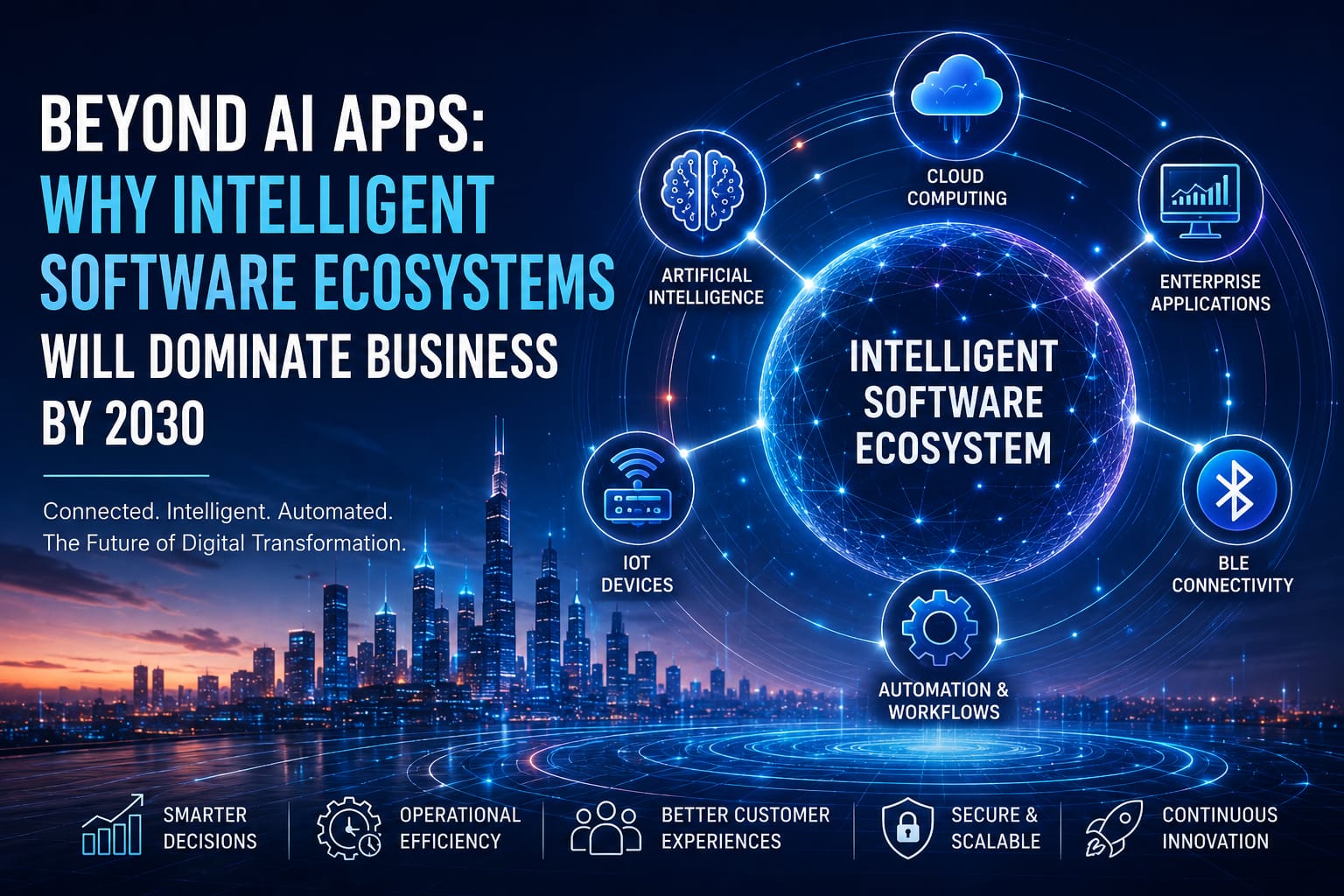
This shift is redefining digital transformation across healthcare, retail, logistics, manufacturing, finance, and smart cities. Companies that embrace interconnected intelligence today will become tomorrow’s industry leaders. Organizations are increasingly combining AI, IoT, BLE connectivity, cloud infrastructure, and automation to build software that continuously adapts to business needs.
What Is an Intelligent Software Ecosystem?
An intelligent software ecosystem is a connected network of applications, devices, APIs, cloud services, and AI models that work together rather than independently.
Instead of asking:
“Can this application solve my problem?”
Businesses are now asking:
“Can my entire technology ecosystem solve problems automatically?”
These ecosystems combine:
- Artificial Intelligence
- Machine Learning
- IoT Devices
- Bluetooth Low Energy (BLE)
- Cloud Infrastructure
- Enterprise Applications
- Mobile Apps
- Data Analytics
- Automation Engines
- Cybersecurity
The result is software that doesn’t simply execute instructions—it continuously improves its performance through connected data and automation.
Why Traditional Software Is Becoming Obsolete
Standalone applications create several challenges:
- Duplicate data
- Manual workflows
- Slow decision-making
- Multiple disconnected systems
- High maintenance costs
- Poor customer experiences
Modern organizations require technology capable of:
- Sharing information instantly
- Predicting future outcomes
- Automating repetitive work
- Integrating with thousands of services
- Scaling globally
- Improving without constant redevelopment
That is exactly what intelligent ecosystems provide.
Five Technologies Powering Intelligent Ecosystems
1. Artificial Intelligence
AI transforms business data into actionable decisions.
Examples include:
- Predictive analytics
- AI assistants
- Intelligent customer support
- Fraud detection
- Personalized recommendations
- Workflow automation
Rather than replacing employees, AI augments human decision-making by handling repetitive tasks and surfacing insights faster.
2. Internet of Things (IoT)
IoT devices continuously collect real-world data from:
- Factories
- Vehicles
- Medical equipment
- Retail stores
- Smart buildings
- Industrial machinery
This enables businesses to monitor assets, optimize operations, and respond in real time. IoT development has become a cornerstone of connected digital ecosystems.
3. Bluetooth Low Energy (BLE)
BLE connects nearby devices with minimal power consumption.
Common use cases include:
- Healthcare wearables
- Fitness devices
- Smart locks
- Asset tracking
- Indoor navigation
- Retail beacons
- Industrial sensors
Reliable BLE integration allows businesses to create seamless user experiences while preserving battery life.
4. Cloud Computing
Cloud platforms provide:
- Global scalability
- High availability
- Secure data storage
- Disaster recovery
- Real-time synchronization
- Continuous software delivery
Cloud-native architectures make intelligent ecosystems flexible and easier to expand.
5. Enterprise Automation
Automation links departments together by reducing repetitive manual work.
Examples include:
- Invoice processing
- Employee onboarding
- Supply chain management
- Customer support routing
- Inventory synchronization
- Marketing automation
Automation increases speed, accuracy, and consistency across the business.
Real-World Example: Smart Retail
Imagine a retail chain powered by an intelligent ecosystem:
- BLE detects customer movement.
- AI analyzes shopping behavior.
- Inventory updates automatically.
- Personalized offers appear instantly.
- Payment is completed through contactless systems.
- Analytics dashboards update in real time.
Every technology works together to create a seamless customer experience.
Industries Benefiting Most
Intelligent ecosystems are transforming:
Healthcare
- Remote patient monitoring
- AI diagnostics
- Connected medical devices
Manufacturing
- Predictive maintenance
- Smart factories
- Industrial automation
Logistics
- Fleet tracking
- Warehouse automation
- Route optimization
Retail
- Smart POS
- Customer analytics
- Inventory management
Finance
- Fraud detection
- AI compliance
- Intelligent banking
Hospitality
- Contactless check-in
- Smart room automation
- Guest personalization
Why Businesses Need Technology Partners—Not Just Developers
Creating intelligent ecosystems requires expertise across multiple disciplines:
- AI Engineering
- Mobile Development
- Web Development
- Cloud Architecture
- IoT
- BLE Integration
- API Development
- Enterprise Security
- UX Design
- DevOps
Working with a technology partner that understands these domains reduces complexity and accelerates innovation. QuartusTech focuses on delivering integrated AI, BLE, IoT, cloud, and custom software solutions for businesses across industries.
How QuartusTech Builds Intelligent Software Ecosystems
At QuartusTech, we help businesses move beyond standalone applications by developing connected digital ecosystems that are scalable, secure, and future-ready.
Our expertise includes:
- AI Application Development
- Custom Software Development
- Mobile App Development
- Web Application Development
- IoT Solutions
- BLE Integration
- Cloud Solutions
- Enterprise Software
- POS Development
- API Integration
- Digital Transformation Consulting
From strategy to deployment, our focus is on creating technology that delivers measurable business value.
The Future Belongs to Connected Intelligence
The software industry is entering a new era where isolated applications will gradually give way to intelligent, interconnected ecosystems.
Businesses that invest today will gain:
- Faster innovation
- Better customer experiences
- Lower operational costs
- Improved decision-making
- Greater scalability
- Long-term competitive advantage
The future is no longer about having more software—it’s about having software that works together intelligently.
Conclusion
As digital transformation accelerates, success will depend on how well organizations connect data, devices, people, and processes into a unified ecosystem. Intelligent software ecosystems enable businesses to innovate faster, automate smarter, and adapt continuously to changing market demands.
Whether you’re modernizing legacy systems or building a new digital platform, investing in an integrated approach today positions your business for sustained growth tomorrow.
QuartusTech empowers organizations to build these next-generation ecosystems through AI, IoT, BLE, cloud, and custom software development—helping businesses turn ideas into intelligent, scalable solutions.
FAQ
What is an intelligent software ecosystem?
An intelligent software ecosystem is a connected environment where AI, cloud services, IoT devices, enterprise applications, and automation tools work together to improve efficiency and decision-making.
Why are intelligent ecosystems important?
They reduce data silos, automate workflows, enhance customer experiences, and allow businesses to scale more effectively.
Which industries benefit the most?
Healthcare, retail, logistics, manufacturing, finance, hospitality, and smart city initiatives all benefit from integrated software ecosystems.
How can QuartusTech help?
QuartusTech provides AI application development, IoT and BLE integration, enterprise software, cloud solutions, and digital transformation services to help businesses build scalable, intelligent technology platforms.