
The Internet of Things (IoT) is rapidly changing how businesses design, monitor, and manage connected products. In 2026, Bluetooth Low Energy (BLE) has become an important technology for IoT applications because it provides reliable short-range connectivity while consuming very little power.
From smart devices and healthcare solutions to industrial monitoring and asset tracking, BLE and IoT are helping organizations create connected experiences that are more efficient, scalable, and user-friendly.
What Is BLE IoT?
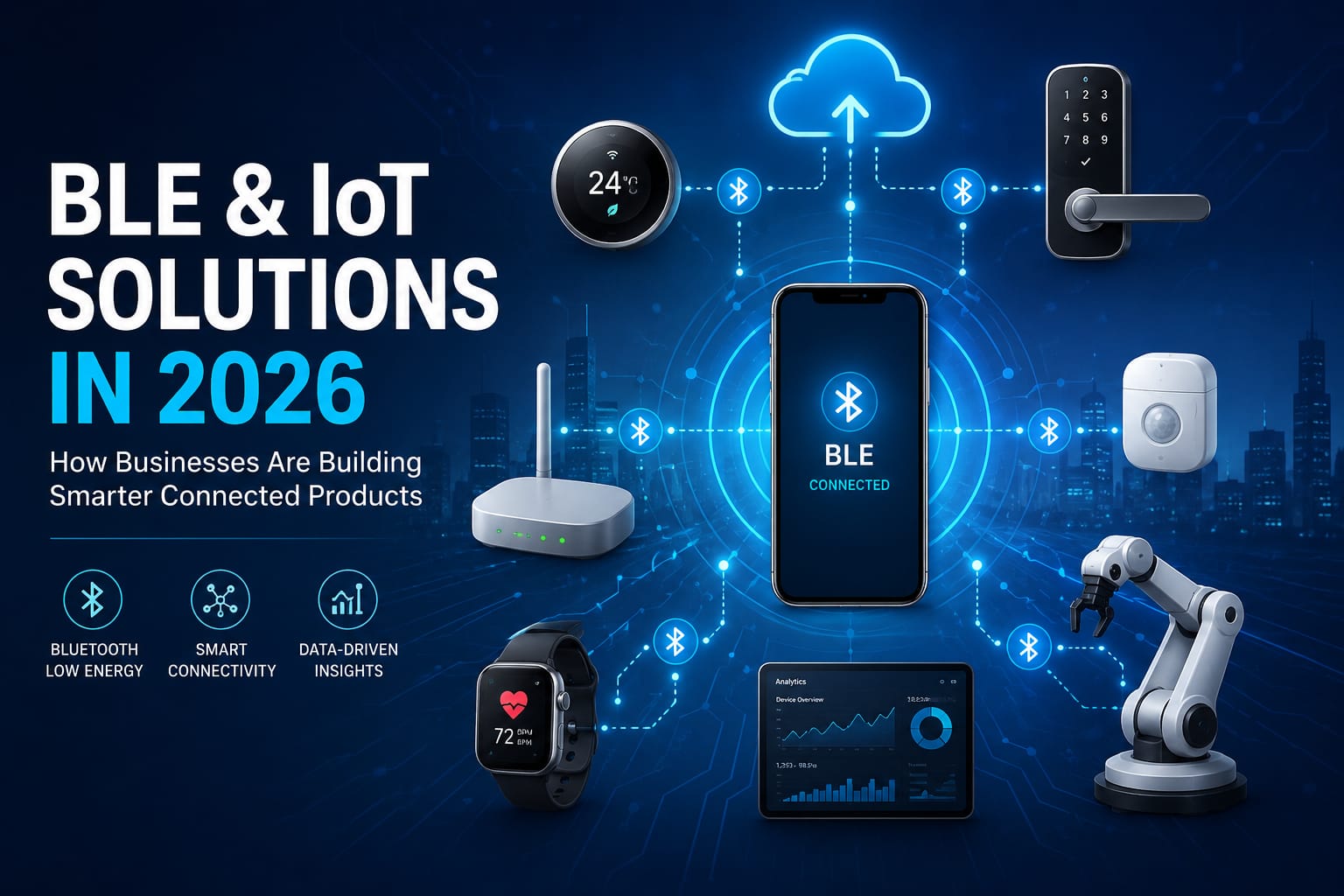
BLE IoT combines Bluetooth Low Energy connectivity with IoT platforms, mobile applications, sensors, cloud services, and data analytics.
A typical BLE IoT ecosystem includes:
- BLE-enabled sensors or devices
- Mobile or gateway applications
- Cloud-based IoT platforms
- APIs and backend systems
- Data analytics and monitoring dashboards
BLE devices collect information from the surrounding environment and transmit it to a smartphone, gateway, or other connected device. The data can then be processed and used for monitoring, automation, alerts, and business intelligence.
Why BLE Is Important for IoT in 2026
One of the biggest advantages of BLE is its low power consumption. Many IoT products operate on batteries, making energy efficiency essential.
BLE can help businesses achieve:
Low Power Consumption
BLE is designed for applications where devices need to communicate periodically without continuously consuming large amounts of energy.
Cost-Effective Connectivity
BLE hardware is widely available, making it a practical connectivity option for many consumer and commercial IoT products.
Smartphone Compatibility
Modern smartphones support BLE, allowing businesses to build mobile applications that communicate directly with connected devices without requiring specialized hardware in many use cases.
Flexible Device Communication
BLE can support communication between sensors, mobile applications, gateways, and other connected systems.
Key BLE IoT Applications
1. Healthcare and Medical Devices
BLE can connect wearable devices and healthcare sensors with mobile applications and monitoring systems.
Potential applications include:
- Patient monitoring
- Fitness and wellness tracking
- Medical equipment monitoring
- Temperature monitoring
- Wearable health devices
2. Asset Tracking
Businesses can use BLE beacons and tags to monitor equipment, inventory, tools, and other valuable assets.
Real-time or periodic location information can improve operational visibility and reduce asset loss.
3. Smart Buildings
BLE IoT can contribute to smarter offices, hotels, hospitals, and commercial buildings.
Applications include:
- Smart access control
- Indoor positioning
- Occupancy monitoring
- Smart lighting
- Environmental monitoring
4. Retail
Retailers can use BLE technology for proximity-based experiences, indoor navigation, product information, and customer engagement.
BLE-enabled systems can also connect sensors and devices to retail management platforms.
5. Industrial IoT
Industrial environments can use BLE sensors to collect information from machines, equipment, and facilities.
This data can support:
- Predictive maintenance
- Equipment monitoring
- Temperature and humidity tracking
- Operational analytics
- Worker and asset tracking
BLE IoT and Mobile Applications
Mobile applications play an important role in many BLE IoT ecosystems.
A BLE-enabled application can scan for nearby devices, establish connections, exchange data, configure devices, and send information to cloud platforms.
Businesses may develop native iOS and Android applications or use cross-platform technologies depending on their product requirements.
A well-designed BLE application should consider connection reliability, background communication, permissions, device discovery, security, data synchronization, and battery efficiency.
The Role of Cloud and APIs
BLE connectivity is only one part of a complete IoT solution.
For large-scale deployments, collected device data often needs to reach a cloud platform. APIs can connect mobile applications, BLE devices, IoT platforms, dashboards, and enterprise software.
A typical architecture may look like:
BLE Sensor → Mobile/Gateway → API → Cloud Platform → Dashboard
This architecture allows businesses to transform raw sensor data into useful operational insights.
BLE IoT Security Considerations
Security should be considered from the beginning of BLE IoT development.
Important areas include:
- Secure device pairing
- Authentication
- Encrypted communication
- Secure API integration
- Access control
- Secure firmware updates
- Protection of sensitive device data
Security requirements can vary significantly depending on whether the product is used in healthcare, industrial, retail, consumer, or other environments.
Challenges in BLE IoT Development
Although BLE provides significant advantages, developing a production-ready BLE IoT solution requires careful engineering.
Common challenges include:
- Device compatibility
- Connection stability
- Background communication
- Battery optimization
- Firmware integration
- Mobile OS restrictions
- Large-scale device management
- Data security
- Cloud integration
Testing across different smartphones, operating systems, BLE chipsets, and real-world environments is particularly important before deployment.
How Businesses Can Benefit from BLE IoT
A properly designed BLE IoT ecosystem can help businesses improve operational efficiency and create new connected-product experiences.
Potential benefits include:
- Reduced manual monitoring
- Better asset visibility
- Automated data collection
- Improved customer experiences
- Lower device power consumption
- Remote monitoring
- Faster access to operational data
- Scalable connected-product infrastructure
Why Choose QuartusTech for BLE & IoT Development?
Building a BLE IoT product requires expertise across hardware connectivity, mobile applications, backend systems, APIs, cloud infrastructure, and security.
QuartusTech helps businesses develop customized BLE and IoT solutions based on their specific product and business requirements.
Its development capabilities can support projects involving BLE integration, mobile applications, IoT systems, cloud connectivity, APIs, and connected-device solutions.
Whether a company is developing a smart consumer product, industrial monitoring system, healthcare device, or asset-tracking platform, a customized BLE IoT architecture can provide the foundation for a scalable connected ecosystem.
Conclusion
BLE IoT is becoming an increasingly important technology for businesses developing connected products in 2026. Its combination of low-power communication, smartphone compatibility, flexible device connectivity, and integration capabilities makes it suitable for a wide range of applications.
The key to successful BLE IoT development is not simply connecting a device through Bluetooth. Businesses need to consider the complete ecosystem—from device firmware and mobile applications to APIs, cloud infrastructure, security, analytics, and scalability.
With the right development strategy and technology partner, BLE and IoT can help businesses transform traditional products into intelligent, connected solutions.