
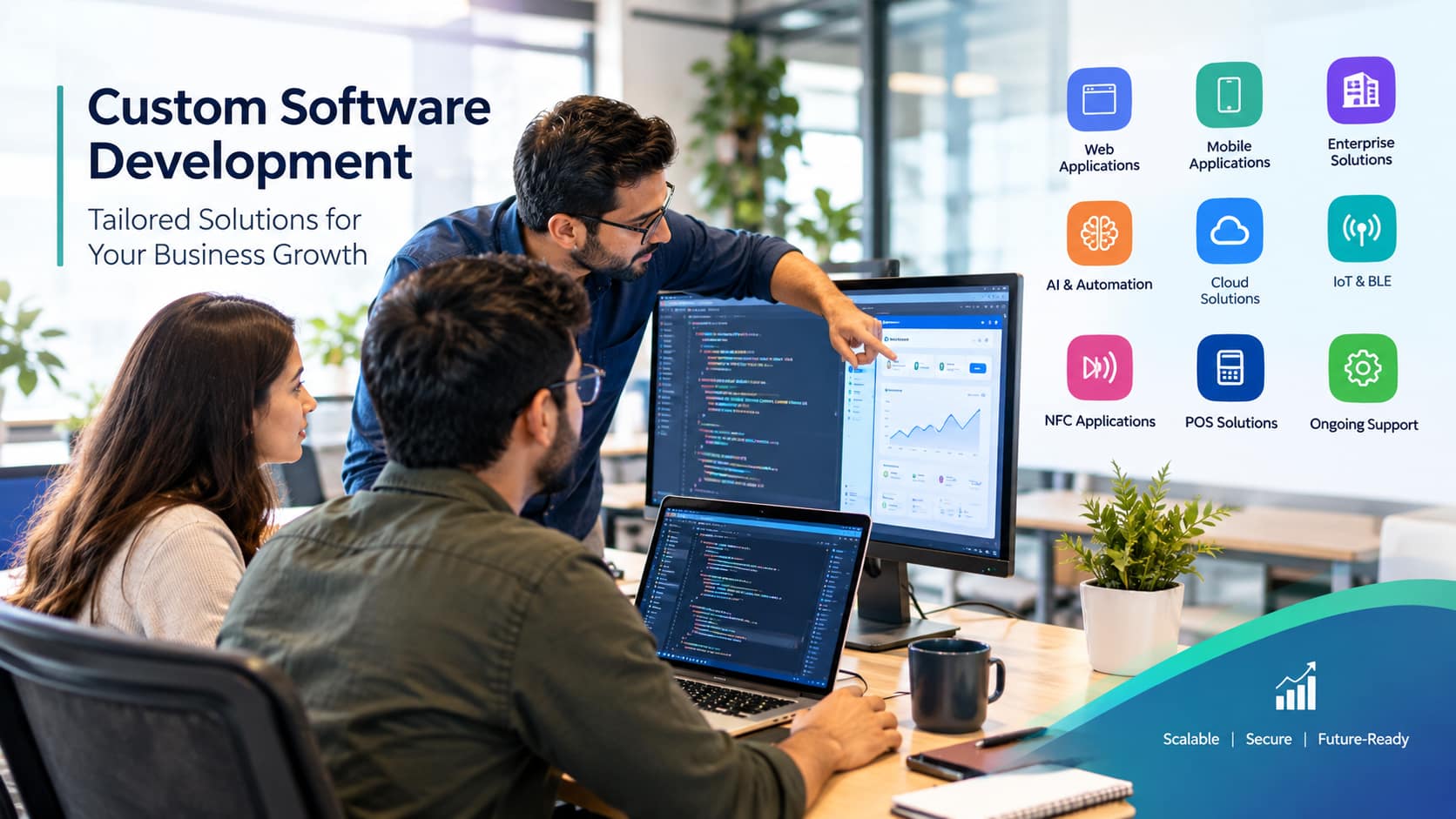
Businesses today rely on software for almost every part of their operations. From customer management and sales to inventory, payments, employee workflows, analytics, and automation, digital systems have become essential to modern business.
However, many companies eventually discover that standard software cannot completely match the way their business operates.
Different workflows, unique customer requirements, industry regulations, legacy systems, and integration needs can make off-the-shelf platforms difficult to scale.
This is where custom software development becomes valuable.
A professional custom software development company can design and build software around a company’s specific processes, goals, users, and technology environment.
What Is Custom Software Development?
Custom software development is the process of designing, developing, testing, deploying, and maintaining software specifically for a particular business or organization.
Instead of changing business processes to fit an existing application, custom software allows the technology to be designed around the business.
A custom solution may include:
- Web applications
- Mobile applications
- Enterprise software
- Customer portals
- Business management platforms
- Cloud-based applications
- AI-powered applications
- POS and payment solutions
- IoT platforms
- BLE-enabled applications
- NFC applications
- Business automation systems
- Data and analytics platforms
The objective is not simply to create software. The objective is to solve a specific business problem with technology that can evolve as the organization grows.
Why Are Businesses Moving Toward Custom Software?
Many businesses begin with standard SaaS platforms because they are quick to deploy and easy to start with.
But as the company grows, limitations can appear.
For example, a business may need:
- A workflow that is not supported by existing software
- Integration with multiple internal systems
- Custom reporting and analytics
- Industry-specific functionality
- Advanced automation
- AI capabilities
- Specialized security requirements
- Mobile access for employees or customers
- Integration with hardware or connected devices
Instead of continuously adding different tools, companies can develop an integrated software platform designed around their actual requirements.
Key Benefits of Custom Software Development
1. Software Designed Around Your Business
Every organization operates differently.
A custom application can be designed according to your existing workflows rather than forcing employees to change their processes to match generic software.
This can make the system more relevant to the users who depend on it every day.
2. Better Integration
Modern businesses often use multiple systems for CRM, accounting, payments, inventory, marketing, customer support, and analytics.
Custom software can connect these systems through APIs and other integration technologies.
This can reduce manual data entry and create a more connected technology environment.
3. Improved Scalability
A software platform should be capable of supporting future growth.
Custom development allows the architecture to be planned around expected users, transactions, integrations, data volumes, and future functionality.
Businesses can therefore add new features and integrations as requirements evolve.
4. Greater Automation
Repetitive business processes can consume significant employee time.
Custom software can automate workflows such as:
- Data processing
- Customer notifications
- Report generation
- Order management
- Approval workflows
- Inventory updates
- Lead management
- Scheduling
- Business alerts
AI can also be incorporated into selected workflows where intelligent automation or data analysis provides practical value.
5. Better User Experience
Generic software often provides a fixed interface for a broad market.
Custom software can instead be designed around specific user roles.
For example, an enterprise platform could provide separate experiences for:
- Administrators
- Managers
- Employees
- Customers
- Partners
- Field workers
A focused user experience can make complex business systems easier to use.
Custom Software vs. Off-the-Shelf Software
The choice between custom and ready-made software depends on the company’s requirements.
| Factor | Off-the-Shelf Software | Custom Software |
|---|---|---|
| Initial deployment | Usually faster | Requires development |
| Customization | Often limited | Designed around requirements |
| Integrations | Depends on available APIs | Can be planned specifically |
| User experience | Standardized | Business-specific |
| Scalability | Depends on provider | Architecture can be customized |
| Ownership | Usually subscription-based | Custom development ownership varies |
| Industry-specific workflows | May require compromises | Can be built specifically |
| Long-term flexibility | Depends on vendor | Greater development flexibility |
There is no single solution for every business.
A company should evaluate its requirements, budget, timeline, technical environment, and long-term growth plans before selecting an approach.
How Custom Software Development Works
A successful software project requires more than programming.
Step 1: Business and Requirement Analysis
The development team first needs to understand the business problem.
This includes identifying:
- Business objectives
- Target users
- Existing systems
- Required features
- Workflow requirements
- Integration requirements
- Security considerations
- Scalability expectations
Step 2: Product Strategy and Architecture
Once requirements are understood, the team can define the product architecture.
This stage may include decisions about:
- Cloud infrastructure
- Database architecture
- APIs
- Frontend technology
- Backend technology
- Mobile platforms
- Security architecture
- Third-party integrations
The architecture should support both current requirements and future expansion.
Step 3: UX/UI Design
The user experience is an important part of software development.
Designers create interfaces based on the needs of actual users rather than simply adding features to screens.
Wireframes and prototypes can help stakeholders understand the product before full development begins.
Step 4: Software Development
Developers then build the application using technologies appropriate to the project.
Depending on the requirements, a solution may use technologies such as:
- React
- Flutter
- Node.js
- Python
- Cloud platforms
- APIs
- AI and machine learning frameworks
- Database technologies
The technology stack should be selected according to the project’s functional, performance, security, and scalability requirements.
Step 5: Testing and Security
Before launch, software should be thoroughly tested.
Testing may cover:
- Functional testing
- Performance testing
- Security testing
- API testing
- Mobile testing
- Browser compatibility
- Integration testing
- User acceptance testing
Security should also be considered throughout development rather than treated as a final step.
Step 6: Deployment
After testing and approval, the software can be deployed to its production environment.
Cloud infrastructure can support scalable applications while monitoring tools can help teams identify performance or operational issues.
Step 7: Maintenance and Continuous Improvement
Software development does not necessarily end at launch.
Businesses may need ongoing:
- Bug fixes
- Security updates
- Performance improvements
- New features
- API updates
- Infrastructure optimization
- AI enhancements
Continuous improvement allows the product to adapt as business requirements change.
Where AI Fits Into Custom Software
Artificial Intelligence is becoming an important component of modern software platforms.
Instead of creating AI applications simply because AI is popular, businesses can identify specific processes where intelligent technology can provide practical value.
Examples include:
AI-Powered Customer Support
AI assistants can help answer common customer questions and route complex requests to human teams.
Predictive Analytics
AI and machine learning can analyze historical data to identify patterns and support forecasting.
Intelligent Document Processing
Businesses can use AI to extract information from documents and reduce manual data entry.
Recommendation Systems
AI can analyze user behavior and provide personalized recommendations.
Workflow Automation
AI-powered systems can assist with repetitive operational tasks and decision-support workflows.
The right implementation depends on the business problem, available data, security requirements, and expected return on investment.
Custom Software for Different Industries
Custom software development can be applied across many industries.
Healthcare
Healthcare organizations may require patient portals, scheduling platforms, healthcare applications, data systems, and secure integrations.
Retail and E-Commerce
Retail companies can use custom platforms for inventory, customer engagement, order management, analytics, and omnichannel operations.
Restaurants and Hospitality
Restaurants can develop custom POS systems, ordering applications, kitchen management platforms, loyalty applications, and multi-location management systems.
Financial Services
Financial applications may require payment integrations, secure customer portals, analytics, automation, and compliance-focused architecture.
IoT and Connected Products
Businesses developing connected devices may require mobile applications, BLE communication, IoT platforms, dashboards, cloud systems, and real-time data processing.
Why Scalability Should Be Considered From Day One
One of the biggest mistakes in software development is designing only for today’s requirements.
A company may start with 100 users but eventually need to support thousands or millions of users.
Similarly, an application may initially process a small amount of data but eventually become a critical business platform.
Scalable architecture considers:
- Growing user numbers
- Increasing data volumes
- Additional integrations
- New geographic markets
- New devices
- New business workflows
- Higher transaction volumes
Planning for these requirements early can reduce expensive architectural changes later.
How to Choose a Custom Software Development Company
Before selecting a development partner, businesses should evaluate several factors.
Technical Experience
Review whether the company has experience with the technologies required for the project.
Relevant Project Experience
Industry or project-specific experience can help developers understand common challenges and integration requirements.
Development Process
Ask how the company handles requirements, design, development, testing, deployment, and support.
Security Approach
Understand how the development team handles authentication, authorization, data protection, secure APIs, and infrastructure security.
Communication
Clear communication is essential for complex software projects.
The development partner should provide a structured process for updates, feedback, testing, and approvals.
Long-Term Support
Software often requires updates after launch. Businesses should understand what maintenance and support options are available.
Why QuartusTech for Custom Software Development?
QuartusTech works with businesses to develop digital products across AI, mobile and web applications, BLE, NFC, IoT, POS, and enterprise software.
Its current website positioning emphasizes an AI + human-centric approach, custom technology solutions, and support for businesses developing high-performance digital products.
QuartusTech’s technology capabilities can be applied to projects that require:
- Custom software development
- AI application development
- Mobile app development
- Web application development
- Enterprise applications
- BLE integration
- NFC applications
- IoT solutions
- Custom POS development
- Cloud-based applications
The focus is on understanding the business requirement first and then selecting the appropriate technology and architecture.
Final Thoughts
Custom software development can help businesses move beyond the limitations of generic applications.
The goal is not simply to build another software product.
A successful custom solution should solve a real business problem, integrate with the existing technology environment, provide a useful experience for its users, and have the architecture needed to support future growth.
For companies planning a new digital product in 2026, the right combination of business strategy, software architecture, AI, cloud technology, integrations, security, and user experience can create a strong foundation for long-term digital growth.
If your business has a software idea, an inefficient workflow, or a technology system that no longer scales with your requirements, working with an experienced custom software development company can help turn that challenge into a practical digital solution.
Build Your Custom Software Solution With QuartusTech
From initial strategy and UX/UI design to development, integration, deployment, and ongoing support, QuartusTech helps businesses transform technology ideas into scalable digital products.
Explore QuartusTech’s software and technology solutions to discuss your next project.