
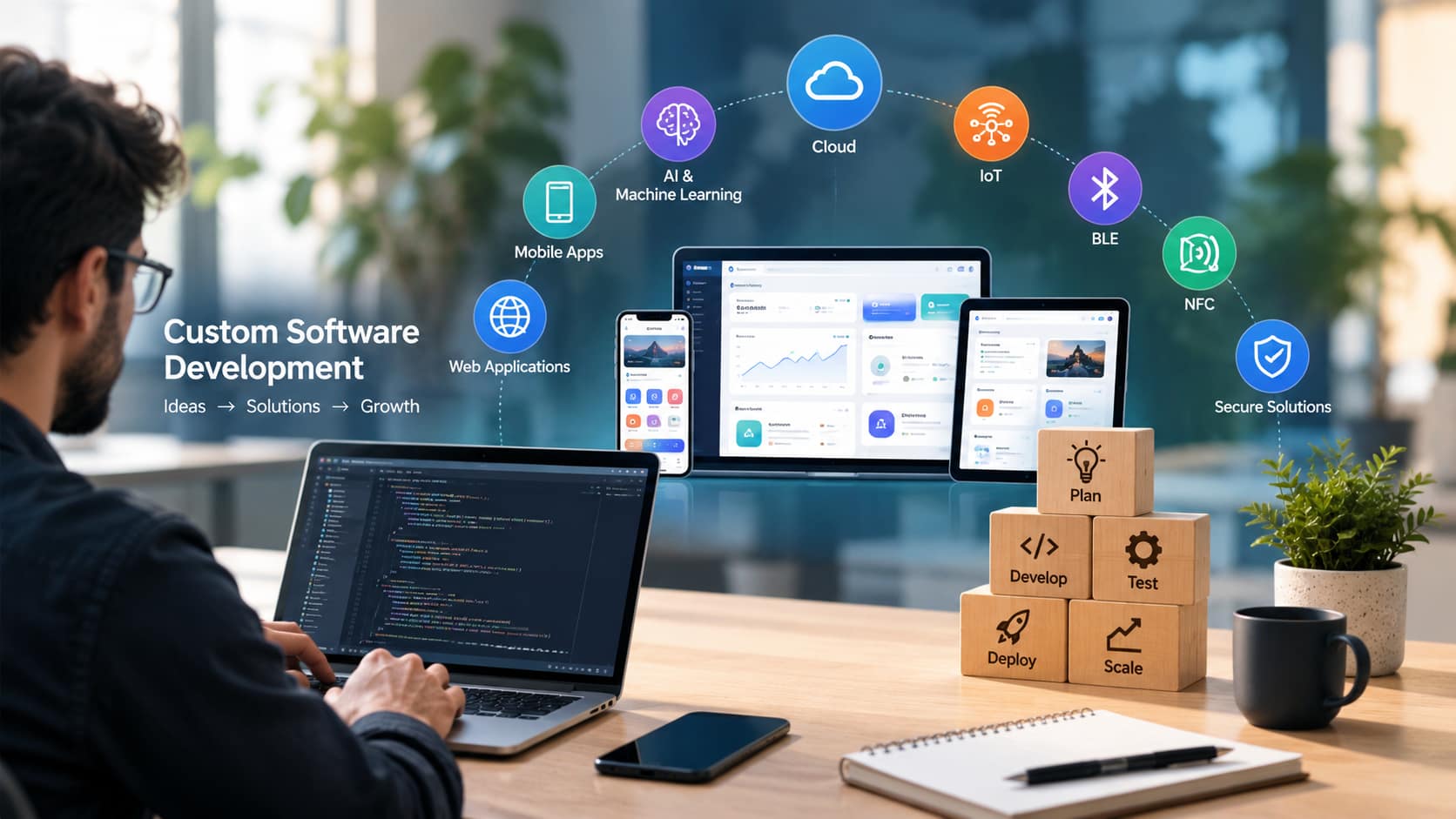
Businesses in 2026 are no longer looking for software that simply “works.” They need digital products that are scalable, secure, AI-ready, connected, and easy to use.
From mobile applications and web platforms to AI solutions, IoT products, BLE applications, NFC systems, and enterprise software, modern technology is becoming a core part of how businesses operate and compete.
This is where custom software development can make a difference.
Instead of forcing a business to adapt to an off-the-shelf platform, custom software is designed around specific workflows, customers, integrations, and long-term business goals.
What Is Custom Software Development?
Custom software development is the process of designing and building software specifically for a company’s requirements.
A custom solution can include:
- Web applications
- Mobile applications
- Enterprise software
- AI-powered applications
- IoT platforms
- BLE applications
- NFC applications
- Payment and POS systems
- Cloud-based platforms
- API integrations
- Data and analytics solutions
The goal is not simply to create another application. It is to build technology that solves a real business problem and can evolve as the business grows.
Why Businesses Are Investing in Custom Software
1. Software Built Around Business Processes
Every business has different workflows.
A generic platform may require employees to change the way they work. Custom software takes the opposite approach by allowing technology to support existing processes.
For example, a business may require:
- Custom dashboards
- Automated workflows
- Role-based access
- Third-party integrations
- Real-time reporting
- Customer portals
- Automated notifications
These capabilities can be developed according to specific business requirements.
2. AI Is Becoming Part of Everyday Software
Artificial intelligence is moving beyond experimental projects.
Businesses are integrating AI into applications for:
- Intelligent search
- Recommendation systems
- Document processing
- Predictive analytics
- Customer support
- Content generation
- Workflow automation
- Data analysis
AI-powered software can help organizations reduce repetitive work while providing users with faster and more personalized experiences.
The key is to integrate AI where it provides practical value rather than adding AI simply because it is trending.
3. Mobile and Web Applications Work Together
Customers expect businesses to be accessible across devices.
A modern digital product may combine:
Mobile App + Web Application + Cloud Backend + APIs + Analytics
This connected architecture allows customers, employees, and administrators to access the same business ecosystem from different devices.
Businesses can use custom mobile app development and web application development to create experiences tailored to their users.
4. IoT and Connected Devices Are Expanding
The Internet of Things is creating new opportunities for businesses that rely on connected hardware.
IoT solutions can connect:
Devices → Sensors → Applications → Cloud → Analytics
BLE technology can also enable communication between smartphones, wearables, sensors, and other connected devices.
Applications include:
- Asset tracking
- Healthcare devices
- Smart buildings
- Industrial monitoring
- Retail technology
- Fitness devices
- Location-based services
- Connected consumer products
For businesses developing connected products, software development needs to consider both the application and the device ecosystem.
5. Security Needs to Be Designed Into the Product
Security cannot be treated as an afterthought.
Modern software may handle customer information, payment data, business records, authentication credentials, and other sensitive information.
A secure development strategy can include:
- Secure authentication
- Encryption
- Access controls
- API security
- Secure data storage
- Vulnerability testing
- Monitoring
- Regular updates
For applications involving payments or regulated information, compliance requirements should also be considered during the development process.
What Does a Modern Software Development Process Look Like?
A successful software project generally starts with understanding the business problem.
Step 1: Requirement Discovery
The development team identifies:
- Business objectives
- Target users
- Functional requirements
- Technical requirements
- Integrations
- Security requirements
- Future scalability needs
Step 2: UX/UI Design
The user experience is planned before development begins.
Wireframes and prototypes help teams understand how users will interact with the product.
Step 3: Technology Architecture
The team selects appropriate technologies for:
- Frontend
- Backend
- Database
- Cloud infrastructure
- APIs
- Security
- Third-party integrations
Step 4: Development
Developers build the product using an iterative approach.
Features can be developed, tested, reviewed, and improved throughout the development cycle.
Step 5: Testing
Testing may include:
- Functional testing
- Performance testing
- Security testing
- Compatibility testing
- API testing
- User acceptance testing
Step 6: Deployment and Optimization
After launch, software requires ongoing monitoring and improvements.
Analytics and user feedback can help identify opportunities for optimization and new features.
Technologies Businesses Should Consider in 2026
The right technology depends on the project, but modern software solutions commonly involve:
- AI and machine learning
- Cloud computing
- APIs and microservices
- Mobile technologies
- IoT
- BLE
- NFC
- Data analytics
- Automation
- Cybersecurity
- Modern web frameworks
Technology selection should always be driven by the product requirements rather than trends alone.
Why Choose QuartusTech for Custom Software Development?
QuartusTech helps businesses transform technology ideas into practical digital solutions.
Its development capabilities can support projects involving mobile applications, web development, AI applications, BLE integration, NFC applications, IoT solutions, POS systems, and enterprise software.
For businesses planning a new digital product, working with an experienced development team can help connect business requirements with technology, design, development, testing, and long-term scalability.
Frequently Asked Questions
What is custom software development?
Custom software development involves creating software specifically around a business’s requirements, workflows, users, and technical environment.
Is custom software better than off-the-shelf software?
The two approaches serve different needs. Off-the-shelf software can be useful for standardized requirements, while custom development allows businesses to build functionality around specific workflows and requirements.
Can AI be integrated into existing software?
Yes. AI capabilities can be integrated into existing applications through APIs, machine-learning models, AI platforms, and custom development, depending on the use case.
Can custom software scale as a business grows?
Yes. Scalability can be considered during architecture and development so the application can support increasing users, transactions, integrations, and data.
How long does custom software development take?
The timeline depends on the project’s scope, features, integrations, design requirements, technology stack, and testing requirements. A small application may take considerably less time than a complex enterprise platform.
Final Thoughts
Software development in 2026 is increasingly about building connected, intelligent, secure, and scalable digital experiences.
Whether a business needs a mobile application, AI-powered platform, IoT solution, BLE application, NFC system, web application, or enterprise software, the development strategy should start with the business problem.
The right technology is the technology that helps solve that problem today while providing room for tomorrow’s requirements.
For businesses exploring their next digital product, custom software development can provide the flexibility needed to turn an idea into a scalable technology solution.