
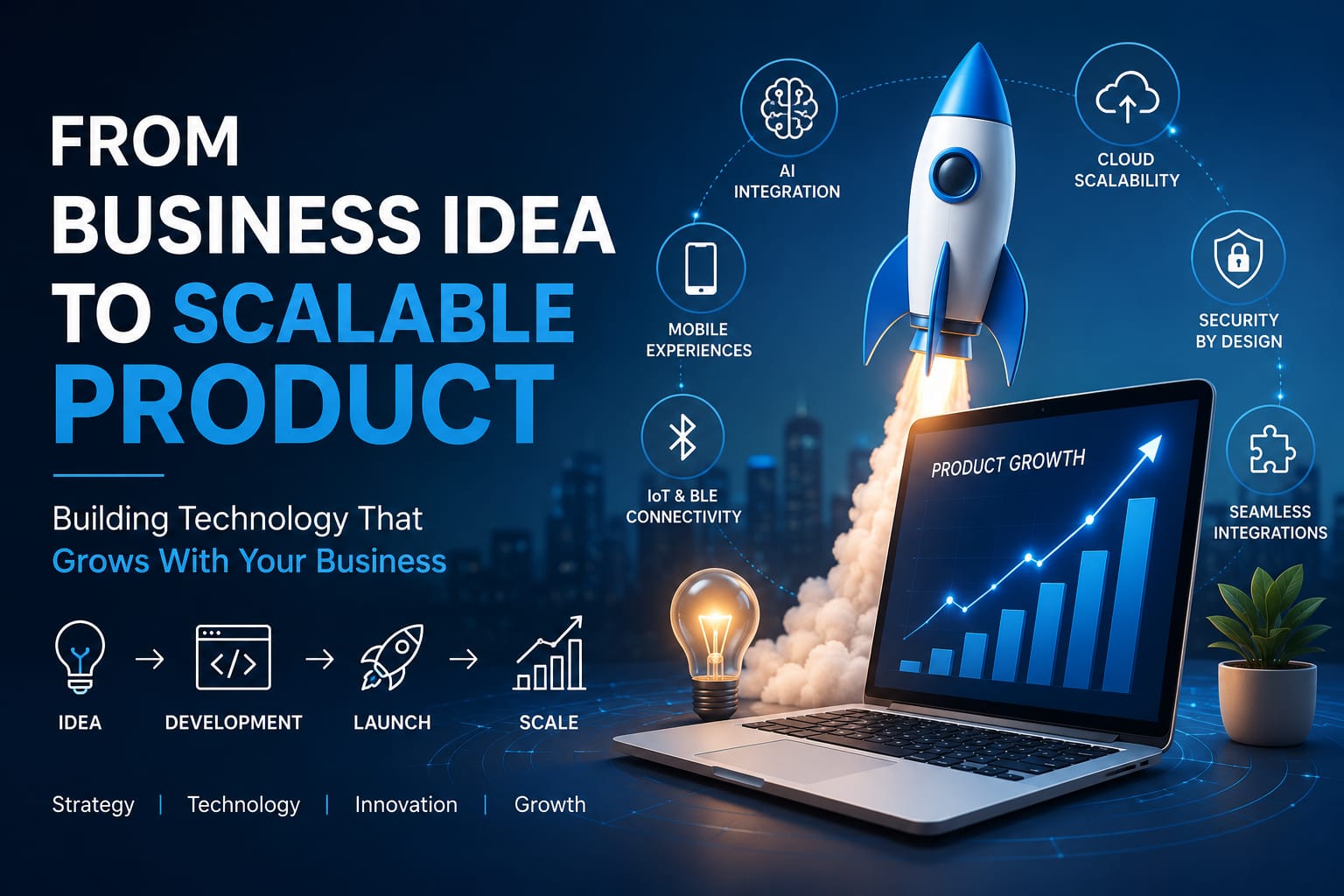
Introduction
Every successful digital product starts with an idea.
It might be a mobile application designed to solve a customer problem, an enterprise platform created to automate operations, a smart device connected through BLE, or an AI-powered system designed to make business decisions faster.
But turning an idea into a successful technology product requires much more than writing code.
A scalable product needs the right combination of business strategy, UX design, software architecture, security, cloud infrastructure, integrations, testing, and continuous improvement.
This is where professional custom software development becomes important.
Instead of simply building an application, businesses need to create technology that can evolve as their customers, data, and operations grow.
1. Start With the Business Problem, Not the Technology
One of the biggest mistakes businesses make is starting with technology before defining the problem.
For example:
“We need an AI application.”
That sounds exciting, but the more important question is:
What business problem should AI solve?
The same principle applies to mobile apps, IoT platforms, POS systems, and enterprise software.
Before development begins, businesses should identify:
- What problem are we solving?
- Who will use the product?
- What process needs improvement?
- What outcome should the product deliver?
- How will success be measured?
- What features are essential for the first version?
A clear business objective creates a much stronger foundation for development.
2. Build an MVP Without Limiting the Future
A Minimum Viable Product (MVP) allows businesses to launch a focused version of their product and learn from real users.
However, an MVP should not mean building something that cannot scale.
A good MVP should have:
- A clear core functionality
- Simple and intuitive UX
- Secure authentication
- Scalable backend architecture
- Analytics and monitoring
- API-ready infrastructure
- A roadmap for future functionality
For example, a business may initially launch a mobile application with account management, payments, and notifications.
Later, the same platform could introduce:
- AI personalization
- Advanced analytics
- IoT integration
- BLE connectivity
- Subscription management
- Enterprise dashboards
- Automation
The architecture should be prepared for that evolution.
3. Choose the Right Technology Architecture
Technology decisions made at the beginning can significantly affect future development costs.
A scalable product should consider:
Frontend
Depending on the product, businesses may choose:
- Native iOS development
- Native Android development
- React Native
- Flutter
- React
- Angular
- Next.js
Backend
The backend should be designed around performance, security, integrations, and future growth.
It may include:
- REST APIs
- GraphQL
- Microservices
- Cloud infrastructure
- Databases
- Authentication systems
- Third-party integrations
The objective is not to use the most fashionable technology.
The objective is to choose technology that fits the business requirements and long-term product roadmap.
4. Make AI Useful Instead of Adding AI for Marketing
Artificial Intelligence is becoming an important component of modern digital products.
But AI should solve a real problem.
Businesses can use AI for:
- Intelligent customer support
- Predictive analytics
- Recommendation systems
- Document processing
- Workflow automation
- Personalization
- Data analysis
- Voice interfaces
- Computer vision
- AI agents
For example, an enterprise application could allow employees to ask questions about business data instead of manually searching through multiple dashboards.
An e-commerce platform could use AI to personalize product recommendations.
A connected device could combine sensor information with AI analytics to identify unusual patterns.
The best AI implementations are not necessarily the ones with the most features.
They are the ones that create measurable business value.
5. Connect Mobile Apps With the Physical World
Modern software is no longer limited to screens.
Businesses are increasingly building products that connect applications with physical devices.
This is where technologies such as BLE, NFC, and IoT become important.
A mobile application can communicate with:
- Wearable devices
- Smart locks
- Sensors
- POS hardware
- Industrial equipment
- Healthcare devices
- Retail beacons
- IoT devices
BLE, for example, can provide energy-efficient communication between mobile applications and compatible hardware.
When combined with cloud platforms and AI analytics, connected devices can become part of a much larger digital ecosystem.
6. Security Should Be Designed From Day One
Security should never be treated as a final development task.
A scalable digital product should consider security throughout its lifecycle.
Important areas include:
- Secure authentication
- Authorization
- Data encryption
- API security
- Secure payment processing
- Access controls
- Data privacy
- Vulnerability testing
- Secure cloud configuration
- Monitoring and logging
For applications handling payments or sensitive business information, security and compliance become even more important.
Building security into the architecture from the beginning is usually far more effective than attempting to fix major security issues after launch.
7. Design for Cloud Scalability
A product may start with a few hundred users and eventually serve thousands or millions.
Cloud infrastructure can help businesses scale resources according to demand.
A scalable cloud architecture can support:
- Increasing traffic
- Large datasets
- Multiple application environments
- Automated deployments
- Backup and recovery
- Monitoring
- High availability
The goal is to make growth technically manageable.
A product should not require a complete rebuild every time the customer base increases.
8. Integrations Can Turn a Good Product Into a Powerful Platform
Modern businesses rarely operate with one system.
They may use:
- CRM platforms
- Payment gateways
- ERP systems
- Accounting software
- Marketing platforms
- Cloud services
- POS systems
- IoT platforms
- Business intelligence tools
APIs and integrations allow these systems to communicate.
For example:
Mobile App → API → CRM → Payment Gateway → Analytics → AI
Instead of creating another isolated application, businesses can create a connected technology environment.
9. Test More Than Whether the App Works
An application can technically work and still provide a poor customer experience.
Comprehensive testing should cover:
Functional Testing
Does every feature perform as expected?
Performance Testing
Can the system handle increasing traffic?
Security Testing
Can unauthorized users access protected information?
Device Testing
Does the mobile application work across different devices and operating systems?
Integration Testing
Do APIs and third-party systems communicate correctly?
User Experience Testing
Can customers complete important tasks easily?
Real-World Testing
Does the product behave correctly under actual usage conditions?
This becomes especially important for applications involving BLE devices, IoT hardware, payments, and real-time communication.
10. Launch Is the Beginning, Not the End
One of the biggest misconceptions about software development is that the project ends when the application goes live.
In reality:
Launch → Measure → Learn → Improve → Scale
After launch, businesses should monitor:
- User behavior
- Conversion rates
- Performance
- Errors
- Customer feedback
- Feature adoption
- Infrastructure costs
- Security events
This information helps development teams identify what needs to be improved.
Continuous improvement can transform a basic product into a competitive digital platform.
Why Businesses Choose Custom Software Development
Off-the-shelf software can be useful for common business requirements.
But businesses with unique workflows often need more flexibility.
Custom software can be designed around:
- Specific business processes
- Unique customer experiences
- Existing systems
- Industry requirements
- Security needs
- Future expansion
- AI capabilities
- Hardware integrations
This makes custom development particularly valuable when a business wants technology to become a long-term competitive advantage.
How QuartusTech Helps Businesses Build Scalable Digital Products
QuartusTech works across multiple technology areas, including AI application development, mobile and web development, BLE integration, NFC applications, IoT solutions, POS development, enterprise software, and digital transformation.
Our approach focuses on connecting business objectives with practical technology.
From the initial concept to product architecture, development, integration, testing, deployment, and ongoing improvement, the goal is to create technology that can grow with the business.
Whether you are building an AI-powered application, connected product, enterprise platform, mobile application, or intelligent business system, the technology should be designed for where your business is going—not only where it is today.
Conclusion
Building a successful digital product is not simply about having a great idea or choosing the latest technology.
It is about creating the right combination of strategy, software architecture, user experience, AI, security, cloud infrastructure, integrations, and continuous innovation.
The businesses that succeed with technology are not necessarily those that build the most complicated systems.
They are the ones that build useful, scalable, secure, and adaptable products.
Your idea may start as a simple application.
With the right technology strategy, it can become an entire digital ecosystem.
Have an idea for your next digital product? QuartusTech can help turn that idea into a scalable technology solution.