
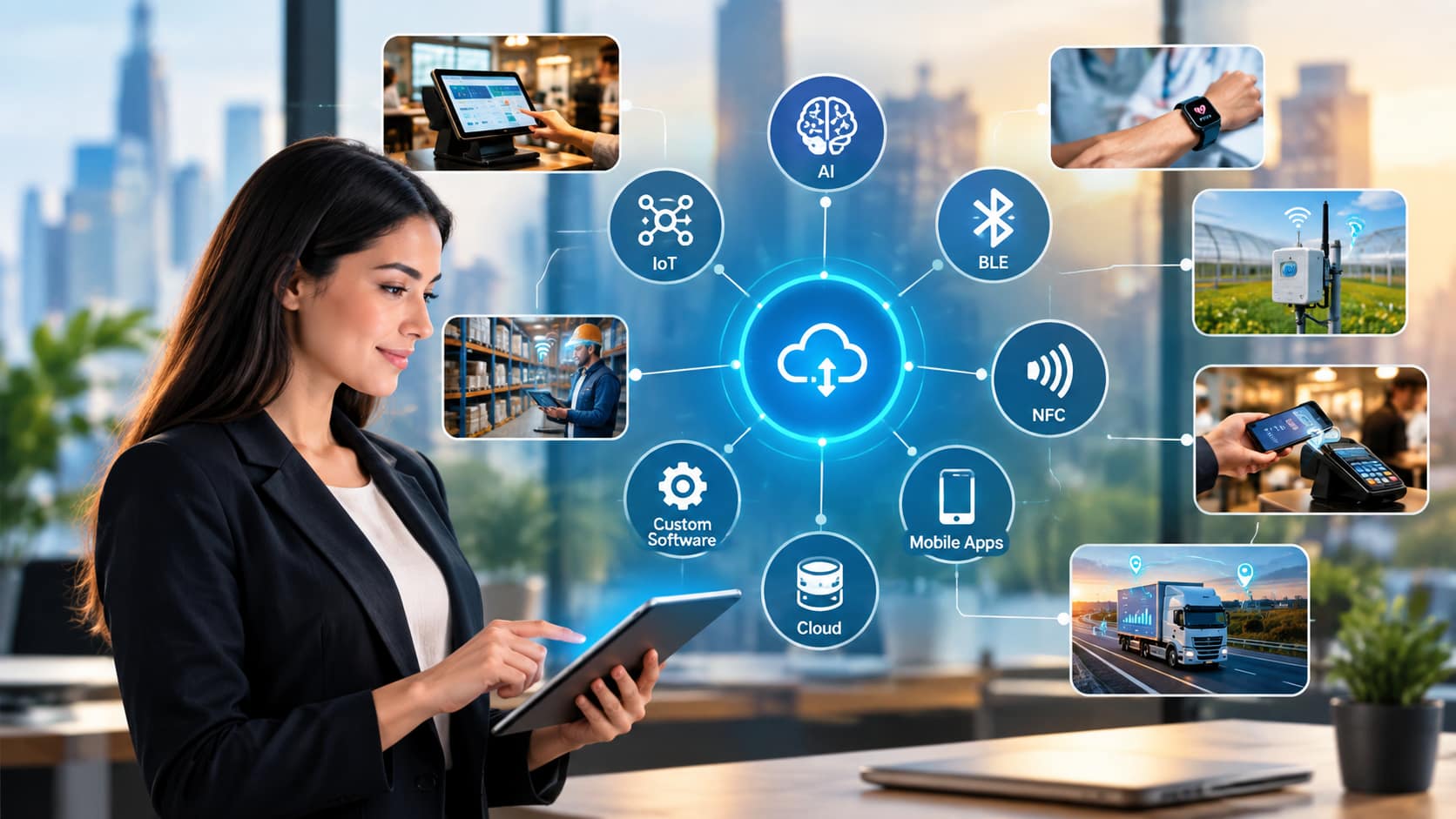
Businesses are no longer using technology as a collection of separate tools. In 2026, companies are increasingly connecting AI, IoT, BLE, mobile applications, cloud platforms, and custom software to create intelligent digital ecosystems.
Instead of having one system for customers, another for operations, and separate platforms for connected devices and analytics, businesses are looking for technology that can communicate, automate workflows, and provide useful insights from one connected environment.
This shift is creating new opportunities for businesses across healthcare, retail, hospitality, manufacturing, logistics, enterprise services, and other industries.
What Is a Connected Digital Ecosystem?
A connected digital ecosystem brings different technologies together so they can share data and support business processes.
For example, a modern business ecosystem could combine:
- AI-powered applications
- Mobile and web applications
- IoT-connected devices
- Bluetooth Low Energy (BLE)
- NFC technology
- Cloud infrastructure
- Custom enterprise software
- Real-time analytics
- Smart POS systems
- Automated business workflows
The goal is not simply to add more technology. The goal is to make existing business processes more connected, intelligent, and scalable.
Why Businesses Are Moving Beyond Standalone Software
Traditional software often solves one specific problem.
A company might use:
- CRM software for customer management
- ERP software for operations
- Separate applications for employees
- IoT platforms for connected devices
- Analytics tools for reporting
- Payment systems for transactions
The challenge is that these systems may operate independently.
When systems are connected, businesses can create automated workflows.
For example, information collected from an IoT device could be transferred to a cloud platform, analyzed by an AI model, and displayed through a mobile application or business dashboard.
This creates a continuous flow of data → analysis → action.
How AI Is Changing Business Software
Artificial Intelligence is becoming an important component of modern software development.
Businesses are using AI for applications such as:
- Intelligent customer support
- Predictive analytics
- Recommendation engines
- Document processing
- Workflow automation
- Fraud detection
- Business forecasting
- Personalized user experiences
- AI assistants and agents
The next generation of applications will increasingly combine traditional software functionality with AI capabilities.
Instead of simply storing information, applications can help businesses understand that information and take action based on defined workflows.
The Growing Role of IoT
The Internet of Things connects physical devices to digital systems.
Sensors and connected devices can collect information such as:
- Temperature
- Location
- Movement
- Equipment status
- Energy consumption
- Device performance
- Environmental conditions
This information can then be transmitted to software platforms for monitoring, analysis, and automation.
For industries that depend on physical assets, IoT can become an important part of digital transformation.
Why BLE Is Important for Connected Products
Bluetooth Low Energy (BLE) enables devices to communicate while using relatively little power.
BLE can be used in applications involving:
- Asset tracking
- Smart devices
- Healthcare equipment
- Retail experiences
- Indoor positioning
- Wearables
- Industrial monitoring
- Proximity-based applications
When BLE is combined with mobile applications, cloud platforms, and analytics, businesses can create connected experiences that extend beyond traditional smartphone functionality.
NFC Is Making Digital Interactions Simpler
Near Field Communication (NFC) enables short-range wireless communication between compatible devices.
Businesses can use NFC technology for:
- Contactless interactions
- Product authentication
- Smart access systems
- Digital information sharing
- Payments
- Customer engagement
- Device configuration
NFC can be particularly useful when a business wants to create a simple physical-to-digital interaction.
A customer can tap a compatible device and immediately trigger a digital experience.
Custom Software Connects the Pieces
Technology ecosystems often require software that is designed around the company’s specific processes.
Off-the-shelf platforms can be useful, but businesses with unique workflows may need custom software development.
Custom software can connect:
- Mobile applications
- Web platforms
- AI services
- IoT devices
- BLE integrations
- NFC systems
- Payment platforms
- Enterprise databases
- Cloud infrastructure
This allows businesses to build technology around their actual processes instead of forcing their processes to fit a generic application.
Mobile Applications Are Becoming Business Interfaces
Mobile applications are no longer limited to consumer services.
Businesses are using mobile applications for:
- Employee management
- Customer engagement
- Connected-device control
- Field services
- Inventory management
- Healthcare workflows
- Retail operations
- Enterprise communication
A mobile application can act as the interface between users, business software, connected devices, and AI-powered services.
Smart POS Systems Are Becoming More Connected
Point-of-sale technology is also evolving.
Modern POS platforms can connect:
- Billing
- Inventory
- Customer information
- Online ordering
- Kitchen operations
- Payments
- Loyalty programs
- Analytics
- Multi-location management
With AI and cloud connectivity, businesses can go beyond basic transaction processing and use POS data for operational insights and automation.
This is particularly relevant to restaurants, hospitality businesses, retail companies, and multi-location organizations.
Security Must Be Part of the Architecture
As businesses connect more systems and devices, security becomes increasingly important.
A connected ecosystem may involve customer information, payment data, device information, business databases, and cloud services.
Businesses should therefore consider:
- Secure authentication
- Encryption
- API security
- Access controls
- Secure data storage
- Device security
- Regular software updates
- Monitoring and logging
- Compliance requirements
Security should be considered during architecture and development rather than added after deployment.
Building a Scalable Technology Ecosystem
A successful digital ecosystem needs to be designed for future growth.
Businesses should consider:
1. Business requirements
Start by identifying the actual business problem.
2. Technology architecture
Determine how applications, devices, APIs, databases, and cloud systems will communicate.
3. User experience
Make the technology easy for customers and employees to use.
4. Integration
Connect existing systems where practical instead of rebuilding everything.
5. Security
Protect applications, devices, APIs, and business data.
6. Scalability
Design the architecture so that new users, devices, locations, and features can be added without major redevelopment.
7. Analytics
Collect useful data and turn it into actionable business information.
Why Businesses Need a Technology Partner
Building a connected digital ecosystem can involve multiple technologies and development disciplines.
A business may need expertise in:
- AI application development
- Mobile app development
- Web development
- Custom software development
- IoT development
- BLE integration
- NFC application development
- Cloud solutions
- POS development
- UI/UX design
- API integration
Working with an experienced technology development partner can help businesses plan these components as part of a larger architecture.
The Future of Connected Business Technology
The future of business software is moving from isolated applications toward connected and intelligent technology ecosystems.
AI can analyze information.
IoT can collect information from physical environments.
BLE can connect devices.
NFC can simplify physical-to-digital interactions.
Mobile applications can provide user interfaces.
Cloud platforms can provide scalable infrastructure.
Custom software can connect these technologies into a unified business solution.
The result is a technology environment where different components work together instead of operating independently.
How QuartusTech Helps Businesses Build Future-Ready Technology
QuartusTech develops digital solutions across areas including AI application development, mobile applications, web development, BLE, IoT, NFC, custom software, and POS solutions. Its current website positions the company around future-ready technology and highlights AI, BLE, IoT, and application development capabilities.
For businesses planning a new digital product or modernizing an existing platform, the focus should be on building technology that can evolve with changing business requirements.
The right architecture today can make it easier to integrate new AI capabilities, devices, applications, and business systems tomorrow.
Final Thoughts
Digital transformation in 2026 is increasingly about connection and intelligence, not simply adding another software application.
Businesses that connect AI, IoT, BLE, NFC, mobile applications, cloud platforms, and custom software can create more integrated digital experiences and more flexible technology infrastructure.
The opportunity is not to use every new technology.
It is to identify where technology can solve a real business problem—and then build a secure, scalable solution around it.
Looking to build a connected digital product? QuartusTech can help transform your technology idea into a scalable, intelligent, and future-ready solution.