
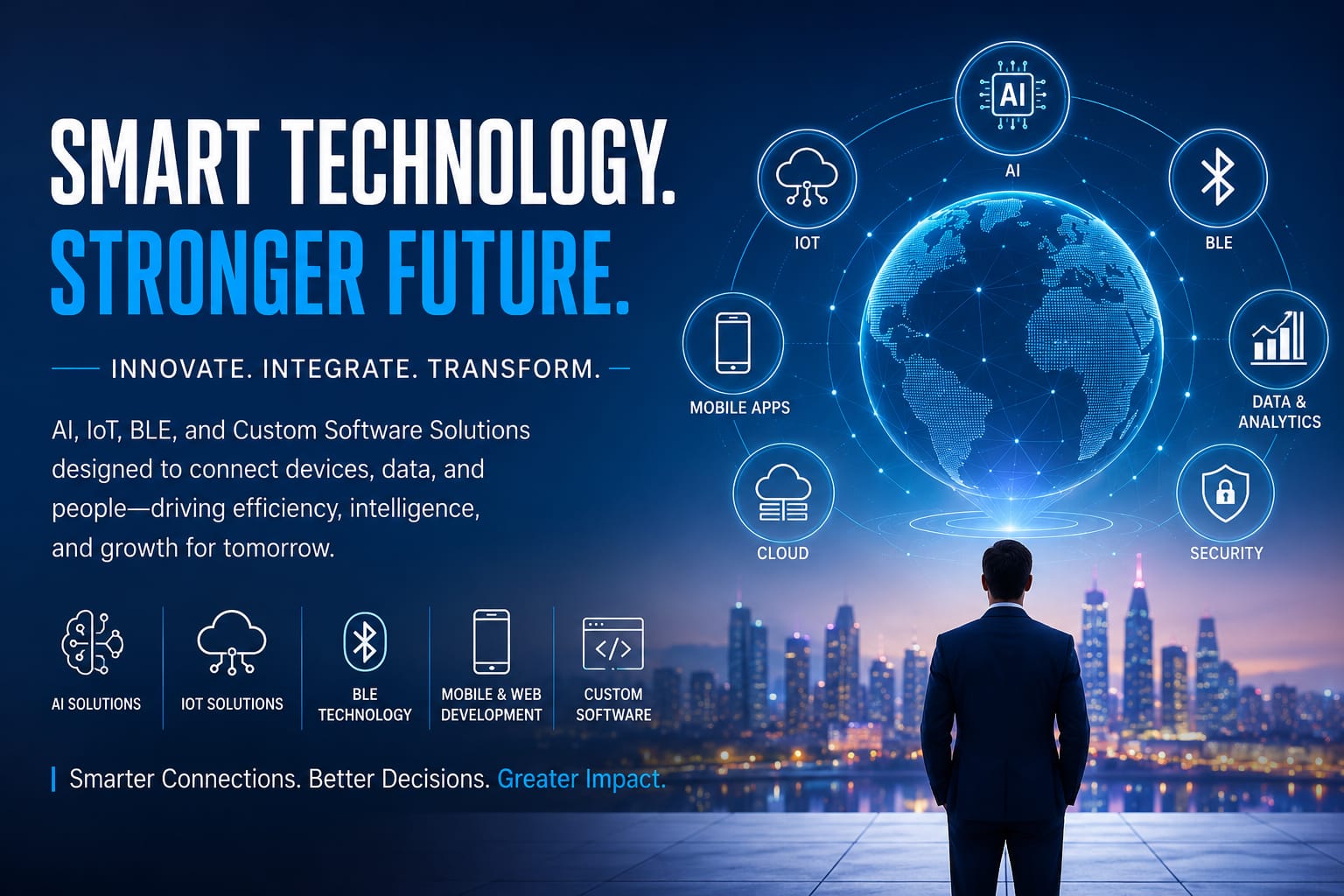
Digital transformation is no longer just about moving from manual processes to digital tools. In 2026, businesses are looking for smarter, connected, and scalable technology solutions that can improve efficiency, customer experiences, and long-term growth.
Technologies such as Artificial Intelligence (AI), Internet of Things (IoT), Bluetooth Low Energy (BLE), mobile applications, cloud platforms, and custom software are becoming important building blocks for modern businesses.
Why Businesses Need Smarter Technology
Customers expect faster services, personalized experiences, and seamless digital interactions. At the same time, businesses need better visibility into their operations and more efficient ways to manage data.
Traditional software can solve individual problems, but integrated technology solutions can create a much bigger impact.
For example, an IoT-enabled business can collect real-time data from connected devices. BLE can provide nearby device communication and tracking. AI can analyze that data and identify useful patterns, while a mobile or web application can turn those insights into an easy-to-use experience.
This combination creates a connected digital ecosystem.
AI Is Becoming Part of Everyday Business
AI is moving beyond experimental projects and becoming part of everyday business applications.
Companies are using AI for:
- Intelligent customer support
- Predictive analytics
- Recommendation systems
- Document and data processing
- Business automation
- Fraud detection
- Personalized user experiences
- Operational decision-making
The real value of AI comes from integrating it into business processes rather than treating it as a standalone technology.
A custom AI application can be designed around a company’s specific data, workflows, customers, and objectives.
IoT Is Connecting the Physical and Digital Worlds
The Internet of Things allows physical devices to communicate with software platforms and exchange valuable information.
From smart buildings and healthcare devices to industrial equipment and retail systems, IoT can help organizations monitor operations in real time.
A typical IoT ecosystem may include:
Sensors → Connectivity → Cloud Platform → Data Processing → AI/Analytics → User Application
This architecture allows businesses to collect information from the real world and convert it into actionable insights.
BLE Makes Proximity-Based Experiences Possible
Bluetooth Low Energy is another important technology for connected products and applications.
BLE enables devices to communicate while consuming relatively little power, making it useful for many applications, including:
- Asset tracking
- Indoor positioning
- Smart wearables
- Healthcare devices
- Retail solutions
- Smart home products
- Industrial monitoring
- Proximity marketing
- Device configuration
BLE can also work alongside mobile applications, allowing smartphones to interact with nearby hardware and connected products.
Custom Software Creates a Competitive Advantage
Every business operates differently. That is why off-the-shelf software may not always provide the flexibility organizations need.
Custom software development allows businesses to create solutions around their exact workflows.
A custom platform can integrate:
Mobile Apps + Web Applications + APIs + Cloud + AI + IoT + BLE + Business Systems
This creates a unified technology environment where different components can communicate with each other.
The Future Is About Integration
The biggest technology opportunity isn’t necessarily one individual technology.
It is the combination of multiple technologies working together.
Imagine a smart retail environment where BLE devices detect customer interactions, IoT sensors monitor store conditions, AI analyzes behavioral data, and a mobile application delivers personalized experiences.
Or consider an industrial environment where connected sensors continuously collect equipment data and AI identifies potential problems before they become expensive failures.
These examples demonstrate how integrated technology can transform traditional business processes.
Choosing the Right Technology Partner
Successful digital transformation requires more than simply selecting new technologies.
Businesses need to consider:
- Scalability
- Security
- Performance
- Integration requirements
- User experience
- Data management
- Long-term maintenance
- Business objectives
A technology partner should understand both the technical requirements and the business problem being solved.
How QuartusTech Can Help
QuartusTech helps businesses turn technology ideas into practical digital solutions.
From AI application development and mobile app development to BLE, IoT, POS applications, NFC solutions, SaaS platforms, and custom software, businesses can build connected solutions designed around their specific requirements.
The goal isn’t simply to adopt the latest technology.
The goal is to use technology to create measurable business value.
Final Thoughts
The next generation of digital transformation will be increasingly connected, intelligent, and automated.
AI can make systems smarter.
IoT can connect physical environments.
BLE can enable proximity-based communication.
Mobile and web applications can make technology accessible.
Cloud platforms can provide scalability.
When these technologies work together, businesses can create powerful digital ecosystems that are prepared for the future.
The future of technology isn’t just about being digital. It’s about being connected, intelligent, and purpose-built.