
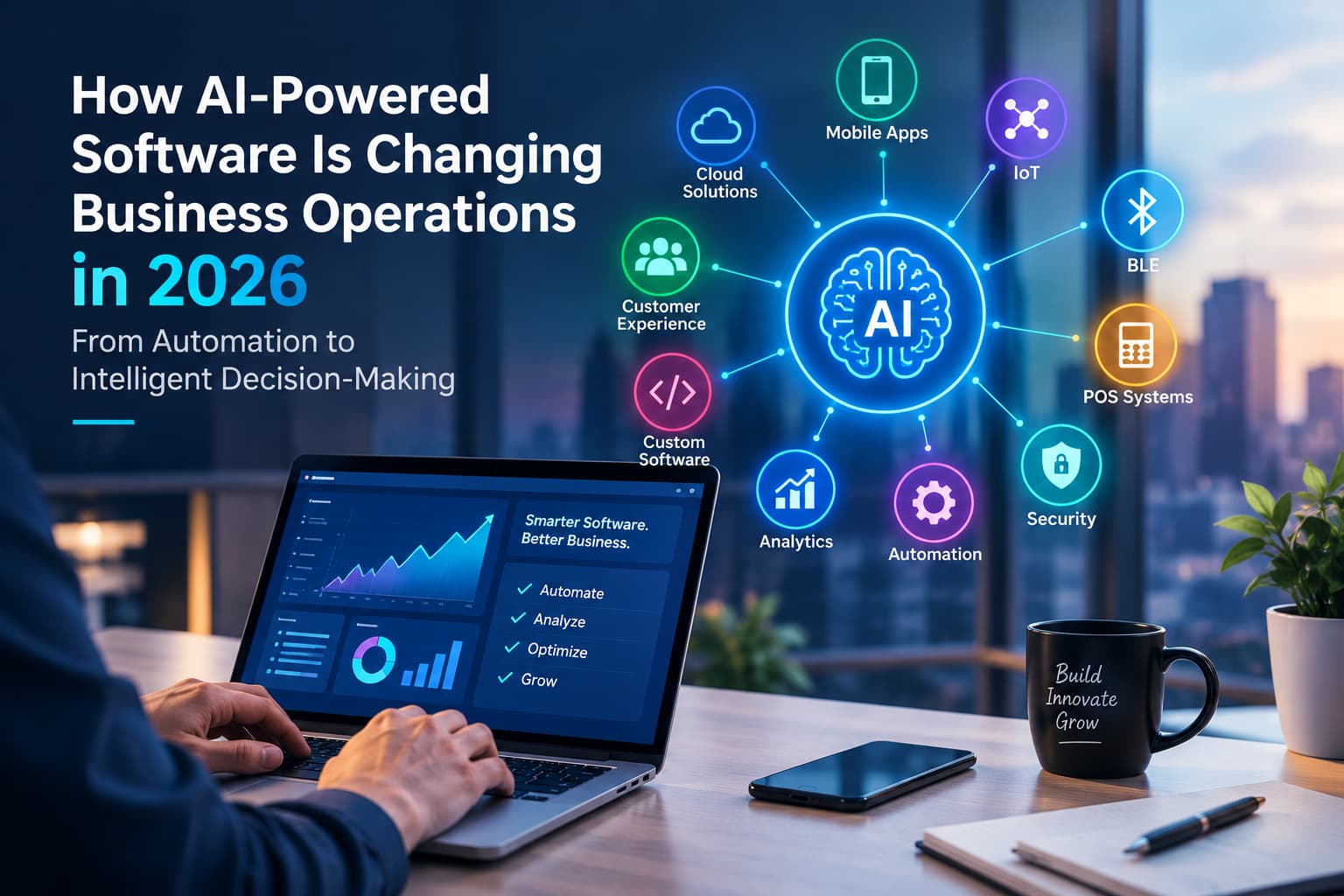
Businesses are entering a new phase of digital transformation.
For years, companies invested in websites, mobile applications, cloud platforms, CRM systems, ERP software, and automation tools. Today, the focus is shifting toward something more powerful: software that can understand data, automate decisions, predict outcomes, and continuously improve business operations.
Artificial Intelligence is becoming a core component of modern software development, helping organizations move from traditional automation to intelligent digital operations.
For businesses looking to stay competitive in 2026, the question is no longer whether to adopt AI. The bigger question is how to integrate AI into existing products, applications, and workflows in a practical and scalable way.
This is where companies like QuartusTech are helping businesses transform ideas into intelligent digital solutions.
What Is AI-Powered Business Software?
AI-powered software combines traditional application development with technologies such as machine learning, generative AI, predictive analytics, natural language processing, and intelligent automation.
Instead of simply following predefined instructions, AI-enabled applications can analyze information and provide insights or recommendations based on data.
For example, a traditional reporting system may show a company’s monthly sales.
An AI-powered system could go further by identifying:
- Which products are likely to sell more next month
- Which customers may stop purchasing
- Which locations are underperforming
- Where operational costs are increasing
- What inventory may need to be reordered
- Which business processes can be automated
This difference is transforming enterprise software development.
Why Businesses Are Investing in AI Application Development
AI can create value across almost every department of a modern organization.
1. Automating Repetitive Business Processes
Employees spend significant amounts of time performing repetitive tasks such as data entry, document processing, reporting, customer support, and information retrieval.
AI-powered automation can reduce manual work by handling many of these processes automatically.
Examples include:
- Automated document processing
- AI customer support
- Intelligent email classification
- Automated reporting
- Workflow automation
- Data extraction
- Appointment management
This allows employees to spend more time on tasks that require creativity, judgment, and human interaction.
2. Smarter Business Decisions
Businesses generate enormous amounts of data every day.
The challenge isn’t always collecting data. The challenge is understanding it.
AI can analyze large datasets and identify patterns that may not be immediately visible to humans.
For example, an intelligent business dashboard could combine sales, customer, inventory, and operational data to provide actionable recommendations.
Instead of asking:
“What happened?”
business leaders can start asking:
“What is likely to happen next, and what should we do about it?”
That is one of the biggest advantages of AI-powered software.
3. AI-Powered Customer Experiences
Customer expectations are changing quickly.
People want faster answers, personalized recommendations, convenient digital experiences, and support available whenever they need it.
AI applications can help businesses provide these experiences through:
- AI chatbots
- Virtual assistants
- Personalized recommendations
- Voice-enabled applications
- Intelligent search
- Automated customer support
- Personalized content
When AI is integrated correctly, customers can receive faster and more relevant experiences without creating additional workload for support teams.
4. AI + Mobile Applications
Mobile applications are becoming more intelligent.
Instead of building an application that simply displays information or allows users to complete transactions, businesses can integrate AI directly into the user experience.
An AI-powered mobile application could provide:
- Personalized recommendations
- Intelligent search
- Voice interaction
- Predictive notifications
- AI assistants
- Image recognition
- Automated content generation
- Personalized dashboards
QuartusTech develops custom mobile and web applications designed around specific business requirements, including iOS, Android, React Native, and web technologies.
5. AI + IoT: From Connected Devices to Intelligent Systems
The combination of AI and IoT is creating another major opportunity.
IoT devices can collect information from the physical world through sensors and connected hardware.
AI can then analyze that information and turn raw device data into actionable intelligence.
Consider an industrial environment.
Sensors could monitor:
- Temperature
- Equipment performance
- Vibration
- Energy consumption
- Machine activity
AI models could analyze this information and identify unusual patterns before equipment fails.
This creates a shift from reactive maintenance to predictive maintenance.
The same concept can be applied to healthcare devices, logistics, smart buildings, retail, manufacturing, and connected consumer products.
QuartusTech’s expertise includes IoT and Bluetooth integration for connected applications and devices.
6. BLE and AI Are Creating Smarter Connected Products
Bluetooth Low Energy, or BLE, plays an important role in connected-device ecosystems.
BLE allows applications to communicate efficiently with nearby devices while consuming relatively little power.
When BLE is combined with cloud platforms and AI, businesses can create much more intelligent solutions.
For example:
BLE Device → Mobile App → Cloud Platform → AI Analysis → Business Insight
This architecture can support applications such as:
- Healthcare monitoring
- Smart wearables
- Asset tracking
- Retail solutions
- Industrial monitoring
- Access control
- Smart equipment
- Location-based applications
The opportunity isn’t simply connecting devices.
The real value comes from collecting useful data and turning it into intelligent decisions.
7. AI in POS and Retail Technology
Point-of-sale systems are also becoming more intelligent.
Traditional POS software primarily focuses on transactions, billing, inventory, and reporting.
AI-powered POS systems can introduce another layer of intelligence.
Businesses can use AI for:
- Sales forecasting
- Inventory prediction
- Customer behavior analysis
- Product recommendations
- Fraud detection
- Demand forecasting
- Automated reporting
For multi-location businesses, AI can potentially identify differences in customer behavior and sales performance across stores.
This can help management make faster, data-driven decisions.
8. AI-Powered Enterprise Software
Enterprise organizations often operate with multiple systems.
CRM.
ERP.
Accounting.
Inventory.
Customer support.
HR.
Analytics.
The challenge is making all these systems work together.
AI can become an intelligence layer connecting information across business systems.
For example, an enterprise AI platform could analyze customer information from a CRM, sales information from a POS system, inventory information from an ERP, and operational data from cloud applications.
The result is a more connected digital ecosystem.
Why Custom AI Development Matters
Every business has different processes.
A generic AI tool may solve a common problem, but it may not understand a company’s unique workflows, data structures, integrations, security requirements, or customer journey.
Custom AI application development allows businesses to build solutions around their actual requirements.
A custom solution can integrate:
- AI models
- Mobile applications
- Web applications
- APIs
- Cloud infrastructure
- Databases
- IoT devices
- BLE technology
- NFC
- POS systems
- Enterprise software
This creates a technology ecosystem instead of another isolated application.
Security Must Be Part of AI Development
As businesses integrate AI into their operations, security becomes increasingly important.
AI applications may interact with sensitive business information, customer data, financial records, or proprietary company information.
Therefore, AI development should consider:
- Secure APIs
- Authentication and authorization
- Data encryption
- Access controls
- Secure cloud architecture
- Privacy protection
- Monitoring and logging
- Compliance requirements
Security should not be treated as something added at the end of development.
It should be considered from the beginning of the architecture.
The Future: Intelligent Digital Ecosystems
The next generation of business technology will not be built around one technology.
It will combine multiple technologies into connected ecosystems.
Imagine a future business platform where:
IoT sensors collect data → BLE connects devices → Mobile apps interact with users → Cloud platforms process information → AI analyzes the data → Automated workflows take action.
This is the direction in which modern digital transformation is moving.
Businesses that successfully connect these technologies can create faster operations, better customer experiences, and more intelligent decision-making.
Why Choose QuartusTech for AI-Powered Software Development?
QuartusTech focuses on developing future-ready digital products for startups, SMEs, and enterprises.
Its capabilities span AI application development, mobile and web applications, smart software, BLE and IoT integration, cloud services, digital transformation, and custom software development.
The company takes a practical approach to technology: understanding the business problem first and then selecting the right combination of technologies to solve it.
Whether the requirement is an AI-powered application, connected IoT platform, intelligent mobile application, custom POS system, or enterprise software solution, the goal is to create technology that delivers measurable business value.
Conclusion
AI is changing software from a tool that simply follows instructions into a system capable of analyzing information, identifying patterns, making recommendations, and supporting business decisions.
But successful AI adoption isn’t about adding AI everywhere.
It is about identifying the right business problems and building technology that solves them effectively.
The businesses that combine AI, cloud, mobile applications, IoT, BLE, automation, and custom software will be better positioned to build intelligent digital ecosystems for the future.
QuartusTech helps businesses turn technology ideas into scalable, intelligent, and connected digital products.
If your business is planning its next AI application, mobile platform, IoT solution, or custom software product, the next step is to identify where intelligent technology can create the greatest business impact.