
A few years ago, businesses asked:
“Do we need an app?”
Today, the better question is:
“How can all our digital systems work together intelligently?”
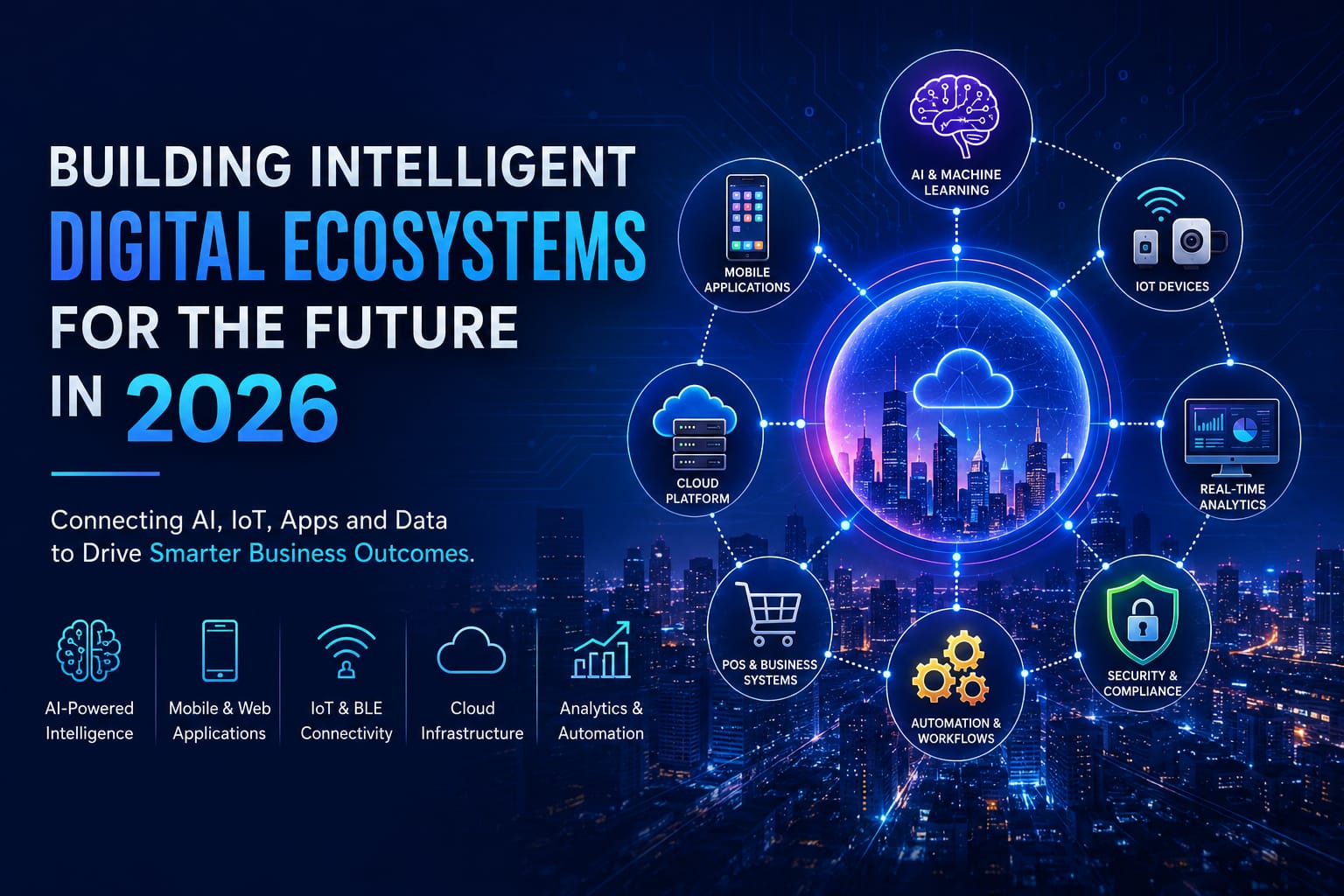
In 2026, businesses are moving beyond individual mobile apps and disconnected software tools. Companies increasingly want technology ecosystems where AI, mobile applications, web platforms, IoT devices, automation, analytics, cloud systems, and business software communicate with one another.
Instead of having ten different tools that barely know each other exist, businesses are building connected digital environments designed around their customers, employees, data, and operations.
This shift is creating a major opportunity for companies investing in custom software development and intelligent technology solutions.
What Is an Intelligent Digital Ecosystem?
An intelligent digital ecosystem is a connected technology environment where multiple digital products and services work together.
It can include:
- AI-powered applications
- Mobile and web applications
- IoT devices
- BLE connectivity
- Cloud platforms
- Enterprise software
- POS systems
- Automation tools
- Data analytics
- APIs and third-party integrations
- Customer-facing applications
- Internal business systems
The goal isn’t simply to add more technology.
The goal is to make technology work together.
For example, a retail business could connect its mobile application, POS system, inventory platform, customer database, analytics dashboard, and AI recommendation engine into one ecosystem.
The result is a business that can make faster decisions using real-time information.
Why Businesses Are Moving Beyond Standalone Apps
A standalone application can solve one problem.
But modern businesses usually have dozens of connected processes.
Consider a restaurant.
A customer places an order through an application.
That order may need to connect with:
Customer App → POS → Kitchen → Inventory → Payment → Analytics → Customer Database
If these systems operate independently, employees may need to manually transfer information between platforms.
That’s where intelligent ecosystems become valuable.
Connected systems can automatically exchange information, reduce repetitive work, and provide businesses with a clearer view of their operations.
1. AI Is Becoming the Intelligence Layer
AI is no longer limited to chatbots.
Businesses are integrating AI into everyday applications to make software more intelligent.
AI can help businesses with:
- Predictive analytics
- Customer recommendations
- Automated support
- Document processing
- Fraud detection
- Demand forecasting
- Workflow automation
- Personalized experiences
- Business intelligence
- Data analysis
For example, an e-commerce platform can analyze purchasing behavior and recommend products automatically.
A restaurant platform can identify ordering trends and help predict inventory requirements.
An enterprise application can analyze operational data and highlight unusual patterns.
This is why AI application development is becoming an important part of digital transformation.
2. Mobile Apps Are Becoming Business Interfaces
Mobile applications remain one of the most important ways customers and employees interact with digital ecosystems.
But modern mobile applications are no longer simply screens for browsing information.
They can act as gateways to an entire technology ecosystem.
A mobile app can connect with:
- AI services
- BLE devices
- IoT platforms
- Payment systems
- Cloud databases
- CRM systems
- POS platforms
- Enterprise APIs
For businesses that require custom functionality, working with an experienced mobile app development company can help create applications that are designed around specific workflows rather than forcing the business to adapt to generic software.
3. IoT Turns Physical Objects Into Data Sources
The Internet of Things allows physical devices to communicate with software platforms.
Sensors can collect information about:
- Temperature
- Location
- Equipment status
- Movement
- Energy consumption
- Inventory
- Environmental conditions
- Machine performance
That information can then be sent to cloud platforms and analyzed using software or AI.
Imagine a manufacturing company monitoring equipment continuously.
Instead of waiting for a machine to fail, the system can identify unusual behavior and potentially alert the maintenance team before a major problem occurs.
This combination of IoT + cloud + AI + automation is one of the strongest examples of an intelligent digital ecosystem.
4. BLE Makes Connected Experiences More Practical
Bluetooth Low Energy can provide businesses with a low-power method for connecting nearby devices.
BLE can be used in applications such as:
- Asset tracking
- Smart retail
- Healthcare devices
- Fitness applications
- Smart buildings
- Industrial monitoring
- Wearables
- Indoor positioning
- Access control
When BLE is connected with mobile applications and cloud platforms, businesses can create experiences that respond to real-world environments.
For example, a retail application could detect nearby BLE-enabled devices and trigger location-based experiences.
5. Automation Reduces Repetitive Business Work
One of the biggest advantages of connected software is automation.
Imagine an organization where an employee currently:
- Receives customer information
- Enters it into a CRM
- Updates another system
- Sends an email
- Creates an internal task
- Generates a report
An integrated system can automate much of this workflow.
The objective isn’t necessarily to eliminate human involvement.
It’s to eliminate unnecessary repetitive work so employees can focus on activities requiring human judgment.
6. Data Becomes More Valuable When Systems Are Connected
A business may already have huge amounts of data.
The problem is that data often exists in separate systems.
For example:
CRM Data
Customer information
POS Data
Transactions
Mobile App Data
User behavior
IoT Data
Device activity
Website Data
Online interactions
When these sources are connected, businesses can gain a much more complete understanding of their operations.
This can support better:
- Forecasting
- Marketing
- Customer experiences
- Product development
- Operational planning
- Business decisions
7. Custom Software Is Becoming More Important
Generic software can be useful for standard business processes.
But businesses with unique workflows often need something different.
Custom software can be designed around the company’s:
- Business model
- Customers
- Internal processes
- Data requirements
- Security needs
- Integration requirements
- Growth plans
This is particularly important for enterprises that need several systems to communicate with each other.
A custom platform can become the foundation connecting different parts of the business.
What Does a Modern Digital Ecosystem Look Like?
A simplified architecture could look like this:
Customers
↓
Mobile & Web Applications
↓
APIs & Cloud Infrastructure
↓
AI + Business Logic
↓
CRM + POS + Enterprise Systems
↓
IoT + BLE + Connected Devices
↓
Analytics & Automation
The exact architecture depends on the business.
The important point is that these technologies don’t have to operate independently.
They can work together as a connected ecosystem.
Industries That Can Benefit From Intelligent Ecosystems
Almost any industry can benefit from connected technology.
Healthcare
Connected devices, mobile applications, patient platforms, remote monitoring, and AI analytics can work together to create more efficient digital healthcare solutions.
Retail
Retailers can combine mobile apps, POS systems, inventory management, customer analytics, AI recommendations, and IoT technologies.
Restaurants
Restaurants can connect POS platforms, ordering applications, kitchen workflows, inventory, payments, customer data, and analytics.
Manufacturing
Manufacturers can combine IoT sensors, machine monitoring, analytics, automation, and predictive maintenance.
Logistics
Connected tracking systems can combine mobile applications, GPS, IoT devices, cloud platforms, and analytics.
Smart Buildings
BLE, IoT sensors, mobile applications, access control, and automation can work together to create intelligent building environments.
The Biggest Challenge: Integration
Building individual applications is only one part of digital transformation.
The bigger challenge is making different technologies communicate correctly.
Businesses may already use:
- Legacy software
- Cloud applications
- CRM platforms
- Payment systems
- Databases
- Mobile applications
- Third-party APIs
- IoT devices
Replacing everything isn’t always practical.
Integration can allow businesses to connect existing systems with newer technologies.
This is where experienced software engineering becomes extremely important.
Security Must Be Part of the Ecosystem
As more systems become connected, security becomes even more important.
Businesses should consider:
- Data encryption
- API security
- Authentication
- Authorization
- Secure device communication
- Access controls
- Cloud security
- Secure software architecture
- Regular security testing
Security should not be treated as something added at the end of development.
It should be considered during the architecture and development process.
What Businesses Should Do in 2026
Companies don’t need to transform everything overnight.
A better approach is to identify one high-value business problem first.
For example:
Problem: Too much manual customer support.
Solution: AI-powered customer service platform.
Then connect it with existing customer data.
Another company may have:
Problem: Poor equipment visibility.
Solution: IoT sensors + cloud dashboard + predictive analytics.
Another business may have:
Problem: Disconnected customer ordering and payment systems.
Solution: Mobile application + POS + payment + CRM integration.
Start with a measurable problem and expand the ecosystem gradually.
The Future Is Not About More Apps
The future of business technology isn’t necessarily about creating another application.
It’s about creating connected systems that understand what is happening and respond intelligently.
AI provides intelligence.
IoT provides real-world data.
Mobile applications provide user interaction.
Cloud platforms provide scalability.
APIs provide connectivity.
Automation provides efficiency.
Analytics provide insights.
Together, these technologies can create a powerful digital ecosystem.
How QuartusTech Helps Businesses Build Connected Technology Solutions
Building an intelligent ecosystem requires more than choosing individual technologies.
Businesses need a technology strategy that connects those technologies to real business objectives.
QuartusTech helps businesses develop customized digital solutions across areas such as:
- AI application development
- Mobile application development
- Web application development
- BLE integration
- IoT solutions
- NFC applications
- POS software
- SaaS platforms
- Custom enterprise software
- Blockchain solutions
- Digital transformation
Whether a company needs a new AI-powered application, a connected IoT platform, a custom POS solution, or integration between multiple business systems, the right architecture can turn disconnected technologies into a unified digital ecosystem.