
Introduction
For decades, software has followed a predictable lifecycle: developers build it, businesses deploy it, users interact with it, and eventually it requires updates or a complete redesign. Every improvement depends on human intervention.
But that model is rapidly becoming obsolete.
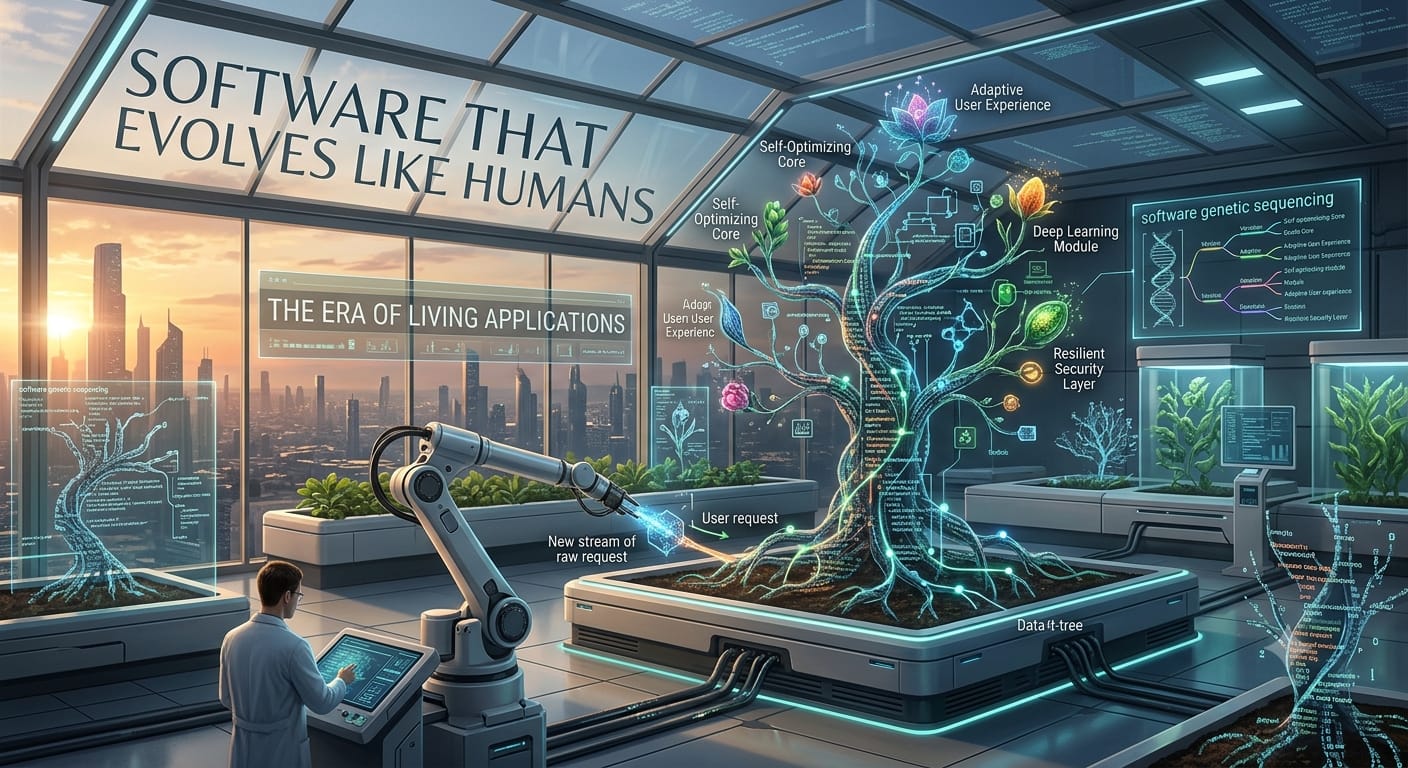
We’re entering an era where software doesn’t simply execute instructions—it observes, learns, adapts, and continuously improves. Much like humans gain experience over time, the next generation of software will become smarter with every interaction.
At QuartusTech, we call these Living Applications.
A Living Application isn’t just intelligent; it’s adaptive. It evolves alongside your business, your customers, and the changing digital landscape without waiting for the next scheduled software release.
This represents one of the biggest shifts in software engineering since the rise of cloud computing.
What Is a Living Application?
A Living Application is software designed to continuously evolve by learning from data, user behavior, operational performance, and business outcomes.
Unlike traditional applications that remain static until developers release updates, Living Applications continuously optimize themselves.
Imagine software that:
- Learns customer preferences automatically.
- Predicts future business requirements.
- Optimizes workflows without manual configuration.
- Detects inefficiencies before employees notice them.
- Adapts interfaces based on user behavior.
- Improves decision-making using real-time intelligence.
Instead of being programmed once, Living Applications grow smarter every day.
From Static Software to Living Intelligence
The software industry has gone through several major transformations.
Generation 1: Static Applications
These systems performed predefined tasks.
Examples include desktop accounting software, offline inventory systems, and early business applications.
Characteristics:
- Fixed functionality
- Manual updates
- No learning capability
- Reactive operations
Generation 2: Connected Applications
Cloud computing introduced synchronization, online collaboration, and remote access.
Software became accessible from anywhere.
Characteristics:
- Internet connectivity
- Cloud storage
- Multi-device support
- API integrations
Generation 3: Intelligent Applications
Artificial Intelligence enabled software to automate repetitive tasks and generate predictions.
Examples include recommendation engines, fraud detection systems, and AI-powered chatbots.
Characteristics:
- Machine learning
- Automation
- Predictive analytics
- Natural language processing
Generation 4: Living Applications
Now software becomes dynamic.
Instead of simply processing data, it continuously improves itself.
Characteristics include:
- Self-learning
- Self-optimization
- Context awareness
- Autonomous decision support
- Continuous adaptation
This is the future of enterprise software.
Why Traditional Software Is No Longer Enough
Modern businesses generate enormous amounts of data every second.
Traditional software cannot keep pace because:
- Customer expectations change daily.
- Market trends shift rapidly.
- Cybersecurity threats evolve continuously.
- Operational bottlenecks emerge unexpectedly.
- Business processes become increasingly complex.
Static applications require manual intervention to keep up.
Living Applications evolve naturally alongside these changes.
The Eight Pillars of Living Applications
1. Adaptive Intelligence
Every interaction teaches the system something new.
The application becomes increasingly accurate over time.
2. Behavioral Learning
Instead of forcing users to adapt to software, Living Applications adapt to users.
Frequently used features become more accessible while unnecessary complexity fades into the background.
3. Predictive Decision Support
Rather than showing historical reports, Living Applications anticipate future events.
Imagine receiving alerts before inventory shortages occur or before equipment failures disrupt operations.
4. Autonomous Optimization
Applications continuously improve performance without waiting for software updates.
Examples include:
- Database optimization
- Resource allocation
- Workflow refinement
- Cloud cost optimization
5. Context Awareness
Modern applications understand context.
For example:
A retail application behaves differently during holiday sales than during normal business operations.
A healthcare platform prioritizes emergency cases automatically.
A logistics platform adjusts delivery schedules based on weather and traffic.
6. Continuous Security Evolution
Cyber threats constantly evolve.
Living Applications use AI-powered monitoring to detect unusual behavior, identify anomalies, and respond to threats in real time.
Security becomes proactive rather than reactive.
7. Personalized Experiences
Every user experiences software differently.
Executives receive strategic insights.
Managers see operational analytics.
Employees receive task-focused interfaces.
Customers enjoy personalized interactions.
The application evolves for every individual.
8. Collaborative Intelligence
Living Applications don’t replace people.
They amplify human capabilities.
Employees spend less time on repetitive work and more time solving creative, strategic problems.
Industries Ready for Living Applications
Healthcare
- Personalized treatment recommendations
- Predictive patient monitoring
- Intelligent scheduling
- AI-assisted diagnostics
Retail
- Dynamic pricing
- Personalized shopping experiences
- Inventory forecasting
- Customer behavior analysis
Manufacturing
- Predictive maintenance
- Autonomous quality inspection
- Production optimization
- Supply chain intelligence
Banking
- Fraud prevention
- Intelligent loan assessment
- Personalized financial advice
- Risk prediction
Logistics
- Route optimization
- Demand forecasting
- Warehouse automation
- Fleet intelligence
The Technologies Behind Living Applications
Several advanced technologies make Living Applications possible:
- Artificial Intelligence
- Machine Learning
- Large Language Models
- Edge Computing
- Internet of Things (IoT)
- Digital Twins
- Cloud Computing
- Real-Time Analytics
- Computer Vision
- Autonomous AI Agents
Together, these technologies create software capable of learning continuously.
Challenges Businesses Must Address
Building Living Applications requires thoughtful planning.
Organizations must address:
- Data quality
- AI governance
- Cybersecurity
- Privacy regulations
- Ethical AI
- Explainable decision-making
- Infrastructure scalability
- Continuous model monitoring
Businesses that prepare today will lead tomorrow.
Why QuartusTech Believes Living Applications Are the Future
At QuartusTech, we believe software should evolve alongside the businesses it serves.
Our vision extends beyond traditional application development.
We build intelligent platforms that:
- Learn from operational data.
- Adapt to changing market conditions.
- Scale with business growth.
- Enhance employee productivity.
- Deliver personalized customer experiences.
- Support better decision-making through AI.
Rather than creating software that becomes outdated, we focus on solutions designed to grow and improve over time.
Looking Ahead: The Next Decade of Software
Imagine opening your business application ten years from now.
Instead of asking:
“What would you like to do?”
It says:
“I’ve already analyzed your sales trends, optimized today’s inventory, detected two supply-chain risks, scheduled follow-up tasks for your team, and identified three new revenue opportunities. Would you like to review them?”
That is the promise of Living Applications.
Software will no longer be a passive tool—it will become an active collaborator.
Organizations that embrace this shift will gain faster decision-making, greater resilience, and a lasting competitive advantage.
Conclusion
The future of software isn’t just smarter—it is alive in the sense that it continuously learns, adapts, and evolves.
Living Applications represent the next chapter in digital transformation, where technology grows with the people and businesses it serves.
As AI, cloud computing, IoT, and autonomous systems continue to advance, organizations have an opportunity to move beyond static software and embrace applications that become more valuable every day.
At QuartusTech, we are committed to building the next generation of intelligent software that evolves with your business—because the best applications of tomorrow won’t simply run; they will learn, adapt, and help shape the future.