
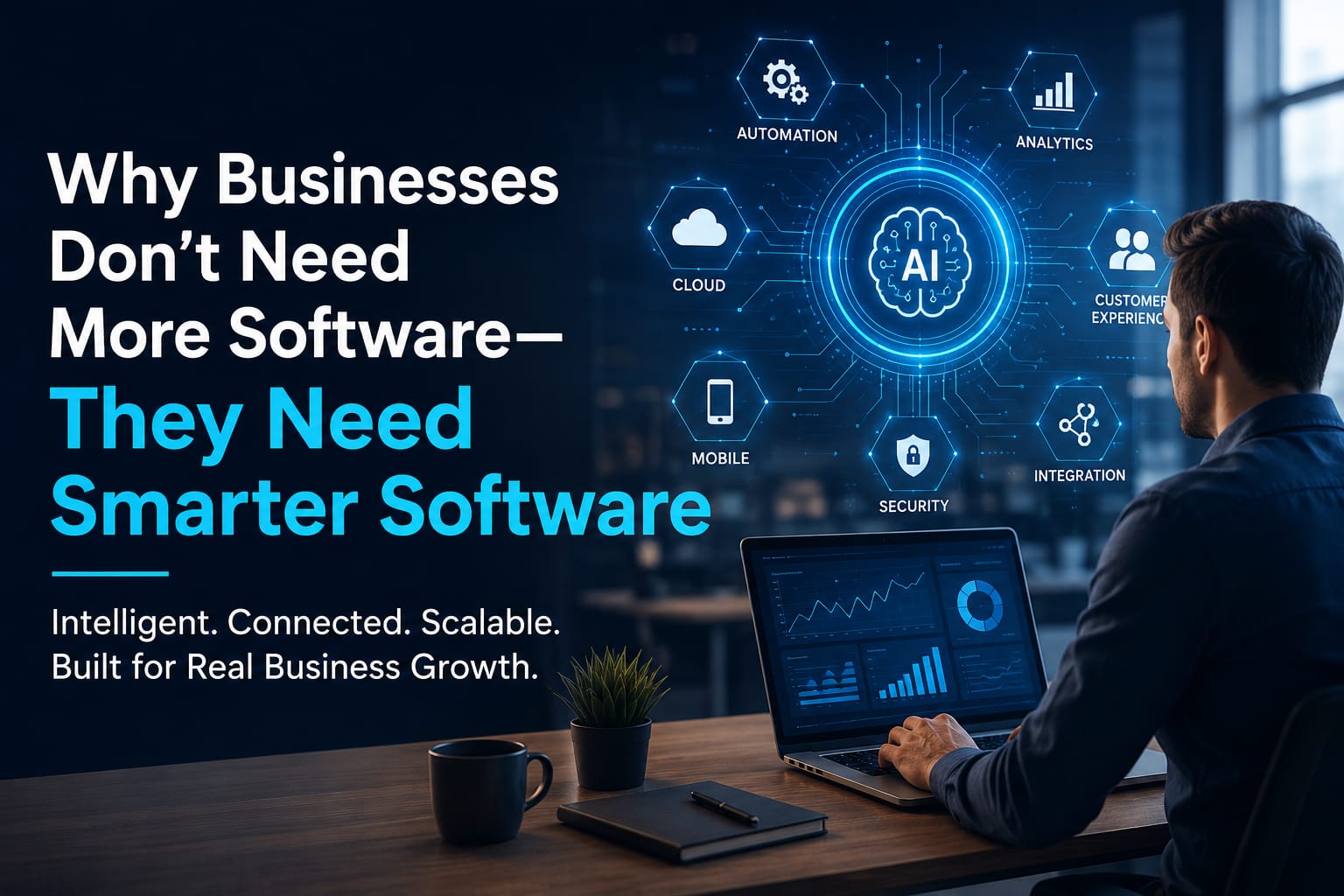
Businesses today use more software than ever before.
There is software for customer management, sales, inventory, employee communication, accounting, marketing, analytics, and customer support. Yet many companies still struggle with slow workflows, disconnected data, repetitive tasks, and poor customer experiences.
The problem is not always a lack of software.
The real problem is that too much software works independently.
A sales platform may not communicate with an inventory system. Customer data may be stored across multiple tools. Employees may spend hours moving information manually from one application to another. Businesses often add another platform to solve a problem—only to create another system that needs to be managed.
This is why the future is not about building more applications.
It is about building smarter, connected, and intelligent software ecosystems.
At QuartusTech, we help businesses transform ideas and complex workflows into scalable digital solutions powered by AI, automation, mobile technology, cloud infrastructure, and intelligent integrations.
What Is Smarter Software?
Smarter software does more than store information or complete basic tasks.
It can:
- Automate repetitive business processes
- Analyze data and identify useful patterns
- Provide intelligent recommendations
- Connect multiple systems
- Personalize customer experiences
- Predict future trends
- Reduce manual work
- Adapt as a business grows
Traditional software usually waits for a user to enter a command.
Intelligent software can help users make better decisions, complete tasks faster, and discover valuable insights from business data.
For example, a traditional inventory system may show how many products are available.
A smarter inventory system can analyze sales patterns, identify fast-moving products, predict future demand, and alert managers before important items run out.
That difference can save time, reduce costs, and improve business performance.
The Hidden Cost of Disconnected Software
Many organizations use separate applications because each tool solves one specific problem.
Over time, this can create a complicated technology environment.
Employees may need to:
- Log in to several platforms every day
- Enter the same information multiple times
- Export and import spreadsheets
- Manually update customer records
- Search across different systems
- Verify information before making decisions
These tasks may appear small individually, but they can consume a significant amount of time across an organization.
Disconnected software can also create:
Data Silos
Important information becomes trapped inside separate systems. Teams may not have access to the complete data they need.
Manual Errors
Repeated data entry increases the possibility of incorrect or outdated information.
Slow Decision-Making
Managers may need to collect information from multiple sources before understanding what is happening.
Poor Customer Experiences
Customers may receive inconsistent information when different departments use disconnected systems.
Higher Operating Costs
Businesses may pay for multiple platforms while still relying on manual processes.
Smarter software connects the right technologies so information can move securely and efficiently across the organization.
How AI Is Changing Business Software
Artificial Intelligence is transforming software from a passive tool into an active business partner.
AI can help applications understand data, recognize patterns, automate tasks, and generate useful insights.
Some common AI-powered capabilities include:
Intelligent Automation
AI can help automate repetitive activities such as document processing, customer requests, data classification, reporting, and workflow management.
This allows employees to spend more time on strategic and creative work.
Predictive Analytics
Predictive models can analyze historical data to identify possible future outcomes.
Businesses can use predictive analytics to:
- Forecast demand
- Identify customer behavior trends
- Detect unusual activity
- Improve inventory planning
- Reduce operational risks
AI-Powered Customer Support
Intelligent chatbots and virtual assistants can answer common questions, guide users, and provide support outside regular business hours.
When designed correctly, AI support tools can improve response times while allowing human teams to focus on more complex requests.
Personalized User Experiences
AI can analyze user behavior and provide relevant recommendations, content, products, or services.
Personalization can make digital experiences more useful and engaging.
Intelligent Search
Traditional search often depends on exact keywords.
AI-powered search can better understand user intent and help people find relevant information faster.
Smarter Software Is Not Only About AI
AI is important, but intelligent software requires more than adding a chatbot or AI feature.
A successful digital solution should also be:
- Secure
- Scalable
- User-friendly
- Reliable
- Easy to maintain
- Connected to the right systems
- Designed around real business goals
Technology should support the business—not make the business change everything to fit the technology.
That is why every software project should begin with understanding the actual challenge.
Before development starts, businesses should ask:
What process are we trying to improve?
Where are employees losing time?
What information is difficult to access?
Which tasks can be automated?
What experience do customers expect?
How should the solution grow over the next few years?
The answers help determine whether AI, automation, mobile technology, cloud infrastructure, IoT, BLE, NFC, or custom software is the right solution.
From Software Products to Intelligent Ecosystems
The future of business technology is connected.
Instead of using isolated applications, companies are moving toward digital ecosystems where systems can exchange information and work together.
For example, a smart retail ecosystem may connect:
- A custom POS system
- Inventory management software
- Customer loyalty tools
- Mobile applications
- Payment systems
- AI-powered analytics
- Cloud-based reporting
When these technologies are connected, business information becomes more useful.
A manager can view sales trends, monitor inventory, understand customer behavior, and make informed decisions without manually collecting information from multiple platforms.
The same approach can support healthcare, logistics, manufacturing, education, hospitality, finance, and many other industries.
How QuartusTech Builds Smarter Digital Solutions
At QuartusTech, we combine business strategy, software engineering, AI, and emerging technologies to create digital products designed for real-world use.
Our development approach focuses on understanding the business before selecting the technology.
1. Research and Discovery
We begin by understanding the business model, users, challenges, workflows, and project goals.
This helps identify opportunities for automation, integration, and intelligent features.
2. Product Strategy
Our team helps define the most valuable features and creates a practical development roadmap.
The goal is to build what the business actually needs—not add technology simply because it is trending.
3. User-Centered Design
A powerful application is only useful when people can use it comfortably.
We create intuitive interfaces that support smooth user journeys and clear interactions.
4. Custom Development
We develop scalable mobile applications, web platforms, enterprise software, AI-powered products, and connected digital systems.
5. Intelligent Integration
When required, we connect software with APIs, cloud platforms, payment systems, IoT devices, BLE hardware, NFC technology, and other business tools.
6. Testing and Deployment
Every solution is tested for functionality, performance, security, reliability, and usability before launch.
7. Continuous Growth
Digital products should evolve as businesses and customer expectations change.
We help organizations improve, expand, and maintain their technology over time.
Technologies That Can Make Software Smarter
The right technology depends on the business problem.
QuartusTech works across multiple technologies to build connected digital experiences.
AI Application Development
AI can support automation, predictive analytics, intelligent assistants, recommendation engines, computer vision, and data-driven decision-making.
Mobile App Development
Mobile applications allow businesses to deliver services, information, and personalized experiences directly to users.
Web Application Development
Scalable web platforms can support customers, employees, operations, analytics, and business workflows.
BLE and IoT Solutions
Bluetooth Low Energy and IoT technologies can connect mobile applications with sensors, wearables, medical devices, smart equipment, and connected products.
NFC Application Development
NFC can support contactless payments, secure access, digital identity, ticketing, loyalty programs, and device interactions.
Custom POS Development
Smart POS systems can combine sales, inventory, payments, customer data, analytics, and multi-location management.
Cloud and DevOps Solutions
Cloud infrastructure and modern DevOps practices can improve scalability, reliability, deployment speed, and long-term software performance.
What Businesses Should Avoid
When planning a new digital product, businesses should avoid several common mistakes.
Building Features Without a Clear Purpose
Every feature should solve a real user or business problem.
More features do not always create more value.
Adding AI Without a Useful Use Case
AI should improve a workflow, decision, experience, or business outcome.
Adding AI only for marketing purposes may create unnecessary complexity.
Ignoring Scalability
A solution that works for 100 users may not work efficiently for 100,000 users.
Scalability should be considered early in the development process.
Focusing Only on Development Cost
The lowest initial price may lead to higher long-term costs if the software is difficult to maintain, insecure, or unable to grow.
Neglecting User Experience
Even advanced technology can fail when users find it confusing or difficult to use.
The Future Belongs to Intelligent Businesses
Businesses that invest in smarter software can create stronger digital foundations for future growth.
The goal is not to replace people with technology.
The goal is to help people work more efficiently, make better decisions, and deliver better experiences.
The next generation of software will be:
- More connected
- More personalized
- More automated
- More predictive
- More adaptable
- More focused on real business outcomes
Companies that begin building intelligent digital systems today can be better prepared for changing customer expectations and future opportunities.
Build Something Smarter with QuartusTech
Your business may not need another disconnected application.
It may need a digital solution that connects your workflows, understands your data, supports your team, and grows with your organization.
Whether you are developing an AI-powered application, a custom software platform, a mobile app, a smart POS system, or a connected IoT solution, QuartusTech can help transform your idea into a scalable digital product.
You dream it. We build it—smarter.
Contact QuartusTech to discuss your next digital project and discover how intelligent technology can create measurable business value.