
Most businesses still think about technology in separate boxes.
A mobile app is one project.
An IoT system is another.
AI belongs to a different team.
BLE is considered a hardware integration problem.
But that approach is changing.
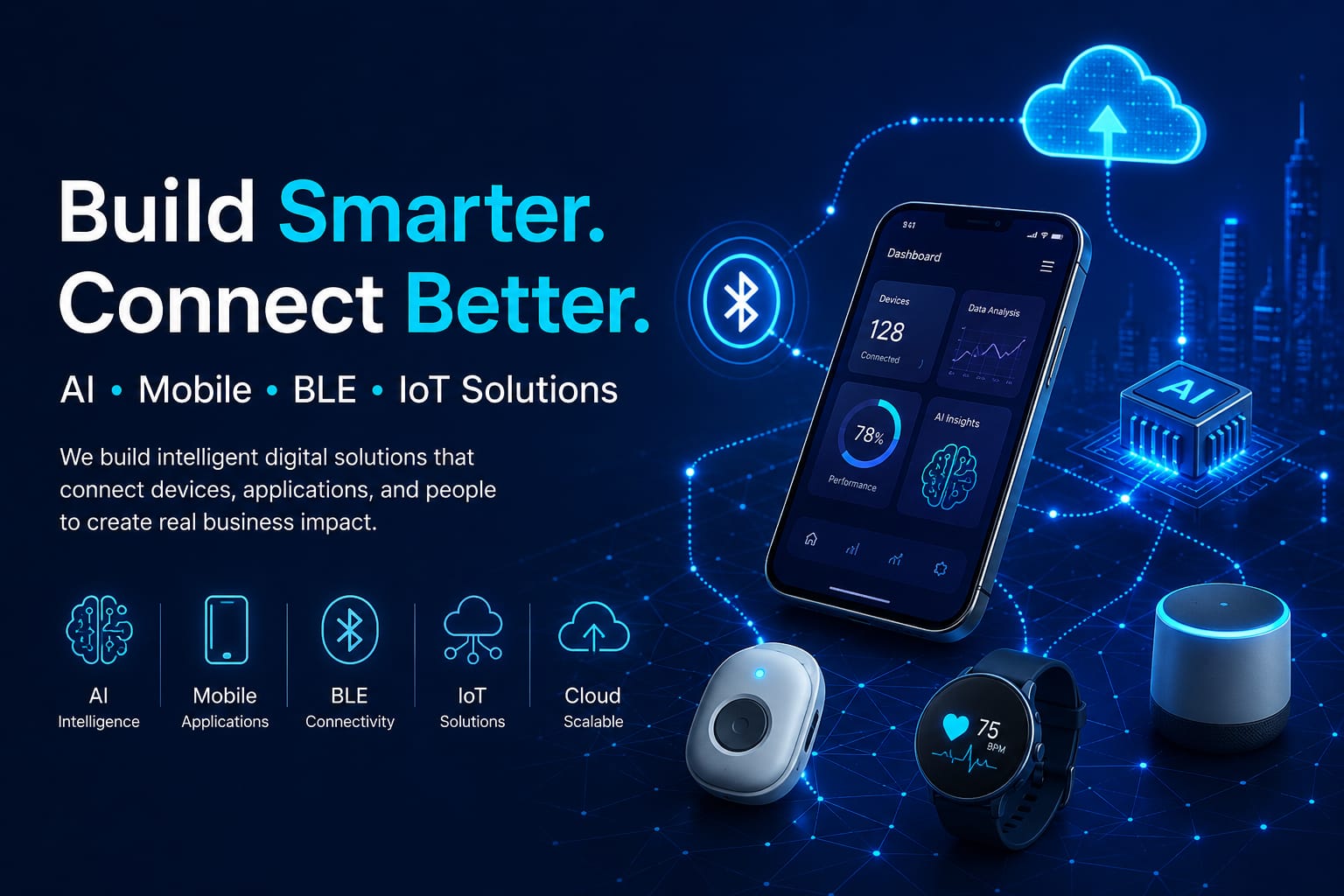
The next generation of digital products is being built as connected technology ecosystems, where mobile applications, artificial intelligence, connected devices, cloud platforms, and real-time data work together.
This shift creates a new opportunity for businesses: instead of simply digitizing an existing process, they can create systems that sense, understand, predict, and act.
From “Smart Apps” to Intelligent Ecosystems
A traditional mobile application waits for a user to perform an action.
An intelligent connected application can do much more.
Imagine a business application that can:
- Receive information from a connected BLE device
- Process the data through a cloud platform
- Use AI to identify patterns
- Automatically trigger a business workflow
- Notify the user through a mobile application
- Store the resulting data for future analysis
The mobile app is no longer the entire product.
It becomes the interface to a much larger technology ecosystem.
This is where modern AI app development, BLE development, IoT development, and cloud engineering begin to overlap.
The New Technology Stack: Sense → Connect → Understand → Act
One of the most interesting ways to look at modern software development is through four stages.
1. Sense
Connected devices collect information from the physical world.
Sensors, wearables, machines, trackers, and smart equipment can continuously generate valuable data.
2. Connect
Technologies such as Bluetooth Low Energy, Wi-Fi, cellular networks, and APIs move that information between devices and software systems.
BLE is particularly useful when applications need to communicate with nearby low-power devices.
3. Understand
This is where AI and analytics become important.
Instead of simply storing thousands of data points, businesses can use intelligent systems to identify patterns, detect anomalies, generate predictions, and provide recommendations.
4. Act
The final step is turning intelligence into action.
A system could automatically:
- Send an alert
- Update a dashboard
- Trigger a workflow
- Recommend an action
- Notify a customer
- Create a service request
- Adjust an operational process
This creates a technology loop rather than a standalone application.
Why BLE Is More Important Than It Looks
Bluetooth Low Energy is sometimes viewed as a simple connectivity technology.
In reality, BLE can become an important bridge between physical products and digital applications.
Consider a company developing a smart device.
The device collects information.
BLE transfers that information to a smartphone.
The mobile application sends it to the cloud.
The backend processes the information.
AI analyzes the data.
The user receives an actionable recommendation.
That entire journey can happen without the user needing to understand what is happening behind the scenes.
This is why businesses developing connected products increasingly need expertise in both BLE app development and mobile application development.
AI Becomes More Valuable When It Has Real-World Data
AI is powerful, but AI without useful data has limitations.
IoT and BLE can provide the continuous data required to make AI applications more context-aware.
For example:
IoT device → Real-time data → Cloud platform → AI analysis → Mobile application → Business action
This model can be applied across industries.
Healthcare
Connected devices can provide information that applications can organize and analyze.
Manufacturing
Connected equipment can help businesses monitor operations and identify unusual patterns.
Logistics
Connected trackers can provide information about assets and movement.
Retail
Connected systems can help businesses understand customer interactions and operational activity.
Fitness
Wearables can provide data that applications can transform into personalized insights.
The real opportunity isn’t simply AI or IoT.
It is the combination of both.
The Rise of “Invisible Technology”
The best technology is often the technology users don’t have to think about.
A customer may never know that a BLE connection is operating in the background.
They may not know which AI model analyzed their data.
They may not see the cloud infrastructure processing information.
They simply experience a product that works.
This creates an important principle for modern product development:
Complex technology should create simple experiences.
Businesses should therefore focus not only on which technologies they use, but on how seamlessly those technologies work together.
What Businesses Should Build in 2026
Instead of asking:
“Should we build an AI app?”
business leaders should ask:
“What information can our product collect, understand, and act upon?”
That question leads to better opportunities.
A business might discover that its next product needs:
- A mobile application
- BLE connectivity
- IoT infrastructure
- AI-powered analytics
- Cloud APIs
- A web dashboard
- Real-time notifications
- Secure data management
The result is not just an application.
It is a digital product ecosystem.
Where QuartusTech Fits
QuartusTech works across the technologies required to build these connected ecosystems.
From AI application development and mobile applications to BLE, IoT, SaaS, cloud-connected platforms, POS applications, and custom software, the goal is to connect individual technologies into a practical business solution.
This integrated approach can be especially valuable for companies developing:
- Connected consumer products
- Smart devices
- Enterprise applications
- IoT platforms
- AI-powered applications
- BLE-enabled mobile solutions
- SaaS products
- Digital transformation platforms
The Future Isn’t AI vs. IoT vs. Mobile
The biggest technology mistake businesses can make is treating emerging technologies as competing categories.
The future is more likely to look like this:
AI + IoT + BLE + Mobile + Cloud + Data
Each technology solves a different part of the problem.
BLE connects.
IoT collects.
Cloud processes.
AI understands.
Mobile delivers the experience.
And businesses turn all of it into value.
Final Thought
The next generation of software won’t simply be smart.
It will be connected, context-aware, and increasingly autonomous.
The companies that understand this shift can move beyond building individual apps and start creating technology ecosystems that continuously collect information, generate intelligence, and improve business operations.
The future of software isn’t just about building an app. It’s about building what happens around the app.
And that’s where the real opportunity begins.