
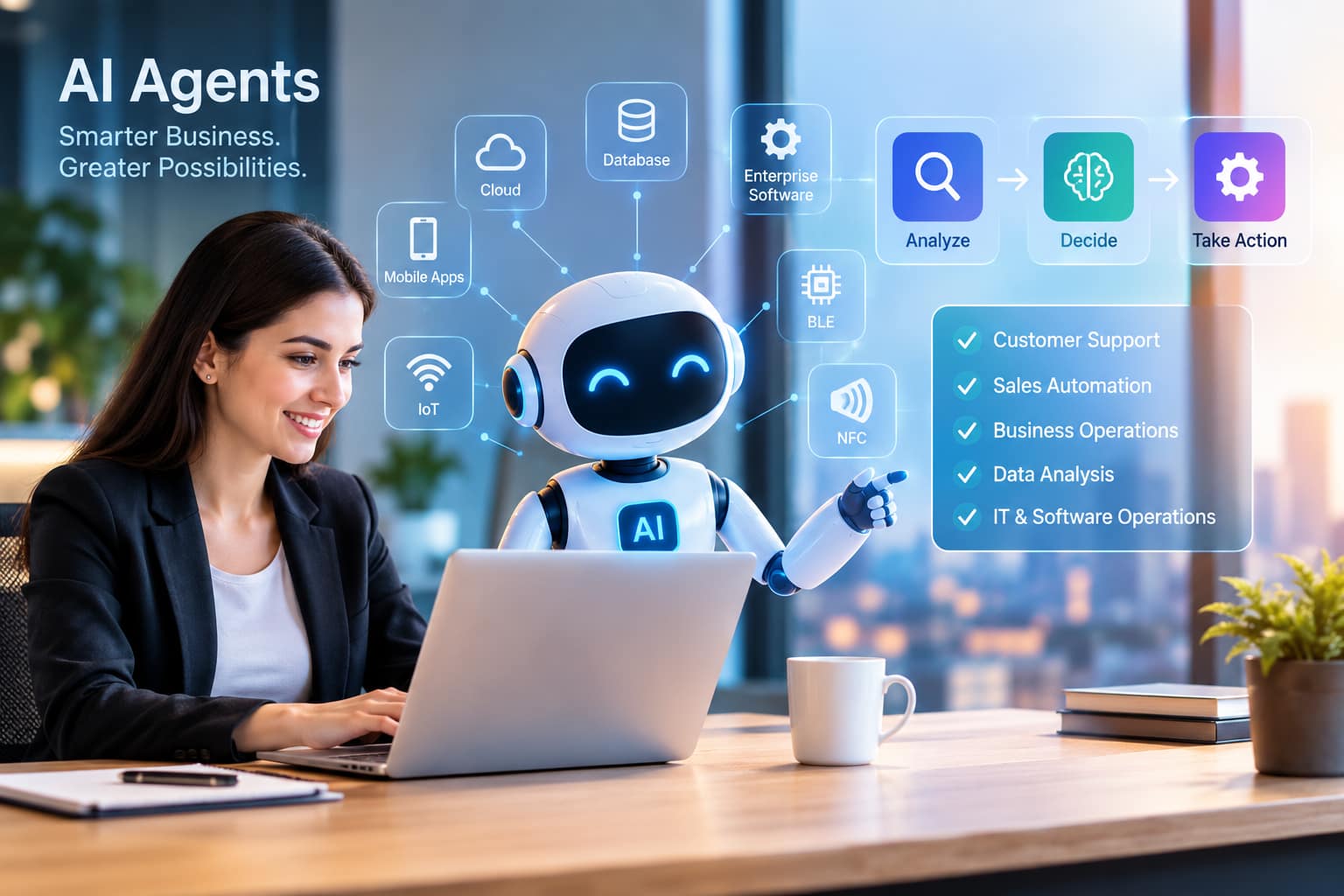
Businesses are entering a new phase of digital transformation.
For years, companies invested in websites, mobile applications, cloud platforms, dashboards, chatbots, and automation tools. Now, the next evolution is taking shape: AI agents that can understand business goals, make decisions, interact with software, and complete tasks with minimal human intervention.
Unlike traditional automation, AI agents are designed to handle more dynamic workflows. They can analyze information, determine the next step, use connected systems, and adapt their actions based on changing conditions.
For businesses looking to improve productivity and build smarter digital products, AI agent development is becoming an important technology strategy.
What Are AI Agents?
An AI agent is a software system that can perceive information, reason about a task, make decisions, and take actions to achieve a defined objective.
A traditional software application generally follows predefined instructions.
An AI agent can work more dynamically.
For example, instead of simply notifying a sales employee that a new lead has arrived, an AI-powered sales agent could:
- Analyze the incoming lead
- Identify the customer’s requirements
- Research relevant information
- Prioritize the opportunity
- Update the CRM
- Prepare a personalized response
- Schedule a follow-up
- Notify the sales team when human involvement is required
This moves software from simply providing information to actively helping complete business processes.
Why AI Agents Matter for Businesses in 2026
Businesses are dealing with increasing amounts of data, software platforms, customer interactions, and operational processes.
Employees often spend valuable time moving information between systems and performing repetitive tasks.
AI agents can help connect these workflows.
Some potential business applications include:
1. Intelligent Customer Support
AI agents can understand customer questions, access relevant information, and provide contextual responses.
Instead of relying only on predefined chatbot answers, businesses can develop AI systems capable of handling more complex customer conversations.
2. Sales Automation
AI agents can support sales teams by analyzing leads, preparing prospect information, updating CRM records, generating follow-up messages, and identifying opportunities that require immediate attention.
This allows sales professionals to spend more time on conversations and relationship building.
3. Business Operations
AI agents can monitor workflows and help employees complete routine operational tasks.
For example, an agent could collect information from multiple systems, prepare reports, identify unusual activity, and notify the appropriate team.
4. Intelligent Data Analysis
Businesses generate huge amounts of operational data.
AI agents can help analyze this information and turn raw data into useful insights.
Instead of asking employees to manually search through dashboards, an AI system could answer questions such as:
“Which products experienced the largest decline in sales this month, and why?”
The agent could analyze connected business data and present the relevant findings.
5. IT and Software Operations
AI agents can also assist technical teams.
Potential applications include:
- Monitoring systems
- Identifying errors
- Analyzing logs
- Creating technical reports
- Supporting QA processes
- Automating routine maintenance tasks
- Assisting development teams
The goal is not to replace technical professionals but to reduce repetitive work and improve response times.
AI Agents vs Traditional Automation
Traditional automation is extremely useful, but it usually depends on predefined workflows.
For example:
When X happens → perform Y.
AI agents introduce a more flexible model:
Understand the objective → analyze the situation → determine the appropriate action → execute → evaluate the result.
This difference becomes important when business processes involve changing information or multiple possible outcomes.
Traditional automation can remain ideal for predictable, rule-based processes.
AI agents can be valuable when businesses need greater flexibility, contextual understanding, and decision support.
AI Agents Need Connected Software
An AI agent becomes significantly more useful when it can interact with the systems a business already uses.
Depending on the application, an AI agent may connect with:
- CRM platforms
- ERP systems
- Payment platforms
- Databases
- Cloud services
- Mobile applications
- Enterprise software
- APIs
- Communication platforms
- IoT devices
- Analytics systems
This is where custom software development becomes important.
Businesses often have unique workflows that cannot be solved effectively with a standalone AI chatbot.
A custom AI application can be designed around the company’s existing processes, data, users, and technology infrastructure.
Combining AI With IoT, BLE and NFC
The future of intelligent software is not limited to cloud applications.
AI can also work with connected physical devices.
For example, an IoT system can collect information from sensors while an AI application analyzes that information and identifies patterns.
BLE can provide device connectivity, while NFC can support quick identification, authentication, or data exchange.
This creates opportunities for intelligent solutions across industries such as:
- Retail
- Healthcare
- Hospitality
- Manufacturing
- Logistics
- Fitness
- Smart buildings
- Enterprise operations
The combination of AI + IoT + BLE + NFC + cloud software can create highly connected digital ecosystems.
Building AI Agents for Real Business Problems
Successful AI implementation starts with the business problem—not the technology.
Before developing an AI agent, organizations should identify:
Business Objective
What problem should the AI agent solve?
Data
What information does the agent need?
Integrations
Which business systems should it interact with?
Human Oversight
When should a human review or approve an action?
Security
How will sensitive business and customer information be protected?
Scalability
Can the solution support increasing users, data, and workflows?
These questions help businesses build practical AI systems rather than adding AI simply because it is trending.
The Importance of Human-in-the-Loop AI
AI agents can automate many tasks, but businesses should not remove humans from every workflow.
Some decisions require human judgment, approval, or accountability.
A well-designed AI system can therefore use a human-in-the-loop model.
For example:
AI analyzes → AI recommends → Human approves → System executes
This approach can provide a balance between automation and control.
It is particularly valuable for financial transactions, sensitive customer interactions, compliance-related processes, and other high-impact decisions.
Security and Responsible AI Development
As AI systems become more connected to business applications, security becomes increasingly important.
Organizations should consider:
- Authentication and authorization
- Data encryption
- API security
- Access controls
- Audit logs
- Secure data storage
- Model monitoring
- Human approval mechanisms
- Privacy requirements
- Continuous security testing
AI should not become another disconnected technology layer. It should be integrated into the organization’s broader security and technology strategy.
How QuartusTech Helps Businesses Build Intelligent Digital Solutions
QuartusTech focuses on building digital products around real business requirements.
Its technology capabilities span AI application development, mobile and web development, enterprise software, BLE integration, NFC applications, IoT solutions, and POS development.
This combination allows businesses to explore connected solutions instead of treating AI as an isolated feature.
From application architecture and UI/UX to integrations, development, testing, deployment, and ongoing improvements, technology can be designed around the organization’s long-term goals.
Whether the requirement is an AI-powered application, enterprise platform, connected IoT product, intelligent POS solution, or custom mobile application, the focus should remain on creating measurable business value.
The Future Is Moving From Software to Intelligent Systems
The next generation of business technology will not simply be about having more applications.
It will be about making existing technology smarter.
AI agents can help businesses move from passive software to systems that can understand context, coordinate workflows, analyze information, and assist teams with everyday decisions.
Combined with AI, cloud platforms, IoT, BLE, NFC, mobile applications, and custom enterprise software, businesses can create digital ecosystems that are more connected and intelligent.
The organizations that start experimenting with these technologies today can build stronger foundations for the next phase of digital transformation.
Final Thoughts
AI agents are changing the way businesses think about software.
The question is no longer only:
“What application should we build?”
It is increasingly becoming:
“What business process can we make intelligent?”
That shift can create new opportunities for automation, productivity, customer experience, and digital innovation.
QuartusTech helps businesses turn technology ideas into scalable, intelligent, and connected digital solutions designed for real-world business needs.