
Introduction
Businesses in 2026 are under increasing pressure to improve productivity, reduce operational costs, and deliver better customer experiences. Traditional software systems can manage daily operations, but manual processes, disconnected applications, and repetitive tasks often prevent organizations from reaching their full potential.
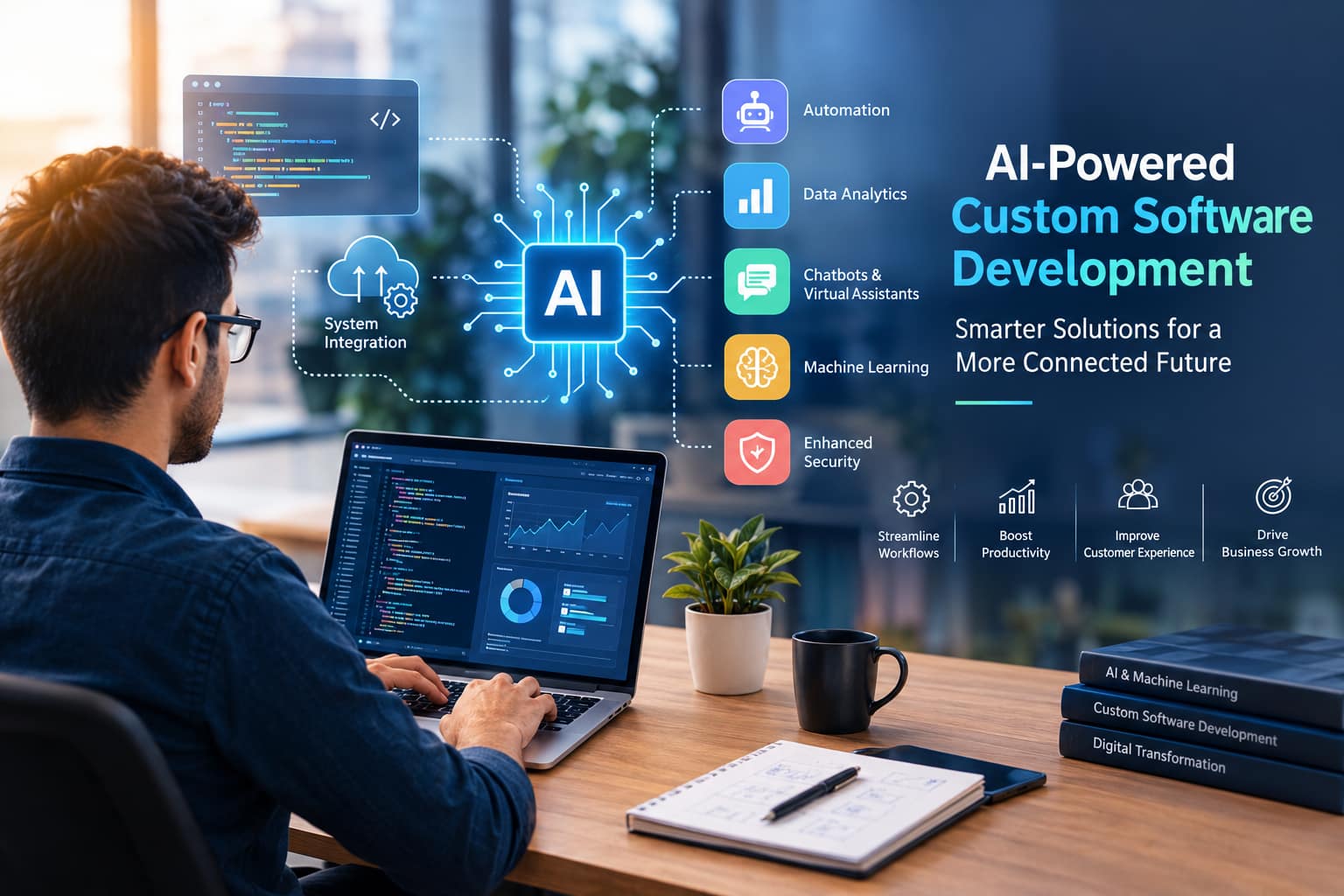
This is where AI-powered custom software development is making a difference. By combining artificial intelligence, automation, and tailored software solutions, businesses can streamline workflows, make data-driven decisions, and build more scalable digital operations.
For companies looking to modernize their technology infrastructure, investing in custom software development and AI automation can create a competitive advantage.
What Is AI-Powered Custom Software Development?
AI-powered custom software development combines traditional software engineering with artificial intelligence capabilities to create applications designed around specific business requirements.
Unlike generic, off-the-shelf software, custom applications can be built to match existing workflows, integrate with business systems, and address industry-specific challenges.
AI capabilities may include:
- Intelligent workflow automation
- Predictive analytics and business forecasting
- AI-powered chatbots and virtual assistants
- Natural language processing
- Automated document processing
- Personalized customer experiences
- Intelligent data analysis and reporting
A well-designed AI-powered application helps businesses automate repetitive work while keeping employees involved in important decisions.
Why Businesses Are Moving Toward Intelligent Automation
1. Reducing Repetitive Manual Tasks
Many organizations still rely on spreadsheets, email chains, and manual data entry to manage everyday operations. These activities consume valuable employee time and can introduce avoidable errors.
AI-powered automation can help process documents, categorize requests, extract relevant information, and trigger predefined workflows.
For example, a service company could automate customer inquiry classification and route requests to the appropriate department. Employees can then focus on resolving complex issues rather than managing repetitive administrative work.
2. Connecting Disconnected Software Systems
Businesses frequently use separate platforms for CRM, accounting, inventory, customer support, analytics, and project management. When these systems cannot communicate effectively, employees must manually transfer information between them.
Custom software integration connects these applications through APIs, middleware, and automated data workflows.
AI can add another layer of intelligence by helping classify incoming data, summarize information, and identify patterns across connected systems.
The result is a more consistent flow of information and better visibility into business operations.
3. Improving Data-Driven Decisions
Traditional reporting often explains what has already happened. AI-enabled analytics can also help businesses identify patterns, estimate potential outcomes, and recognize emerging opportunities.
For example, retailers may use predictive analytics to estimate product demand, while service businesses can analyze historical trends to plan staffing and resources.
The reliability of these insights depends on data quality, model performance, and appropriate human oversight.
4. Creating More Personalized Customer Experiences
Customer expectations continue to evolve. Businesses need digital experiences that are responsive, relevant, and convenient.
AI-powered applications can support personalized recommendations, intelligent search, conversational interfaces, and automated customer support.
When integrated with existing business systems, these capabilities can help teams respond faster and deliver more relevant customer experiences without requiring every interaction to be handled manually.
Custom Software Development vs. Off-the-Shelf Solutions
Off-the-shelf software can be an excellent choice for businesses with standard requirements. However, organizations with specialized workflows or complex integration needs may benefit from custom software development.
Consider these differences:
- Flexibility: Custom software can be designed around specific business processes.
- Integration: Tailored applications can connect with existing tools and databases.
- Scalability: Architecture can be planned around anticipated business growth.
- AI customization: AI features can be selected and configured for defined business use cases.
- Ownership and control: Businesses can gain greater control over application functionality and development priorities, depending on the contract and licensing model.
Custom development generally requires more upfront planning and investment. The right choice depends on business objectives, technical complexity, available resources, and long-term maintenance requirements.
Practical AI Automation Use Cases Across Industries
Healthcare
Healthcare organizations can explore administrative automation, document classification, appointment workflows, and operational reporting. Solutions involving patient information require strong privacy protections, access controls, and appropriate clinical oversight.
Retail and E-commerce
Retail businesses can use AI to support product recommendations, customer service automation, inventory forecasting, and sales analysis.
Manufacturing
Manufacturers can explore predictive maintenance, production monitoring, quality inspection, and workflow optimization using suitable operational data and connected systems.
Financial Services
Financial organizations may use AI for document processing, customer support, anomaly detection, and internal workflow automation, subject to applicable regulatory and security requirements.
Professional Services
Consulting firms, agencies, and service providers can automate lead qualification, proposal preparation, document summarization, project reporting, and internal knowledge retrieval.
How to Implement AI Automation Successfully
AI adoption should begin with a clear business problem rather than a technology trend.
Step 1: Identify Workflow Bottlenecks
Review existing processes and identify repetitive tasks, operational delays, duplicated data entry, and areas where employees spend excessive time on administration.
Step 2: Define Measurable Objectives
Establish measurable goals such as reducing processing time, improving response speed, lowering error rates, or increasing workflow throughput.
Step 3: Evaluate Existing Systems
Assess the applications, databases, APIs, security controls, and data sources that the proposed solution must support.
Step 4: Select the Right AI Capabilities
Choose technologies based on the actual requirement. Some workflows need conventional automation, while others may benefit from machine learning, large language models, or computer vision.
Not every business problem requires AI.
Step 5: Build and Test a Pilot
Start with a limited use case. Test accuracy, reliability, integration performance, security, and the experience of employees who will use the system.
Step 6: Monitor and Improve
Track business outcomes after deployment. Review model performance, user feedback, operating costs, and security requirements before expanding the solution.
Security and Responsible AI: What Businesses Should Consider
AI-powered software introduces additional considerations around data privacy, system access, accuracy, and accountability.
Businesses should establish clear policies for handling sensitive information, restrict access according to user roles, validate AI-generated outputs, and monitor integrations for unexpected behavior.
Applications that use external AI services should also be evaluated for data retention, vendor terms, and compliance obligations.
For high-impact decisions, human review and clear escalation procedures remain important. A successful implementation combines automation with appropriate governance rather than relying on AI outputs without verification.
How QuartusTech Can Help Businesses Modernize Their Software
QuartusTech helps businesses explore technology solutions aligned with their operational requirements. From custom software development and mobile applications to AI-powered applications and software integration, the objective is to build practical digital solutions that support business goals.
A structured development process can help organizations identify the right use cases, evaluate integration requirements, design suitable architectures, and develop applications that can evolve as business needs change.
Whether a company wants to modernize a legacy application, connect disconnected software systems, or introduce AI-powered capabilities, the first step is understanding the underlying business challenge.
Conclusion
AI-powered custom software development is creating new opportunities for businesses to automate repetitive work, connect existing systems, improve analytics, and deliver more responsive customer experiences.
However, successful digital transformation requires more than adding AI features. Businesses need clear objectives, reliable data, secure integrations, and a development strategy that aligns technology investments with measurable outcomes.
By combining custom software development, intelligent automation, and responsible AI adoption, organizations can build a stronger foundation for sustainable growth in 2026 and beyond.
Ready to explore custom software or AI automation for your business? Connect with QuartusTech to discuss your requirements and identify practical opportunities for digital transformation.
Frequently Asked Questions
1. What is AI-powered custom software development?
It is the process of building tailored software applications that incorporate AI capabilities such as predictive analytics, intelligent automation, natural language processing, or AI-assisted decision support.
2. How can AI automation help businesses?
AI automation can reduce repetitive work, assist with data processing, improve customer support workflows, and help teams identify patterns in business data.
3. Is custom software better than off-the-shelf software?
Not always. Off-the-shelf solutions are often suitable for standard requirements, while custom software may be preferable when specialized workflows, integrations, or unique functionality are essential.
4. How long does custom software development take?
Timelines vary according to project scope, integrations, security requirements, complexity, and testing needs. A small pilot may take weeks, while a complex enterprise application may require several months or longer.
5. What should businesses consider before implementing AI?
Businesses should evaluate the use case, data quality, expected return on investment, privacy, security, integration requirements, ongoing operating costs, and the need for human oversight.
6. Can AI be integrated into existing business applications?
Yes. Depending on the architecture and available interfaces, AI capabilities can often be integrated through APIs, middleware, and purpose-built services without replacing every existing system.