
Introduction
Businesses in 2026 are no longer looking at technology simply as a way to automate repetitive tasks. They want intelligent systems that can analyze information, support decision-making, improve customer experiences, and help teams work more efficiently.
Traditional software solutions often struggle to meet these growing expectations. As companies expand, they face disconnected applications, manual workflows, outdated systems, and increasing operational complexity.
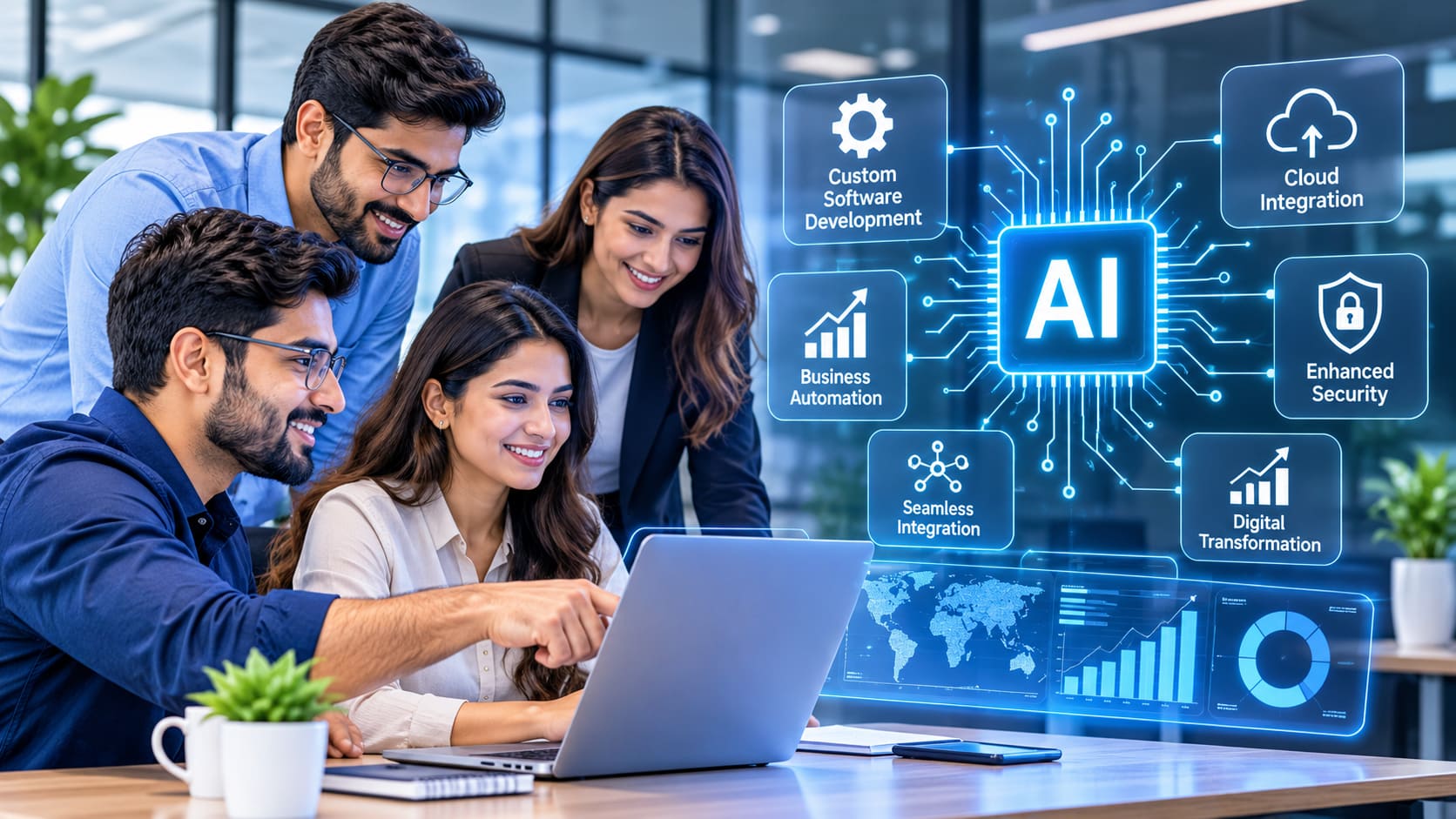
This is where AI-driven custom software development is making a difference. By combining artificial intelligence, business automation, cloud technologies, and tailored software architecture, organizations can build digital solutions that align with their actual operational requirements.
For businesses looking to stay competitive, investing in intelligent custom software is becoming a strategic decision rather than just a technology upgrade.
1. Why Traditional Business Software Is No Longer Enough
Many organizations depend on multiple software platforms to manage sales, customer relationships, inventory, finance, communication, and reporting.
Although these applications serve individual purposes, they do not always work together efficiently.
Common business challenges include:
- Data duplication across different platforms.
- Manual reporting and time-consuming administrative work.
- Limited visibility into business performance.
- Poor communication between departments.
- Difficulty scaling existing software.
- Security and integration challenges.
Custom software development helps overcome these limitations by creating solutions around specific business workflows instead of forcing companies to adjust their processes to generic software.
2. AI Is Making Custom Software More Intelligent
Artificial intelligence is changing how modern business applications operate. Instead of simply following predefined instructions, AI-powered applications can analyze patterns, process information, and assist users with complex tasks.
Some practical applications include:
Predictive Analytics: Analyze historical business data to identify trends, forecast demand, and support strategic planning.
Intelligent Customer Support: AI-powered chatbots and virtual assistants can handle common customer questions and improve response times.
Workflow Automation: Automate repetitive tasks such as document processing, data entry, notifications, and approval workflows.
Personalized Experiences: Use customer behavior and preferences to deliver more relevant recommendations and interactions.
With the right implementation, AI becomes a valuable component of business software rather than an isolated technology experiment.
3. Custom Software Integration Connects Business Operations
One of the biggest challenges for growing companies is managing multiple applications that operate independently.
For example, a sales team may use one CRM platform, the finance department may depend on separate accounting software, and the operations team may manage inventory through another application.
Custom software integration connects these systems through APIs, middleware, and centralized data workflows.
The benefits include:
- Improved data consistency.
- Reduced manual intervention.
- Faster business reporting.
- Better collaboration between departments.
- More efficient operational processes.
A well-planned integration strategy allows businesses to maximize their existing technology investments while building a more connected digital ecosystem.
4. Cloud-Based Applications Support Business Scalability
Cloud technology gives organizations the flexibility to access applications, manage data, and support distributed teams without depending entirely on traditional infrastructure.
Modern cloud-based software solutions offer several advantages:
- Flexible infrastructure and resource management.
- Remote accessibility.
- Simplified software updates.
- Improved collaboration.
- Scalable application architecture.
When combined with custom application development, cloud infrastructure enables businesses to expand their digital capabilities as operational requirements change.
5. Cybersecurity Must Be Part of Software Development
As organizations become increasingly dependent on digital applications, protecting business information is essential.
Security should not be treated as an additional feature added after development. It must be considered throughout the software development lifecycle.
Important security practices include:
- Secure authentication and authorization.
- Data encryption in transit and at rest.
- Role-based access control.
- Regular vulnerability assessments.
- Secure API integrations.
- Continuous monitoring and maintenance.
Businesses handling sensitive customer or financial information should also consider applicable industry regulations and compliance requirements.
6. How to Choose the Right Custom Software Development Partner
Selecting a reliable software development company is an important part of any digital transformation initiative.
Before choosing a development partner, businesses should evaluate:
Technical Expertise: Does the team understand modern technologies, AI integration, cloud infrastructure, and software architecture?
Business Understanding: Can the development team translate operational challenges into practical software solutions?
Integration Capabilities: Can the company connect existing applications and third-party platforms?
Security Practices: Does the development process include security testing and reliable data protection?
Long-Term Support: Can the partner provide maintenance, optimization, and future development as the business grows?
The right development partner should focus on delivering measurable business value, not simply writing code.
7. The Future of Intelligent Business Applications
The next generation of business software will focus on greater intelligence, connectivity, and adaptability.
AI-assisted decision-making, predictive analytics, intelligent automation, and connected digital platforms will continue influencing how companies manage their operations.
However, successful implementation will depend on choosing technologies that solve genuine business problems.
Organizations that combine the flexibility of custom software with the capabilities of AI and cloud computing can build a stronger foundation for sustainable digital growth.
Conclusion
AI-driven custom software is transforming business operations by helping organizations simplify workflows, connect applications, improve productivity, and make better use of business data.
In 2026, companies need more than disconnected digital tools. They need intelligent, scalable, and secure software solutions designed around their long-term objectives.
QuartusTech helps businesses explore modern software development, application integration, AI-powered solutions, and digital transformation opportunities. With a focus on practical technology and business requirements, organizations can move beyond basic automation and build smarter digital operations.
Frequently Asked Questions
1. What is AI-driven custom software development?
AI-driven custom software development involves building tailored applications that use artificial intelligence to automate processes, analyze data, improve decision-making, and enhance user experiences.
2. Why should businesses invest in custom software in 2026?
Custom software helps businesses address unique operational requirements, integrate existing systems, improve efficiency, and scale their digital infrastructure.
3. Can AI be integrated into existing business applications?
Yes. AI capabilities can be integrated into existing applications using APIs, machine learning models, and other AI services, depending on the application’s architecture.
4. What are the benefits of custom software integration?
It connects disconnected applications, reduces manual work, improves data accuracy, and creates more efficient business workflows.
5. Is cloud-based custom software suitable for growing businesses?
Yes. Cloud-based applications can offer flexible infrastructure, remote accessibility, and scalable resources to support changing business requirements.
6. How do I choose a custom software development company?
Evaluate technical expertise, industry experience, integration capabilities, security practices, communication, and long-term maintenance support.
Suggested SEO Details
SEO Title: AI-Driven Custom Software Development: Business Trends in 2026
Meta Description: Discover how AI-driven custom software development, intelligent automation, and cloud integration are transforming business operations in 2026.
Primary Keyword: AI-driven custom software development
Secondary Keywords:
- Custom software development company
- AI software development
- Business process automation
- Custom software integration
- AI-powered business applications
- Cloud-based software development
- Digital transformation solutions
- Enterprise software development
Suggested URL Slug: /ai-driven-custom-software-development-2026/
Suggested Category: AI & Software Development