
Introduction
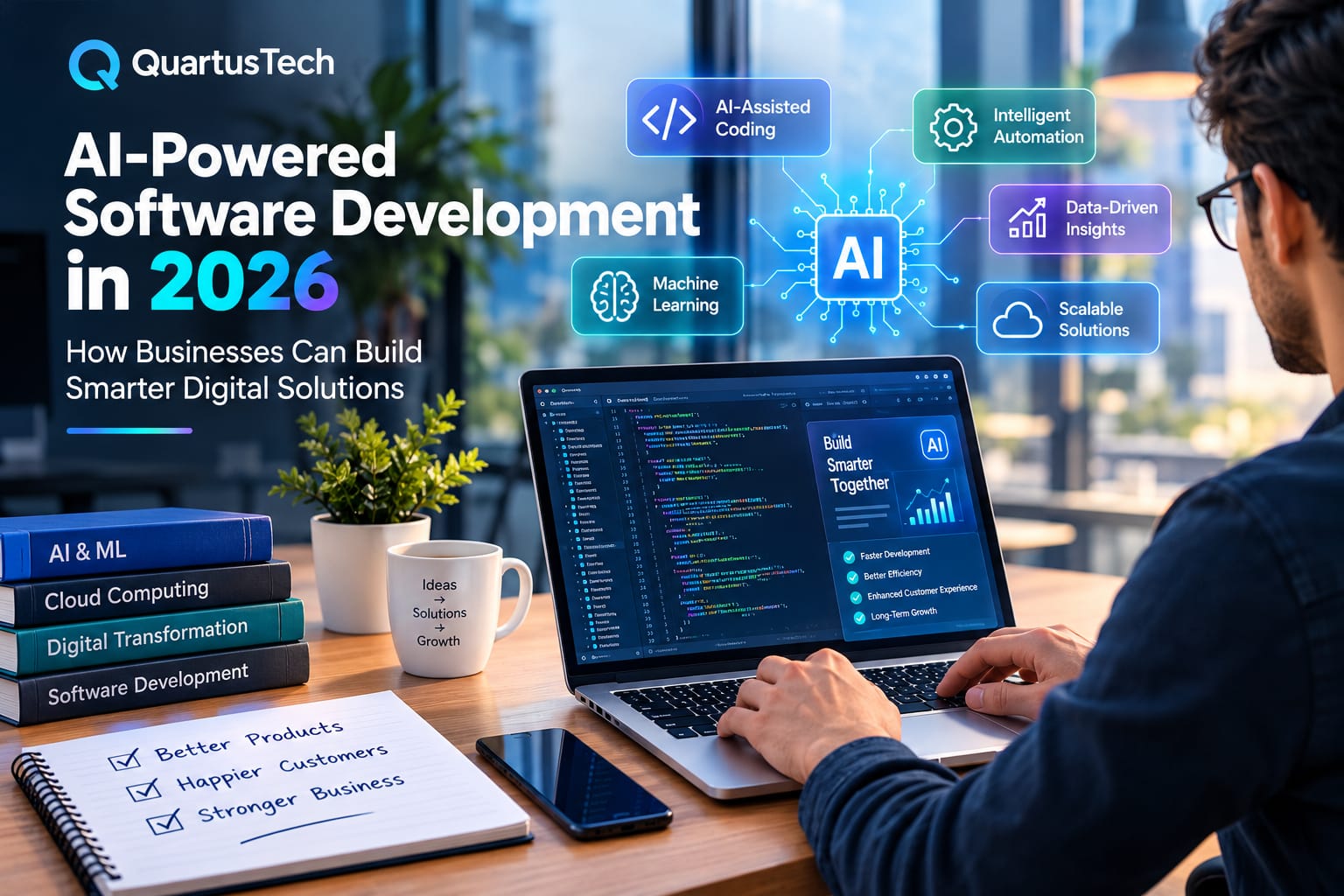
Artificial intelligence is transforming how businesses plan, develop, test, and maintain software. In 2026, AI-powered software development is becoming an important strategy for organizations looking to improve operational efficiency, deliver better customer experiences, and stay competitive in a rapidly changing digital landscape.
From intelligent automation to AI-assisted coding and predictive analytics, modern software solutions can help companies solve complex business challenges more effectively. However, successful implementation requires more than simply adding AI features to an application. Businesses need the right technology, a clear strategy, reliable data, and a scalable development architecture.
At QuartusTech, we help businesses explore innovative software solutions that align with their operational goals, customer expectations, and long-term growth plans.
What Is AI-Powered Software Development?
AI-powered software development involves integrating artificial intelligence capabilities into the software development lifecycle and the applications businesses use every day.
It can include AI-assisted coding, automated software testing, intelligent workflow automation, natural language processing, machine learning models, and AI-driven decision support.
Businesses can use these technologies to improve existing applications or create new digital products designed around intelligent capabilities.
For example, a company can develop an AI-enabled customer support platform that categorizes incoming requests, suggests responses, and helps support teams resolve issues faster. A manufacturing business might use predictive analytics to identify equipment maintenance needs before a breakdown occurs.
The objective is to build software that does more than process information. It should help businesses make better decisions and deliver measurable value.
Why AI-Powered Software Development Matters in 2026
1. Faster Software Development
AI coding assistants can help developers generate code suggestions, explain unfamiliar code, create test cases, and identify potential issues. These capabilities can accelerate specific development tasks and allow engineering teams to focus more time on architecture, problem-solving, and product quality.
AI-generated code still requires human review, testing, and security validation before deployment.
2. Smarter Business Process Automation
Many organizations still depend on repetitive manual processes across customer service, finance, operations, and internal reporting.
AI-powered applications can automate selected workflows, classify documents, extract information, summarize business data, and route requests to the appropriate teams.
With carefully designed automation, businesses can reduce manual effort while improving consistency and visibility across operations.
3. Better Customer Experiences
Customers increasingly expect personalized, convenient, and responsive digital experiences.
AI-powered software can support intelligent recommendations, conversational interfaces, personalized content, and customer behavior analysis. When implemented responsibly, these features can help businesses deliver more relevant experiences across websites, mobile applications, and customer service platforms.
4. Data-Driven Decision-Making
Traditional reporting explains what has already happened. AI-driven analytics can also help identify patterns, estimate likely outcomes, and highlight potential opportunities.
For example, a retail business could analyze sales patterns to improve inventory planning, while a service provider could use customer data to identify recurring support issues.
The quality of these insights depends on reliable data, appropriate models, and continuous evaluation.
Key Applications of AI in Custom Software Development
AI-Powered Mobile Applications
Businesses can integrate AI features into mobile applications to improve usability and functionality. Examples include personalized recommendations, voice-enabled interactions, image recognition, intelligent search, and contextual assistance.
For organizations building customer-facing mobile products, AI can create additional value when the features directly address user needs.
Intelligent Enterprise Software
Enterprise applications often manage large volumes of business information across departments. AI can help users search internal knowledge bases, summarize documents, extract information, and identify relevant insights.
Integrating AI into existing enterprise systems can also help organizations modernize workflows without necessarily replacing their entire technology infrastructure.
AI Chatbots and Virtual Assistants
AI-powered chatbots can answer common questions, guide users through processes, and assist with customer service requests.
More advanced solutions can connect to approved business systems to retrieve relevant information or initiate specific workflows. Appropriate access controls, escalation procedures, and human oversight are essential for reliable results.
Predictive Analytics and Machine Learning
Machine learning can help businesses recognize patterns in historical data and generate predictions for selected use cases.
Applications may include demand forecasting, customer churn analysis, predictive maintenance, fraud detection, and resource planning.
Businesses should evaluate these systems using relevant performance metrics rather than assuming that every AI model will produce accurate predictions.
AI-Enabled IoT Applications
Combining AI with Internet of Things (IoT) devices can help organizations analyze sensor data, monitor equipment, and detect unusual behavior.
For example, an industrial IoT solution may identify abnormal operating conditions and notify maintenance teams. Edge processing can also support selected use cases where low latency or limited connectivity matters.
How to Build an AI-Powered Software Solution
Developing a successful AI application requires a structured approach.
Step 1: Identify a Clear Business Problem
Start by defining the challenge the software should solve. Determine whether the primary goal is reducing manual work, improving customer satisfaction, increasing operational visibility, or supporting better decisions.
A clearly defined problem makes it easier to evaluate whether AI is the right solution.
Step 2: Assess Data Readiness
AI solutions often depend on relevant, accurate, and appropriately governed data.
Before development begins, assess data quality, availability, access permissions, privacy requirements, and integration challenges. Businesses should also identify gaps that could affect the reliability of AI-generated results.
Step 3: Select the Right Technology
The technology stack depends on the application, business requirements, data environment, and expected scale.
Possible components include cloud platforms, APIs, machine learning frameworks, enterprise databases, mobile technologies, and existing business systems.
Not every application needs a custom-trained AI model. In some cases, an existing model or managed AI service may offer a more practical starting point.
Step 4: Develop and Test an Initial Version
Build a focused proof of concept or minimum viable product (MVP) to validate the proposed solution.
Test functionality, performance, usability, security, accuracy, and integration behavior. Establish measurable success criteria before expanding the project.
Step 5: Prioritize Security and Responsible AI
AI applications can introduce risks involving sensitive data, unauthorized access, inaccurate outputs, and unexpected model behavior.
Businesses should implement appropriate access controls, data protection measures, logging, monitoring, output validation, and human review for high-impact decisions.
Security and privacy should be considered throughout the development lifecycle rather than added only before launch.
Step 6: Deploy, Monitor, and Improve
After deployment, monitor application performance and business outcomes. Evaluate response quality, system reliability, operating costs, user feedback, and other relevant metrics.
Regular reviews help teams identify problems, improve workflows, and determine whether additional AI capabilities are justified.
Common Challenges in AI Software Development
Although AI offers significant opportunities, businesses should prepare for several challenges.
- Data quality: Incomplete or inconsistent data can reduce the reliability of AI outputs.
- Integration complexity: Connecting AI capabilities to legacy applications may require additional engineering.
- Security and privacy: Sensitive information must be handled according to applicable requirements and internal policies.
- Unpredictable outputs: Generative AI systems may produce inaccurate or misleading responses.
- Cost management: Model usage, infrastructure, monitoring, and ongoing maintenance can affect the total cost of ownership.
- Skills and governance: Teams need appropriate technical expertise, testing processes, and clear accountability.
Addressing these challenges early can help businesses make more informed investment decisions and reduce implementation risks.
How to Measure the ROI of AI-Powered Software
AI adoption should be evaluated using business outcomes rather than the number of AI features deployed.
Useful metrics may include:
- Time required to complete a business process
- Reduction in repetitive manual tasks
- Software development and testing cycle time
- Customer satisfaction and response time
- Error rates and rework
- Infrastructure and operating costs
- Revenue impact or employee productivity
Compare results against a documented baseline and include implementation, integration, training, and ongoing operating expenses when assessing return on investment.
Why Choose QuartusTech for Software Development?
Choosing the right software development partner is an important part of building a reliable digital solution. Businesses need a team that understands their objectives, technical constraints, integration requirements, and future growth plans.
QuartusTech supports businesses with software development and technology solutions tailored to their needs. A structured development approach can help organizations assess opportunities, define project requirements, select suitable technologies, and build scalable applications.
Whether a business is exploring AI-enabled applications, modernizing existing software, or integrating intelligent features into a digital product, the focus should remain on practical outcomes, maintainability, security, and long-term value.
Before beginning an AI project, businesses should establish clear deliverables, ownership of data and intellectual property, testing standards, and ongoing support expectations.
The Future of AI-Powered Software Development
AI is expected to continue influencing software engineering, business automation, application design, and digital product development.
Future solutions may combine AI agents, natural language interfaces, intelligent automation, and real-time analytics to support increasingly complex workflows. At the same time, reliable software engineering, human oversight, cybersecurity, and responsible data management will remain essential.
Organizations that approach AI strategically can identify valuable use cases, validate them through measurable experiments, and scale successful solutions as their needs evolve.
Conclusion
AI-powered software development in 2026 offers businesses new ways to automate processes, improve digital experiences, and turn data into useful insights. The most successful projects begin with clear business objectives, reliable data, suitable technology, and a commitment to security and continuous improvement.
For businesses planning their next digital initiative, QuartusTech can be a starting point for exploring software development opportunities aligned with their requirements.
Ready to explore your next software development project? Contact QuartusTech to discuss your business goals and potential digital solutions.