
Introduction
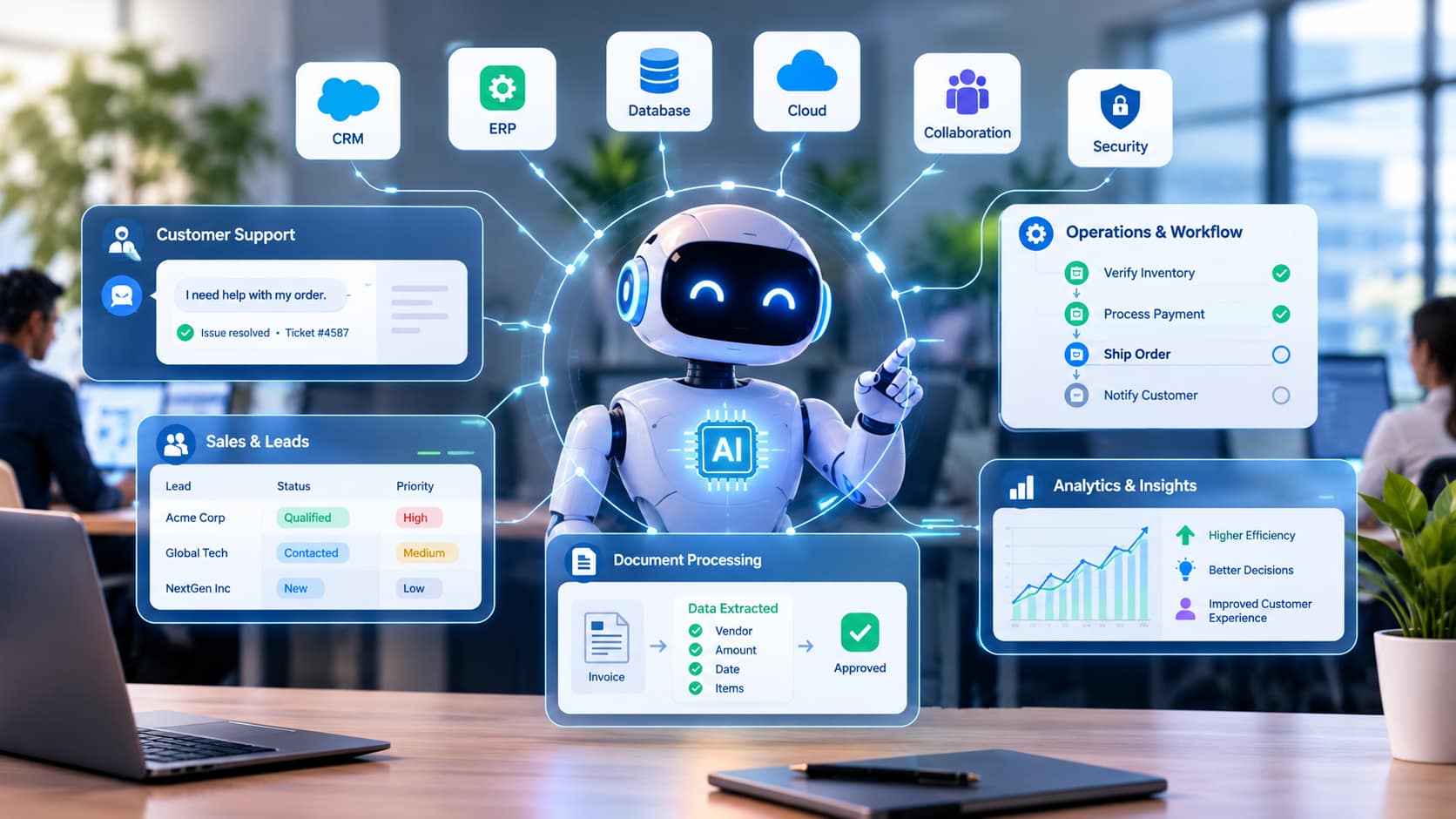
What if your business software could do more than display information, answer questions, or automate a single task? Imagine a system that can analyze incoming customer requests, retrieve relevant data, recommend the next action, and coordinate workflows with minimal manual intervention.
This is the growing opportunity behind AI agents in enterprise software development.
In 2026, businesses are exploring AI agents to improve operational efficiency, streamline customer service, and connect disconnected business systems. However, successful implementation requires more than integrating an AI model. Companies need secure architecture, reliable data, well-defined permissions, and effective human oversight.
For organizations planning digital transformation, AI agent development, custom software development, and enterprise AI integration can help turn repetitive workflows into intelligent, measurable business processes.
What Are AI Agents in Enterprise Software?
AI agents are software systems designed to interpret information, work toward defined objectives, and perform permitted actions using connected tools or applications.
Unlike a conventional chatbot that primarily responds to user questions, an AI agent can potentially complete multiple steps within a workflow.
For example, an AI-powered customer support system could:
- Categorize incoming support requests.
- Retrieve relevant customer and product information.
- Recommend a solution based on approved documentation.
- Create a support ticket or draft a response.
- Escalate complicated cases to a human employee.
The exact capabilities depend on the underlying AI model, software integrations, permissions, and business rules.
For enterprises, the goal is not to eliminate human involvement. It is to reduce repetitive work while allowing employees to focus on decisions that require experience, judgment, and accountability.
6 Business Applications of AI Agent Development in 2026
1. Intelligent Customer Support Automation
Customer support teams frequently manage repetitive questions, ticket routing, account inquiries, and troubleshooting requests.
AI agent development can help automate parts of this process by connecting conversational AI with customer relationship management (CRM) platforms, knowledge bases, and ticketing systems.
Potential benefits include faster responses, consistent information retrieval, and improved ticket organization.
Businesses should establish clear escalation rules and ensure that sensitive account changes or financial decisions receive appropriate authorization.
2. AI-Powered Sales and Lead Qualification
Sales teams spend considerable time researching prospects, updating CRM records, preparing follow-ups, and identifying potential opportunities.
An AI-enabled sales application can assist with lead classification, summarize customer interactions, identify missing information, and prepare personalized outreach drafts.
With appropriate integrations, these capabilities can support sales representatives throughout the customer journey.
For companies investing in business automation software, the priority should be improving lead quality and sales productivity rather than simply increasing the volume of automated messages.
3. Automated Document Processing
Organizations handle contracts, invoices, purchase orders, reports, and other documents every day.
AI-powered document processing software can extract information, classify files, identify missing fields, and route documents to the appropriate team.
For example, a procurement application could extract invoice details and compare them against purchase records before sending the transaction for approval.
Human review remains important when documents contain ambiguous information or when errors could create financial or legal consequences.
4. Predictive Maintenance for IoT Systems
Manufacturers and industrial businesses can combine AI applications with Internet of Things (IoT) devices to improve equipment monitoring.
Connected sensors can collect operational data such as temperature, vibration, and energy consumption. AI systems can analyze these readings to identify unusual patterns and help maintenance teams investigate potential problems.
A complete solution may involve IoT product development, sensor integration, cloud infrastructure, data analytics, and custom software development.
The effectiveness of predictive maintenance depends on sensor quality, historical data, system design, and validation against actual equipment performance.
5. AI-Driven Internal Knowledge Management
Large organizations often store information across internal documents, databases, project management tools, and communication platforms.
Employees may spend unnecessary time searching for policies, technical documentation, or project updates.
An enterprise AI assistant can retrieve relevant information from approved sources and provide contextual answers with links to supporting documents.
Secure implementation requires access permissions that reflect each employee’s existing authorization. AI systems should not expose confidential information simply because it exists somewhere in the company’s data infrastructure.
6. Workflow Coordination Across Business Applications
Many business processes involve several independent applications.
Consider a product order that requires inventory verification, payment confirmation, shipping coordination, and customer notifications.
Custom software development can connect these systems through APIs and workflow orchestration. AI agents may assist with interpreting exceptions, summarizing information, or recommending the next step.
Critical operations should retain transaction validation, authorization checks, audit logs, and recovery mechanisms. AI should not bypass established financial or security controls.
AI Agent Development vs. Traditional Business Automation
Traditional automation and AI agents solve related but different problems.
| Capability | Traditional automation | AI agent-based software |
|---|---|---|
| Workflow execution | Predefined rules | Goals combined with defined tools and constraints |
| Input handling | Structured inputs | Can interpret unstructured information |
| Decision process | Explicit conditions | Model-assisted reasoning within configured boundaries |
| Predictability | Usually highly deterministic | Outputs may vary and require validation |
| Best use case | Repetitive, stable processes | Workflows involving variable information |
| Oversight | Rule monitoring and exception handling | Rule monitoring, model evaluation, permissions, and human review |
The most effective enterprise architecture may combine both approaches. Deterministic automation is often preferable for critical calculations and fixed business rules, while AI can help interpret documents, summarize information, and handle less structured tasks.
Essential Technologies Behind Enterprise AI Agents
Developing a reliable AI agent requires several technical components working together.
Large language models (LLMs): Interpret natural-language requests and help generate responses or action plans.
Retrieval-augmented generation (RAG): Retrieves relevant information from approved knowledge sources to improve context and traceability.
APIs and system integrations: Connect AI capabilities with CRM, ERP, databases, internal portals, and third-party applications.
Workflow orchestration: Controls task sequencing, approval requirements, retries, and exception handling.
Cloud infrastructure: Supports deployment, monitoring, scalability, and secure access to application services.
Security and observability: Help teams manage permissions, audit actions, monitor performance, and investigate failures.
The technology stack should be selected according to business requirements, existing infrastructure, data sensitivity, expected workload, and long-term maintenance costs.
Security Challenges Businesses Must Address
AI agent development introduces risks that differ from those of conventional business applications.
Data privacy
AI systems may process confidential customer information, financial records, or internal documents. Businesses should define what data can be accessed, where it can be processed, and how it is retained.
Unauthorized actions
An AI agent connected to business tools could cause damage if it receives excessive permissions. Apply least-privilege access, approval workflows, and restrictions on sensitive operations.
Incorrect outputs
AI-generated answers and recommendations can be inaccurate. Validate important outputs against trusted data sources and use deterministic checks where appropriate.
Prompt injection
Untrusted documents or user inputs may contain instructions intended to manipulate an AI system. Developers should isolate untrusted content, restrict tool access, and test against adversarial inputs.
Cost and performance
AI usage costs, response latency, and infrastructure requirements can increase as adoption grows. Monitor usage and evaluate whether the solution delivers measurable business value.
Security testing, continuous monitoring, and regular evaluation should be part of the software development lifecycle rather than activities reserved for the final deployment stage.
How to Build an AI Agent for Your Business
A structured development process helps businesses control risk and avoid investing in unnecessary features.
Step 1: Identify a specific business problem.
Choose a repetitive process with clear boundaries, such as classifying support tickets or extracting invoice information.
Step 2: Define measurable success criteria.
Establish baseline metrics such as processing time, error rates, manual effort, and cost per transaction.
Step 3: Assess data and integrations.
Identify the systems, APIs, knowledge sources, and access permissions required for the proposed solution.
Step 4: Develop a focused proof of concept.
Build a small version that demonstrates feasibility before expanding the system across the organization.
Step 5: Test reliability and security.
Evaluate normal workflows, unusual inputs, incorrect recommendations, permission boundaries, and failure recovery.
Step 6: Deploy with human oversight.
Begin with low-risk tasks, monitor performance, and require approval for sensitive or irreversible actions.
Step 7: Measure results and improve.
Use real operational data to refine workflows, manage costs, and determine whether further investment is justified.
This approach allows businesses to validate their assumptions before committing to a large-scale enterprise AI platform.
Why Choose QuartusTech for AI and Custom Software Development?
Businesses exploring intelligent automation need software that integrates with their operations instead of introducing another disconnected tool.
QuartusTech can be considered for technology projects involving custom software development, AI application development, mobile and web application development, BLE and IoT solutions, NFC applications, and hardware-software integration.
Depending on project requirements, a software solution may combine AI capabilities with existing enterprise applications, connected devices, cloud services, or custom-built interfaces.
When evaluating a development partner, businesses should look for technical expertise, transparent project planning, secure engineering practices, integration experience, and ongoing maintenance support.
The objective should be a practical solution that addresses a defined business need and can evolve as requirements change.
Frequently Asked Questions
What is AI agent development?
AI agent development involves creating software systems that can interpret information, work toward defined goals, and use approved tools or integrations to perform tasks within established constraints.
How is an AI agent different from a chatbot?
A chatbot primarily focuses on conversations and responses. An AI agent may also coordinate multiple steps, retrieve information from connected systems, and execute authorized actions.
How much does AI agent development cost?
The cost depends on workflow complexity, AI model selection, integrations, security requirements, infrastructure, testing, and ongoing support. A discovery phase and focused proof of concept can help establish a realistic budget.
Can AI agents integrate with existing enterprise software?
Yes. AI agents can often connect to existing applications through APIs, databases, and workflow platforms. The feasibility depends on integration access, data quality, security, and the existing system architecture.
Are AI agents suitable for small and medium-sized businesses?
Yes. Smaller organizations can begin with a narrow use case, such as document processing or support-ticket classification, and expand after demonstrating measurable value.
What are the main risks of AI agents?
Key risks include inaccurate outputs, data exposure, excessive permissions, prompt injection, unpredictable behavior, and operating costs. Strong security controls, testing, monitoring, and human approval can help mitigate these risks.
Conclusion
AI agents are creating new possibilities for enterprise software by helping businesses interpret information, coordinate workflows, and automate selected tasks across connected applications.
However, successful AI implementation depends on more than choosing a powerful model. Businesses need reliable integrations, secure architecture, measurable objectives, and appropriate human oversight.
For organizations exploring the next stage of digital transformation, combining AI agent development with custom software engineering can create practical opportunities to improve efficiency and customer experiences.
Planning an AI-powered software solution? Connect with QuartusTech to discuss your business requirements and explore an implementation approach aligned with your technology roadmap.
SEO Metadata
SEO Title: AI Agent Development for Enterprise Software in 2026
Meta Description: Discover how AI agent development, enterprise AI integration, and custom software development help businesses automate workflows and improve efficiency in 2026.
Suggested URL Slug: /blogs/ai-agent-development-enterprise-software-2026/
Primary Keyword: AI agent development
Secondary Keywords:
- Enterprise AI solutions
- AI application development
- Custom software development
- AI workflow automation
- Enterprise software development
- AI integration services
- Business process automation
- AI-powered applications
- IoT software development
- Digital transformation solutions
Suggested Internal Links:
- AI Application Development
- Custom Software Development
- Mobile App Development
- Web Development
- BLE and IoT Development
- NFC Application Development
Suggested Image Alt Text: AI agents coordinating enterprise software workflows across connected business applications
Recommended Schema: BlogPosting, BreadcrumbList, and Organization. Add FAQPage structured data only where appropriate for the site’s implementation and applicable Google search guidelines.