
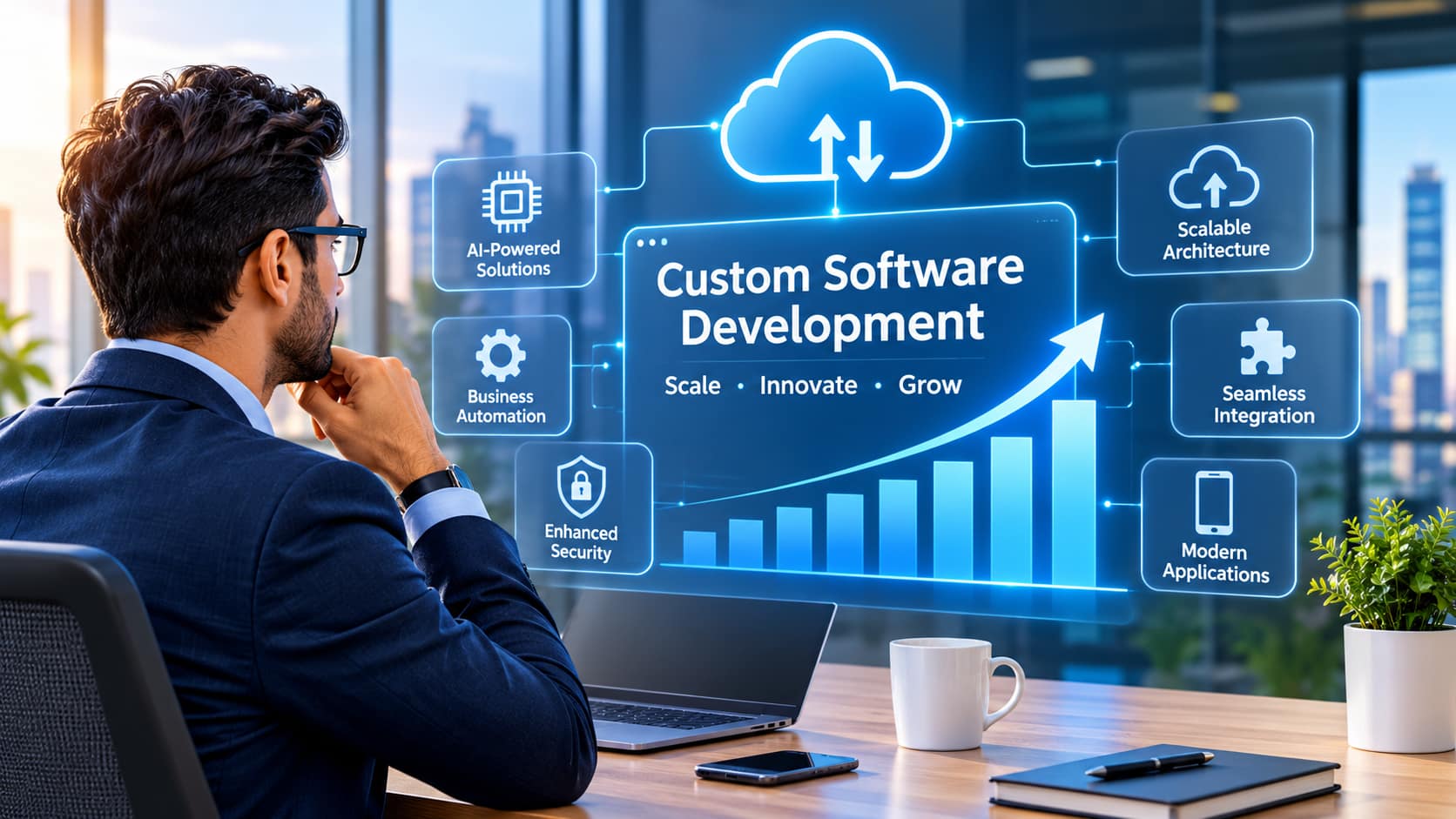
Custom Software Development in 2026: Building Scalable, AI-Ready Business Solutions
Every growing business reaches a point where its technology starts holding it back.
A system that worked perfectly for 10 employees may struggle with 100. A manual process that once took minutes can consume hours. Multiple applications may store the same information but fail to communicate with each other.
The result? Slower operations, frustrated employees, missed opportunities, and rising technology costs.
In 2026, businesses need more than software that simply works. They need technology that adapts, scales, and supports long-term growth.
This is where custom software development becomes a strategic advantage.
At QuartusTech, we believe the right software should simplify business operations, connect workflows, and create opportunities for smarter digital transformation.
Why Traditional Business Software Starts Falling Behind
Off-the-shelf software is often an excellent starting point. It provides ready-made functionality and can help businesses get started quickly.
However, as companies expand, their requirements become more complex.
Consider a growing US-based company managing sales, inventory, customer relationships, and reporting through separate platforms.
Its employees might need to:
- Enter the same customer information into multiple systems.
- Manually generate reports from different applications.
- Switch between platforms to complete a single task.
- Depend on spreadsheets for business-critical information.
- Purchase additional software whenever a new requirement appears.
These problems are not always caused by poor software. Often, the real issue is that disconnected tools were never designed to work together.
Custom software development helps businesses build technology around their actual processes instead of forcing employees to adapt to rigid systems.
5 Ways Custom Software Development Supports Business Growth
1. Connect Disconnected Business Applications
Modern businesses rely on CRM platforms, ERP systems, accounting software, marketing tools, and customer support applications.
When these systems operate independently, information becomes fragmented.
Custom software integration connects applications through APIs, shared data structures, and automated workflows.
For example, when a sales team closes a deal, an integrated system could automatically:
- Update the customer relationship management platform.
- Notify the operations team.
- Create a project record.
- Trigger billing workflows.
- Update business reporting dashboards.
This reduces repetitive work and improves visibility across departments.
Target keywords: Custom Software Development, Custom Software Integration, Enterprise Software Development, API Integration Services.
2. Build AI-Powered Business Applications
Artificial intelligence is becoming an important part of enterprise software development.
Businesses are exploring AI-powered applications to automate repetitive tasks, analyze large datasets, and improve decision-making.
According to Deloitte’s 2026 software industry outlook, AI-first product development and agentic AI are becoming increasingly important themes in the software industry.
However, successful AI adoption requires more than adding a chatbot to an existing application.
Businesses need reliable data, secure integrations, clear objectives, and appropriate human oversight.
Examples of AI-powered business applications include:
- Intelligent customer support platforms.
- AI-powered document processing systems.
- Predictive analytics dashboards.
- Automated workflow management applications.
- AI-driven business intelligence solutions.
A custom AI application can be designed around specific business requirements, making it easier to connect AI capabilities with existing operations.
3. Create Scalable Cloud-Based Applications
Business growth brings changing technology requirements.
An application may need to support more users, larger datasets, additional locations, and new business processes.
Cloud-native software development helps businesses build applications that can adapt to changing workloads.
With the right architecture, organizations can improve application availability, manage infrastructure resources, and introduce new features without rebuilding the entire platform.
Scalable software architecture may include:
- Cloud-based application infrastructure.
- API-first development.
- Modular application components.
- Automated deployment pipelines.
- Performance monitoring and optimization.
The goal is not to build the biggest system from day one.
The goal is to build a system that can grow when the business needs it.
4. Improve Operational Efficiency Through Automation
Manual processes are often hidden sources of business costs.
Employee onboarding, invoice processing, approval workflows, reporting, and customer communication can consume valuable working hours.
Custom business process automation helps organizations eliminate unnecessary manual steps.
For example, a custom workflow management application could automatically route an approval request to the appropriate manager, notify relevant employees, and maintain a record of every action.
This improves consistency while allowing employees to focus on higher-value activities.
Business automation is particularly useful when standard workflow tools cannot accommodate complex or industry-specific processes.
5. Strengthen Security and Data Control
As businesses become more digitally connected, protecting business information becomes increasingly important.
Custom enterprise software can incorporate security requirements directly into the development process.
Depending on the application, this may include:
- Role-based access control.
- Multi-factor authentication.
- Data encryption.
- Secure API integrations.
- Audit logging.
- Backup and recovery planning.
- Security testing and monitoring.
Security requirements should be evaluated according to the application’s purpose, data sensitivity, and applicable regulations.
Building security into the architecture from the beginning can help reduce the cost and complexity of addressing vulnerabilities later.
Custom Software vs. Off-the-Shelf Software
| Business requirement | Off-the-shelf software | Custom software |
|---|---|---|
| Initial deployment | Usually faster | Requires development |
| Business workflows | Standardized | Tailored to requirements |
| Integrations | Depends on available connectors | Can be designed around specific systems |
| Scalability | Depends on vendor capabilities | Designed around growth requirements |
| Feature control | Vendor-controlled | Greater development control |
| Long-term flexibility | May be limited | Can evolve with business needs |
Neither approach is automatically better.
Off-the-shelf software may be the right choice for common business requirements.
Custom software becomes particularly valuable when existing solutions create operational bottlenecks, integration challenges, or limitations that affect business growth.
How to Know When Your Business Needs Custom Software
Your organization may benefit from a custom software solution if:
- Employees repeatedly perform the same manual tasks.
- Different departments use disconnected applications.
- Existing software cannot support your business workflows.
- Reporting requires significant manual effort.
- Your technology costs continue increasing without improving efficiency.
- Your business needs specialized functionality that standard platforms do not provide.
Before investing in development, identify the business problem, evaluate existing tools, and determine how success will be measured.
A clear strategy helps ensure that software investment delivers measurable business value.
How QuartusTech Helps Businesses Build Smarter Digital Solutions
At QuartusTech, we help businesses transform technology challenges into practical digital solutions.
Our software development approach focuses on understanding business objectives, designing scalable architectures, and developing applications that support real operational needs.
Our capabilities include:
Custom Software Development: Tailored business applications designed around specific operational requirements.
AI Application Development: Intelligent software solutions that incorporate AI capabilities into business workflows.
Mobile and Web Application Development: Responsive digital applications designed to improve customer and employee experiences.
Software Integration: Connecting existing business applications to improve information flow and reduce manual work.
IoT and BLE Application Development: Connected software solutions for businesses developing smart devices and connected products.
By combining software engineering expertise with a business-focused approach, QuartusTech helps organizations build technology that supports their next stage of growth.
Frequently Asked Questions
What is custom software development?
Custom software development is the process of designing, building, testing, and maintaining software specifically for an organization’s unique business requirements.
How does custom software help businesses scale?
Custom software can support business growth through flexible architecture, automated workflows, application integrations, and infrastructure designed to accommodate changing requirements.
Is custom software better than off-the-shelf software?
Custom software is often better suited to specialized workflows and complex integration requirements. Off-the-shelf software may be more practical for standard business needs and faster deployment.
Can custom software integrate with existing business applications?
Yes. Custom software can integrate with existing applications using APIs, webhooks, databases, and other supported integration methods.
How much does custom software development cost?
The cost depends on application complexity, features, integrations, technology requirements, security needs, and ongoing maintenance. A detailed scope and technical assessment are useful for estimating the investment.
Final Thoughts: Build Software That Moves Your Business Forward
Business growth should create new opportunities, not additional technology headaches.
When software becomes disconnected, outdated, or difficult to scale, it can slow down operations and limit innovation.
Custom software development offers businesses an opportunity to rethink their technology, streamline workflows, and build digital solutions around their long-term goals.
The right software is not simply another business expense.
It is an investment in operational efficiency, adaptability, and future growth.
Ready to build software that supports your next stage of growth?
Connect with QuartusTech to explore custom software development, AI-powered applications, and enterprise software integration solutions.
Visit: https://quartustech.com/